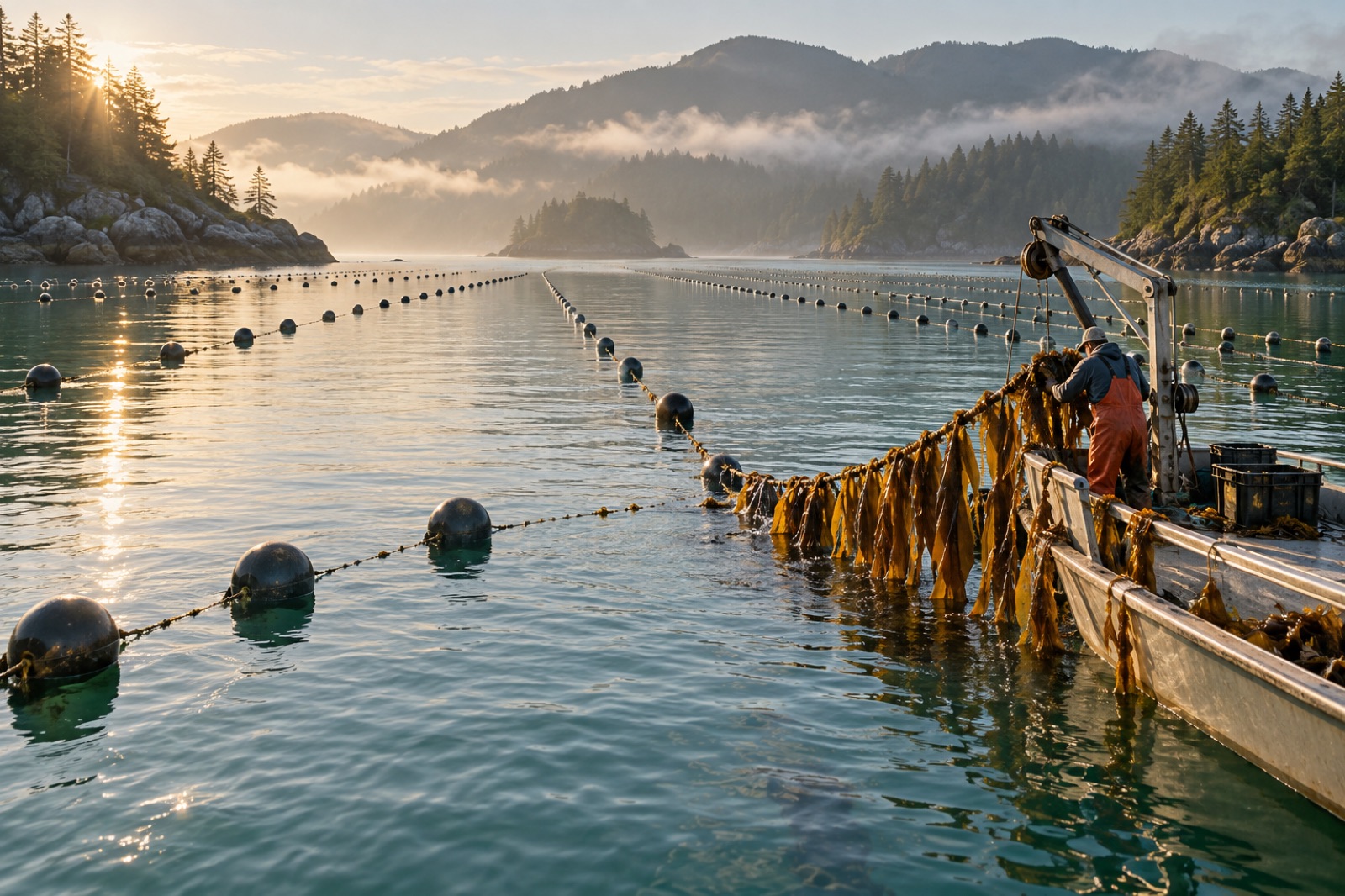
Walk into a well-stocked food shop or browse a biostimulant catalogue and you will find two kinds of seaweed origin story: "wildcrafted from pristine waters" and "sustainably farmed." Both claims can be true; both can be spin. Wild harvest supplies the vast majority of the world's kelp for extraction industries, while farming supplies the overwhelming majority of farmed food seaweeds — and each sourcing route is genuinely better at some things and worse at others. This is a clear-eyed comparison: how farmed and wild seaweed differ in quality, consistency, price, and ecological footprint, and how to choose depending on what you are buying and why.
Two supply systems, briefly defined
Wild harvest means cutting or gathering seaweed from naturally occurring beds — hand-cutting intertidal oarweed at low tide, raking cast southern bull kelp off beaches after storms, or mechanical harvesting of subtidal forests under licence. The seaweed sets its own timing, density and chemistry; the harvester manages effort.
Farming means controlling the life cycle deliberately: seed produced in a hatchery, deployed on lines or rafts at a chosen site, tended, and harvested at a chosen moment — the pipeline described in how to start a seaweed farm. The farmer manages everything except the weather.
Neither is inherently "better." They are different production systems with different strengths, and confusing the marketing for the agronomy is the most common sourcing mistake.
Quality and consistency: farming's home turf
For any buyer who needs a repeatable specification — a food brand with a flavour profile, an extraction plant with a yield target — farming wins almost every time:
- Species purity. A line seeded with sugar kelp produces sugar kelp. Wild beds are mixed communities, and hand-sorting species on a beach is slow and imperfect.
- Tissue age and composition. Farmed kelp is harvested at a chosen physiological stage — young blades before senescence, timed as described in harvest timing. Wild plants are whatever age the bed contains that day, with corresponding variation in iodine, alginate content, toughness and colour.
- Cleanliness and grade. Controlled depth keeps farmed crop off the bottom and out of the worst of the biofouling zones; grading is easier when every blade grew on the same line in the same current. Wild lots vary batch to batch in sand loading, epiphytes and mixed debris — which is why wild material usually feeds less specification-sensitive markets.
- Traceability. A farmed lot is a line, a site, a date. A wild lot can be traced to a stretch of coast and a licensed bed — good operators do track this — but the resolution is coarser.
Where wild harvest retains a quality edge is in certain prized products where time is the point: storm-cast Durvillaea in Chile (cochayuyo) and New Zealand are genuinely wild products with no realistic farmed equivalent, and mature kombu beds in northern Japan supply thick blade grades that young farmed crop cannot match.
Price and supply: wild volume, farmed value
Global seaweed production is dominated — by a wide margin — by aquaculture, the vast majority of it in Asia, because farming scales and wild beds do not. The economics play out like this:
- Wild harvest can undercut on raw-volume price where abundant beds allow cheap bulk collection, particularly for extraction feedstocks. Its hidden costs are variability (bad-bed years, storm-dependent supply) and the rising cost of licences as regulators tighten access.
- Farmed kelp carries higher unit costs — hatchery seed, lines, anchors, boats, labour — detailed honestly in seaweed farm economics. But it sells into higher-value, specification-driven markets: food, cosmetics, premium biostimulants — where consistency allows premium pricing and multi-year contracts.
- Supply reliability increasingly favours farming. Marine heatwaves have damaged wild kelp forests from Tasmania to California, and buyers with a five-year product plan are understandably nervous about a feedstock that a hot summer can halve. A farmed crop is not immune — farmers read the same temperature signals — but site choice, seed timing and depth control give it levers a wild bed does not have.
The ecology question, honestly framed
This is where marketing noise is loudest, so here is the sober version.
Wild harvest done well is benign; done badly it takes down forests. Kelps regrow from a holdfast after canopy cutting, and rotational cutting of healthy beds under science-based quotas has sustained fisheries like the Norwegian tangle kelp harvest for decades. But mechanical harvesting of stressed forests, harvest during marine heatwave recovery, or taking the holdfast itself can convert a forest to barren — and wild beds today face exactly the pressures described across our atlas of kelp coastlines, so the margin for error is thinner than it used to be.
Farming done well displaces pressure; done badly it adds impacts. A well-sited, well-scaled farm takes harvesting pressure off wild beds, creates local habitat structure on its lines, and requires no fertiliser, freshwater or arable land. The genuine concerns are different: over-dense development can alter local currents and shade habitats, poorly managed farms can move pests and non-local genetics (hence the discipline of farm biosecurity and locally sourced seed), and marine debris from neglected gear is a real failure mode.
The honest summary: the ecological question is rarely wild-vs-farmed; it is well-managed-vs-poorly-managed within each system. Ask a wild supplier about their bed assessments and rotation; ask a farmer about seed provenance and gear management. The quality of the answer tells you more than the label.
How to choose: a buyer's decision guide
Match the sourcing model to the requirement:
- Buying food ingredients at scale, needing a flavour and contaminant spec? Farmed. You need lot-to-lot consistency, iodine and heavy-metal certification, and volume guarantees — all farming strengths, the same logic by which Tidewright supplies chefs and makers through Tidewright Harvest from restoration-adjacent farms.
- Buying extraction feedstock at commodity scale? Either works; wild bulk often wins on price, contracted farmed volume wins on reliability. Many processors hedge with both.
- Buying for a story-rich artisan product? Either can be excellent — but verify the story. Hand-cut wild under a real rotational licence, and small-line farmed from local seed, are both defensible; vague "wildcrafted" with no bed or licence information is not.
- Buying for conservation alignment? Prefer supply that demonstrably reduces pressure on recovering wild forests: farmed product, or wild harvest from verified-healthy, quota-managed beds. If a region's kelp forests are in documented decline, wild harvest from that region deserves extra scrutiny.
Key takeaways
- Farming and wild harvest are different production systems, not a moral hierarchy — each is better at some jobs.
- Farmed seaweed wins on species purity, harvest timing, cleanliness, traceability and contract-grade consistency.
- Wild harvest can supply cheap bulk and a few products with no farmed equivalent, but volume and quality swing with bed condition and weather.
- Ecological impact depends on management, not sourcing category: rotational wild harvest of healthy beds and well-sited farms are both defensible; poorly managed versions of either are not.
- Buyers should match sourcing to the specification they actually need, and verify the management claims behind the marketing words.
FAQ
Is wild-harvested seaweed more nutritious than farmed?
Not reliably. Nutrient content depends far more on species, tissue age, season and water conditions than on whether a plant grew on a reef or a line. Farmed kelp harvested young and processed quickly — as detailed in post-harvest processing — often outperforms wild material harvested at random maturity.
Is seaweed farming bad for wild kelp forests?
Generally it is the opposite: farmed supply reduces harvest pressure on wild forests. Localised concerns — density shading, debris from neglected gear, non-local seed genetics — are real but manageable with good siting, local-provenance seed and gear management. The biggest threat to wild forests is marine heatwaves, not farms.
Why is farmed seaweed often more expensive?
Because it carries the costs of hatchery seed, lines, anchoring, boats, labour and harvest timing — a full production system instead of a collection regime. It sells into higher-value markets precisely because those costs buy consistency and certification that commodity wild bulk cannot guarantee.
What does "wildcrafted" actually mean on a label?
Usually "hand-harvested from wild beds," but the word carries no standardised legal meaning in most markets. It tells you nothing about bed health, quotas or rotation. Ask the supplier where the bed is, who licenses it, and how its condition is assessed.
Can wild harvest and farming coexist in the same region?
Yes, and they often should: quota-managed wild harvest of healthy abundant beds plus farms supplying specification markets gives coastal communities diversified income while keeping total pressure on wild forests low. Many coastal regions covered in our Coastal Atlas already run exactly this mixed model.