Encyclopedia9 min read
Oarweed (Laminaria digitata): Species Profile
Oarweed is the digitate kelp marking the low-water line of North Atlantic shores. Learn its biology, industrial past, and the warm-water rival now replacing it.
Dr. Theo Nakamura ·
For a century the world's iodine came from burned kelp. The story of kelp ash, a wartime accident in Paris, and what remains of seaweed iodine today.
Every chemical element has an origin story, but few have one you can smell. Iodine's begins on the stormy shores of the northeast Atlantic, where for generations coastal communities cut, dried and burned kelp in shoreline kilns — and it continues, accidentally, in a Paris saltpetre works during the Napoleonic Wars. For roughly a hundred years, seaweed was the world's principal source of iodine, an element that would go on to prevent millions of cases of goitre and cretinism and become indispensable in medicine and industry. Then geology won: rich mineral sources undercut kelp ash, and the industry that had redistributed whole populations around Scottish sea-lochs collapsed within a generation.
This is that story — why kelp concentrates iodine in the first place, how the extraction industry actually worked, what replaced it, and what tiny but interesting niche seaweed iodine still occupies.
Iodine in seawater is scarce — a few tens of micrograms per litre. Yet the brown kelps concentrate it to astonishing densities: dry oarweed (Laminaria digitata) tissue can carry iodine at concentrations tens of thousands of times that of the surrounding water. The kelps are doing chemistry no other large organism on the coast attempts.
The reason, uncovered by physiologists only in this century, is defence. Brown algae accumulate iodide ions and deploy them as part of an antioxidant system. When a kelp frond is exposed at low tide — dried, sun-struck, stressed — its cells suffer an oxidative burst, and the iodide system mops up reactive oxygen species, venting iodine compounds into the air in the process (a phenomenon with its own atmospheric afterlife, covered in our piece on kelp, iodine and coastal air). The uptake runs through vanadium-dependent enzymes, the haloperoxidases, that handle both iodine and bromine chemistry at the cell surface.
The practical upshot for every industry that followed: kelp is a self-building iodine concentrator. All the ash-burners had to do was collect the concentration job the plant had already done.
The iodine industry grew out of an older one. From the seventeenth century onward, coastal communities around the British Isles, Ireland, Brittany and Norway burned dried kelp and wrack in long, shallow stone kilns. The product — kelp ash — was a blue-grey, glassy cake rich in sodium and potassium carbonates, sold to glassworks and soap-boilers. "Kelp" in the old records often means the ash itself, not the plant.
The trade ran on labour and geography. On Ireland's Atlantic coast and through the Hebrides and Scotland's west and northern isles, estates reorganised tenancies around it: crofters were settled on the shore, rents were effectively paid in ash, and summers were spent cutting at spring tides and tending kilns. At its height the industry moved tens of thousands of tonnes of ash a year and briefly made some Highland landowners genuinely rich. It was hard, smoky, seasonal work — and when cheap industrial soda (the Leblanc process and its successors) collapsed the price of Scottish ash in the early nineteenth century, the communities left behind were among the most vulnerable in Europe. Later humanitarian guidelines would count enforced kelp-labour arrangements among the grim drivers of Highland clearance-era poverty.
The element itself was discovered by accident in wartime. Napoleon's blockade had cut France off from its usual sources of saltpetre — potassium nitrate, essential for gunpowder. Manufacturers turned to seaweed ash as an alternative source of potassium salts. In 1811, a Paris saltpetre manufacturer, Bernard Courtois, noticed that the copper vats used in processing were corroding oddly fast. Investigating the chemistry, he added an excess of sulfuric acid to the ash liquor and watched violet vapour rise and condense into dark, metallic-looking crystals. He passed the curious substance to chemists including Joseph Louis Gay-Lussac and, across the wartime Channel, Humphry Davy; both studied it, and in 1813 Gay-Lussac named it iode, from the Greek for violet.
Within a decade, doctors had connected the new element to an old scourge. Iodine preparations proved effective against goitre, the thyroid swelling endemic in inland, iodine-poor regions from the Alps to the American Midwest. Coastal populations had unknowingly eaten their protection in seafood and seaweed for millennia; now medicine could bottle the coastal advantage.
Demand created the trade. Through the nineteenth century, iodine was extracted from kelp ash across the northeast Atlantic:
Yields were meagre: kelp ash contained iodine at well under one percent, so a tonne of plant — itself cut at immense labour — yielded a small flask of heavy, glittering crystals. Still, for decades there was no alternative: if you wanted iodine for medicine, photography's early chemistry, or dye-making, you wanted seaweed.
Seaweed iodine's demise was swift and total. In the Atacama Desert, miners working the great sodium nitrate (caliche) deposits of Chile — the same deposits feeding the fertiliser boom — found iodates as a minor component. From the later nineteenth century, Chilean producers began recovering iodine as a by-product of nitrate processing, at volumes and prices no kelp kiln could match. By the early twentieth century Chile dominated world supply, a position it still holds.
Japan's industry took a different route to the same destination. Starting in the 1930s and accelerating after the Second World War, Japanese producers switched from kelp ash to natural gas brines — deep, iodine-rich fossil seawater that comes up with gas production, especially in Chiba Prefecture. Extracting iodine from brine by blowing it out with chlorine and stripping it with air proved vastly cheaper than burning kelp. Today, Chile and Japan together supply the overwhelming majority of the world's iodine, with brine production in the United States adding a further share; seaweed contributes only a niche remainder.
Modern iodine is everywhere but invisible: X-ray contrast agents are its single largest medical use; iodine-based polarising films are inside most LCD screens; disinfectants, catalysts, pharmaceuticals and animal-feed supplements absorb the rest. The public-health story continues too — the global programme of salt iodisation that has quietly eliminated so much preventable thyroid disease runs on mined and brined iodine, not kelp.
Seaweed's contemporary relationship with iodine is mostly the inverse of the old industry: the question is no longer how much iodine can we extract from kelp but how much iodine is in the kelp we're eating. Brown kelps remain potent enough that food-safety agencies in several countries publish consumption guidance, and kelp processors manage iodine through species selection, blanching and labelling — a fascinating reversal in which the same biochemistry that built an industry now needs managing in the kitchen (our iodine and seaweed safety guide has the practical detail).
A small, interesting niche persists at the premium end: some producers market kelp-derived iodine supplements, where the seaweed's whole-mineral matrix is the selling point. And in research, kelp's vanadium haloperoxidases and its extraordinary uptake biology continue to draw attention as model systems. But as a bulk commodity source, kelp's iodine century is over; what it burned into the world were the element's name, its medicine and much of its early chemistry.
The kelp-ash saga is worth holding onto as a cautionary map. It shows a coastal industry that organised entire communities around a single extractive product — and evaporated when a cheaper source appeared. Modern seaweed ventures chasing single-compound extraction (one pigment, one mineral) over distant synthetic or mineral competition are running the same race. The durable models are the ones the ash industry only glimpsed: whole-crop cascades of food, feed, actives and materials, and — at operations like Tidewright Harvest — supply chains where transparency, ecology and quality are the product, not just the tonnage, and where the policy side (our work with fisheries and aquaculture partners) builds markets that don't vanish with a price swing.
Essentially none at scale. World supply comes overwhelmingly from Chilean caliche (nitrate ore) and from iodine-rich natural gas brines in Japan and the United States. Seaweed-derived iodine survives only in small premium supplement and speciality markets.
Concentration and cost. Kelp ash is well under one percent iodine and requires cutting, drying and burning enormous biomass; caliche and brines deliver far more iodine per tonne processed, with industrial rather than seasonal coastal labour.
Among the classic ash species, Laminaria digitata (oarweed) is notably rich, and kelps generally exceed reds and greens by a wide margin — which is why they were burned and why they're eaten in moderation today.
Mixed. It brought cash income to cash-poor regions and supported large populations, but the tenant systems it entrenched left communities deeply exposed when prices collapsed — the wreckage of the ash trade is part of the Highland clearance story.
Chemically, iodine is iodine. Whole-kelp supplements carry a broader mineral matrix along with more variability — the trade-offs (and the dosing cautions) are covered in our kitchen-side safety guide.
Oarweed is the digitate kelp marking the low-water line of North Atlantic shores. Learn its biology, industrial past, and the warm-water rival now replacing it.
Dr. Theo Nakamura ·
How alginates are extracted from brown seaweeds, the chemistry that makes them gel, and what food, pharma and industrial grades actually demand from raw material.
Naomi Reyes ·
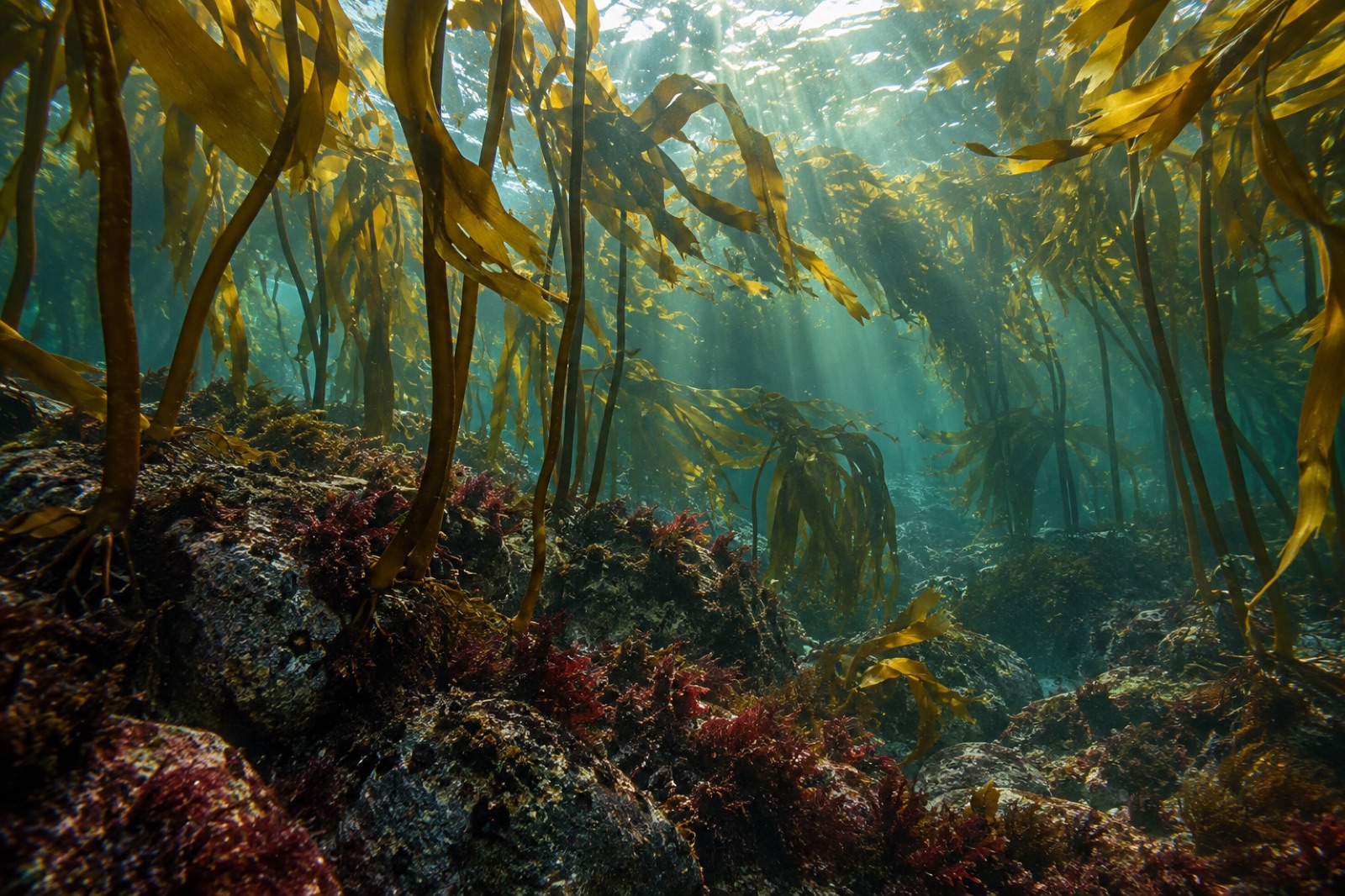
Kelp forests of Ireland's Atlantic west — the species beneath the cliffs, two centuries of kelp ash money, and a hand-harvest tradition that never died.
Dr. Mara Ellison ·