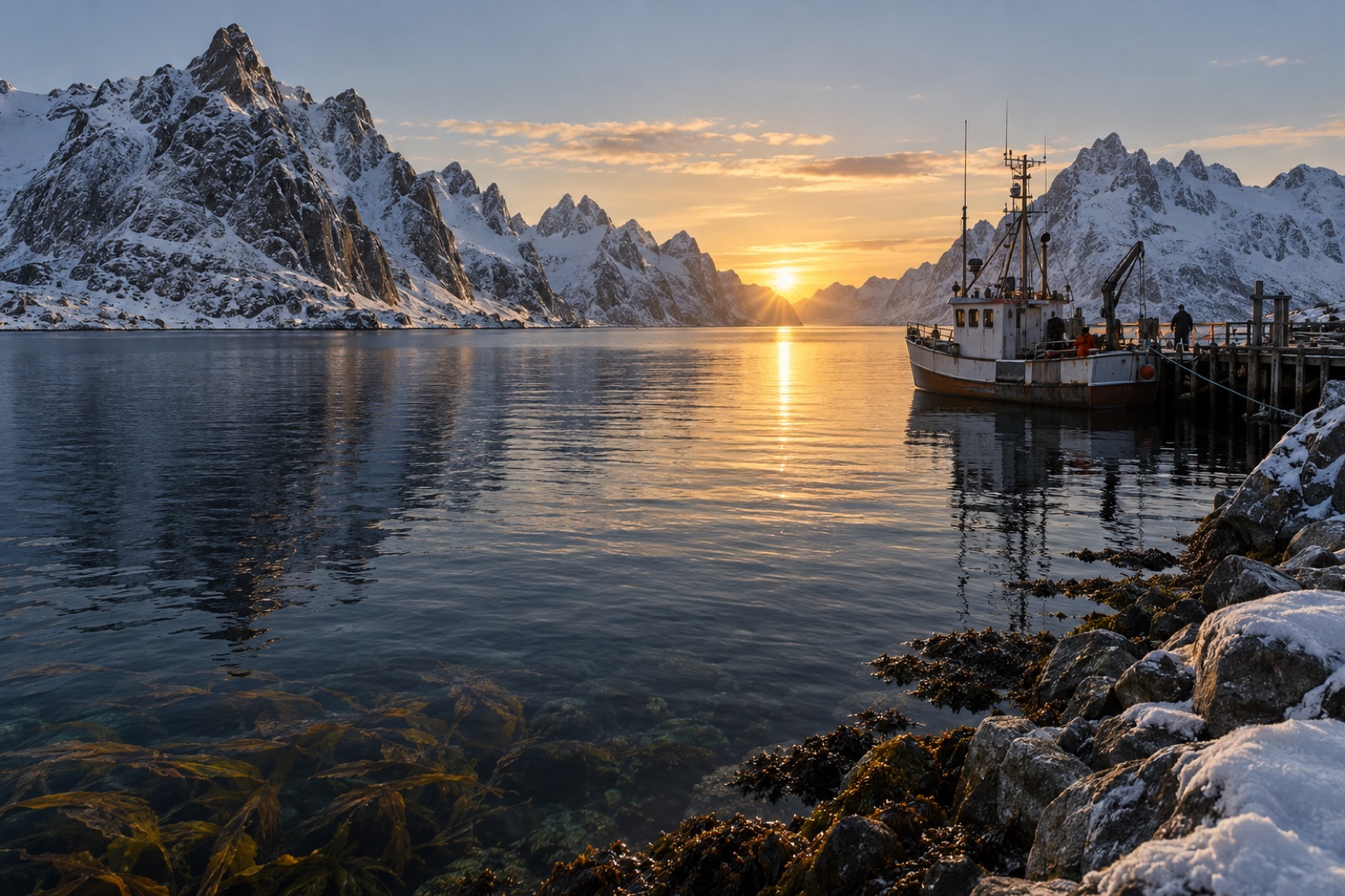
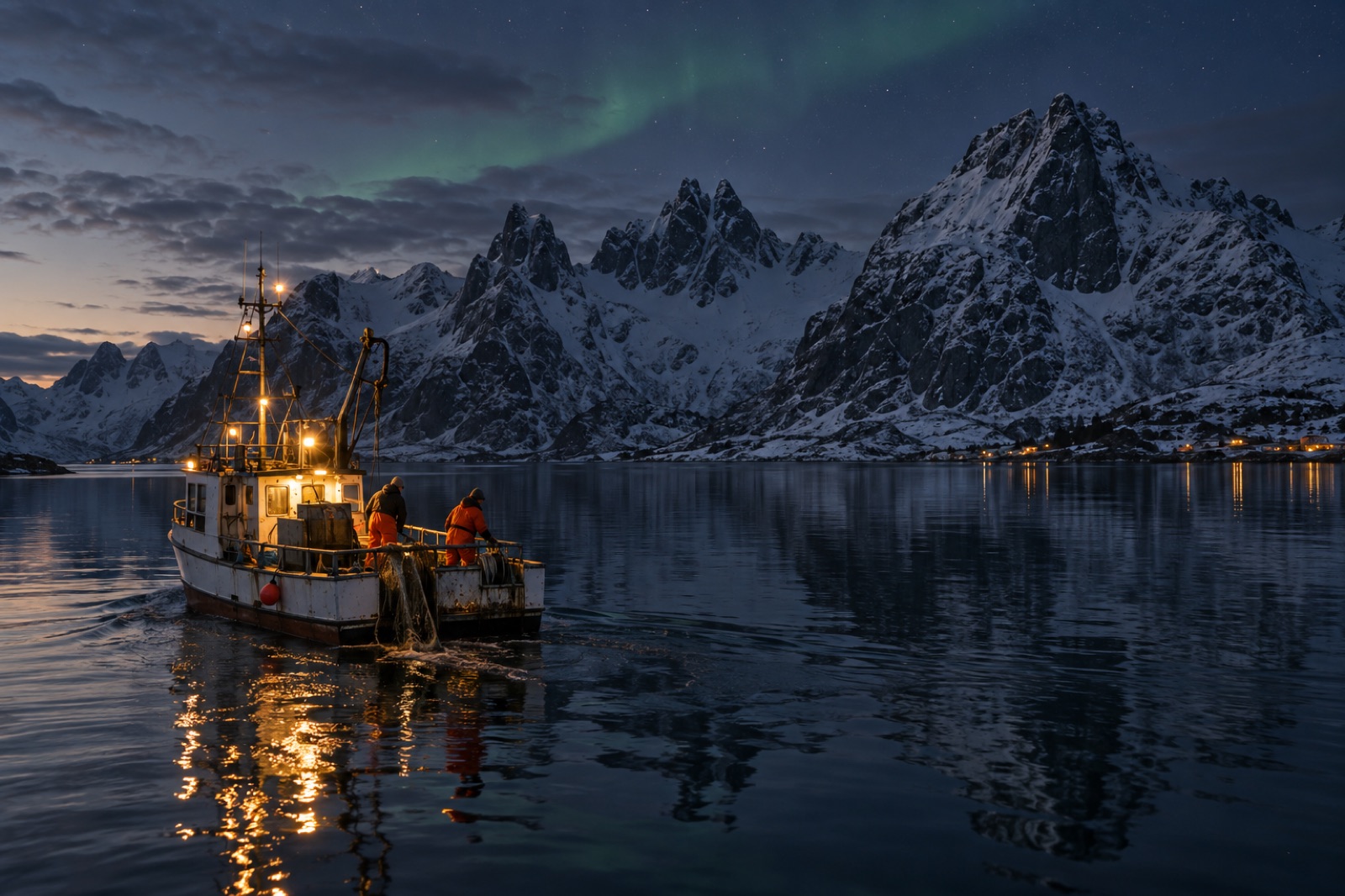
There is a moment, about ninety minutes north of the Lofoten wall, when the light does something that makes four people from the east coast of Tasmania stop talking mid-sentence. It's 11 a.m., the sun has technically risen, and it is lying flat on the horizon like it has no plans to work today. "That's all we get?" asks Jarli, the Kudjela ranger team's senior diver. That's all we get. In February, that's plenty.
Four rangers from the Kudjela sea-country project have flown essentially the full diagonal of the planet to spend a week at our Lofoten sugar-kelp program. The exchange is the point of these notes: what two Indigenous-and-local partnership models, on opposite coasts at opposite latitudes, had to teach each other.
Field notes carry Tidewright's own operational detail — illustrative numbers, real linked science.
Why Send Anyone 15,000 Kilometres?
Because restoration partnerships fail, when they fail, on the soft stuff: how decisions actually get made, whose knowledge gets recorded and in what language, what "consultation" feels like from the receiving end, how a ranger authority and a vessel crew disagree productively. Those lessons don't travel in PDFs. They travel with people who sit in the same boat for a week.
The Kudjela program is our most developed sea-country partnership — the rangers hold monitoring authority on their own transects, the spore-collection nights and survey calendars are set jointly, and the project's reporting flows through the ranger team's review before it flows anywhere public. Lofoten is younger: a working-fisheries partnership in a place where kelp knowledge is deep, generational, and woven into a coastline with its own fierce identity. The plan was for the two crews to trade the parts each had already learned the hard way.
What Lofoten Showed the Rangers
Winter operations, first. The Norwegian crew works through the dark season on systems that would cancel an Australian program twice weekly: heated hose loops, deck de-icing routines, dry-suit protocols for near-freezing water, and a scheduling culture that treats daylight as a budgeted resource down to the twenty-minute granularity. The rangers' takeaway wasn't the gear — it was the planning posture. In Tasmania, weather closes windows. In Lofoten, weather is the window, and you design the work to be indifferent to it.
Then the kelp itself. Sugar kelp is an annual and a winter-grower — the inverse of the perennial canopy Tasmanian work centres on — and the Lofoten crews read it the way farmers read a crop, in growth curves and harvest timing rather than succession stages. Watching the Norwegian team walk a seeded line and call its condition from blade texture and epiphyte load was a quiet masterclass in a different literacy. Same discipline, different grammar.
And the guest lesson nobody planned: how a partnership behaves on water it doesn't call home. The Norwegian crews were meticulous about deferring to local knowledge holders on their own coastline — which fishing families hold which ground, whose call a site decision is. Good partnership is legible from outside. The rangers clocked it in half a day.
What the Rangers Showed Lofoten
Monitoring as governance. The Kudjela system treats every transect, every drone pass, every dataset as something with named custodians and protocols — who may see it, who must approve its use, how it can leave the country. The Lofoten program, like most of ours, had grown its data handling operationally: competent, careful, but built for engineering convenience rather than declared custodianship. By mid-week, the two teams were sketching a Lofoten data-governance charter on the galley whiteboard, built on the Kudjela template and translated for a European regulatory frame. It will probably outlast these notes.
Long timeframes, plainly stated. The rangers describe their work in generational units without ceremony — not "project Phase 2" but "what this bay looks like when the kids doing work experience now are running it." Our program plans run in seasons and funding cycles. Saying a fifty-year horizon out loud in a planning meeting changes the meeting. It certainly changed ours.
And the exchange ran both ways on the water, which is where respect is actually minted. The rangers dived the seeded lines, ran their own quadrat method alongside the Norwegian one, and — in the week's most contested hour — lost a friendly argument with the winter light during a photo-documentation dive. Lofoten in February wins that one.
The Part That Follows Everyone Home
Exchanges are easy to romanticise and hard to operationalise, so here is the unromantic ledger. Both teams left with a shared monitoring-methods annex — three procedures the Norwegians will trial, two the rangers will adopt, one (a combined written-and-oral sign-off step for project decisions) that both sides agreed was better than either of theirs. The next exchange is pencilled for the Tasmanian spring, the Norwegian crew heading south at last into daylight.
The deeper thing is harder to minute. Restoration at Tidewright's scale only works if the coasts doing the work are connected to each other, not just to a head office. A ranger team in Tasmania and a fishing crew in Lofoten now have each other's numbers, a shared protocol document, and one standing joke about the sun that doesn't come up. That's infrastructure too — the kind that doesn't show up on a canopy ledger, and decides anyway whether the canopy can.
Key Takeaways
- Partnership knowledge travels with people, not documents — a week in the same boat beats a year of reports.
- Lofoten contributed dark-season operating discipline and crop-style literacy for an annual kelp; the rangers contributed data custodianship and generational timeframes.
- Data governance is partnership infrastructure: the Kudjela monitoring-authority model is now shaping a Lofoten charter.
- The reciprocal visit heads south in the Tasmanian spring — exchanges are a cycle, not an event.
- Inter-coast relationships between partner crews are a form of restoration capacity in their own right.
FAQ
What is a sea-country ranger program?
In Australia, Indigenous ranger groups care for land and sea Country under their communities' authority — monitoring, managing and making decisions about waters they hold responsibilities for. Tidewright's sea-country projects are partnerships where rangers hold monitoring and decision-making roles, not stakeholder seats.
Why Lofoten for an exchange?
Because it's Tidewright's deepest Northern Hemisphere program and its knowledge culture is equally local and generational — a fisheries-based partnership rather than a ranger-based one. Pairing different partnership models surfaces lessons that two similar projects never would.
What did the two sides actually exchange?
Operating methods (winter work, winter kelp husbandry north; survey governance and long-horizon planning south), plus a concrete shared-methods annex both programs will trial before the return exchange.
Who funds exchanges like this?
They're budgeted into both projects as capacity-building, with partner organisations contributing in-kind — vessels, beds, time. It's among the cheapest high-leverage line items either program carries.
The exchange model is being generalised into a partner-crew rotation under our Reef Partners programs — the intent is a network of coasts, not a hub and spokes.