Field Notes are Tidewright's own dispatches from our (fictional) restoration sites. The program, people and numbers below are illustrative — but the training is built from real cold-water practice, and there is nothing fictional about the physics of 3-degree water.
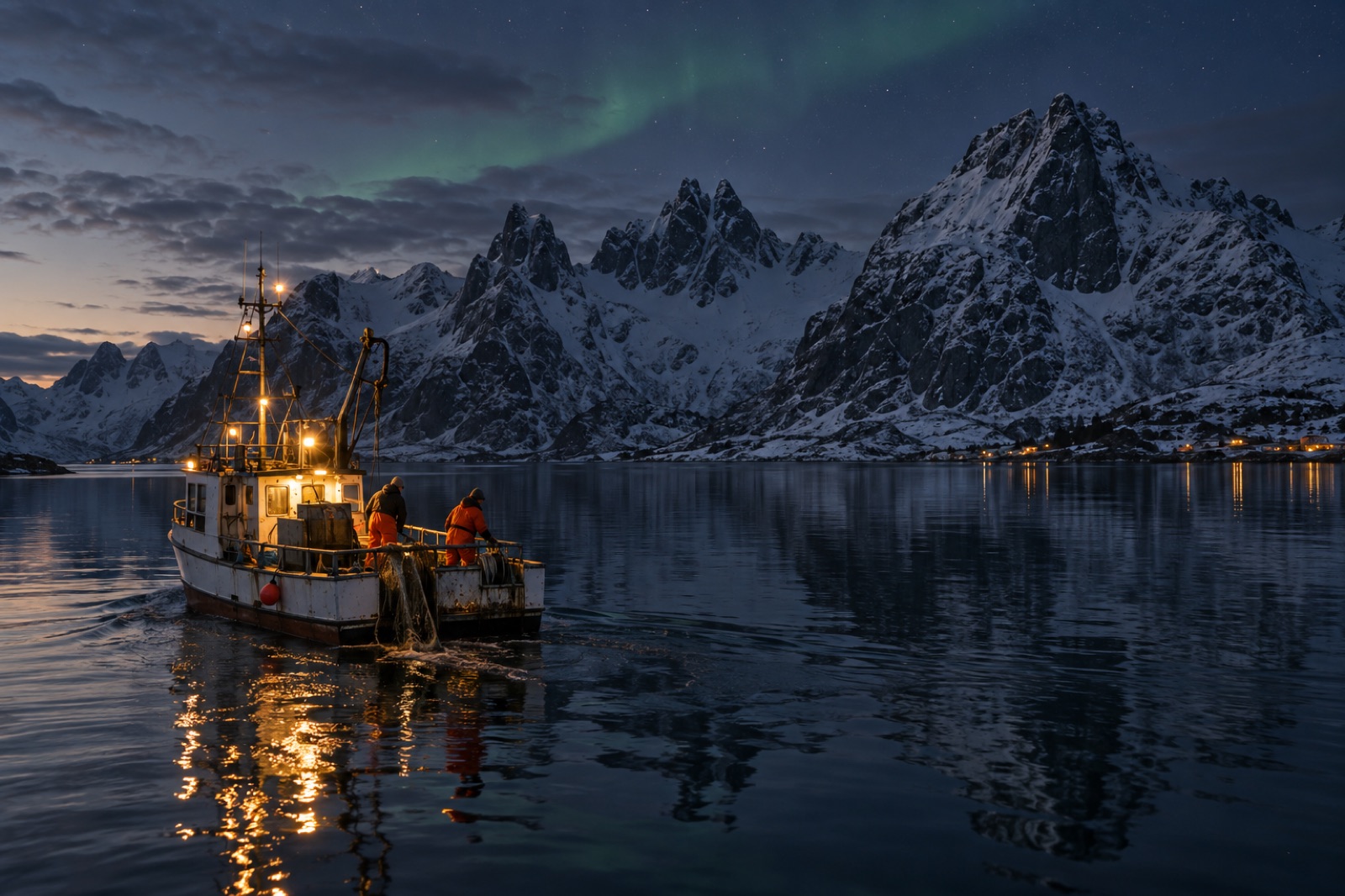
You cannot improvise a Lofoten winter. That sentence took us a full season to earn, and it is now the first line of the training manual. Last November, ahead of the second winter seeding season of the Lofoten Sugar Kelp Belt, we ran the program's first formal cold-operations course: six days at the Svolvær wharf and on the water, for fourteen people — our own field crew plus eight skippers' hands from the small-boat fleet association that lays the lines. This note is the course from the inside: what we taught, what the sea retaught us, and why the most important module was the one about standing still.
Some context for new readers: the why, where and when of seeding sugar kelp through the polar twilight is laid out in the note from our first season, First Lines in Lofoten. This one is about the human machine that has to work in that dark.
Day one: dressing for the water you're in
The course opens indoors, which surprises people until the second day. Cold-water operations fail at the clothing layer more often than anywhere else, so the first morning is a full dress rehearsal: heated vests over base layers under drysuits, mitts versus five-finger gloves versus the thin liners you swap to for shackle work, hood layering, and the unglamorous discipline of managing your own sweat — because a damp base layer at 3°C water and 40-knot apparent wind is a countdown clock.
The module everyone remembers is the cold-water immersion drill. Off the wharf, in survival suits, in pairs, in water that slaps the thought out of your head. The exercise isn't toughness; it's calibration. You learn, in your own body, what the first sixty seconds of immersion do to breathing, to fingers, to decision-making — the cold-shock response that recreational divers rightly learn to respect in our cold-water guides like the cold-water dive gear guide. People who have felt it stop romanticising it. People who stop romanticising it work slower, clip on more often, and come home.
Days two to four: the dark curriculum
Low light is Lofoten's defining condition — in December the sun never clears the mountains, and the working day is a long blue twilight pinched between floodlights. We built the middle of the course around it.
Deck-light discipline. Every boat runs the same lighting map: working deck lit, sightlines dark. A floodlight pointed wrong blinds your own helmsman and erases the one thing you need — the horizon, the loom of a skerry, the other boat. Crews drill moving loads, connecting tow bridles and paying out seeded line in that half-lit choreography until it stops feeling clever and starts feeling normal.
Depths by torch. All diving in the dark months is effectively night diving, so we treat it as such: primary and backup lights checked like life support, buddy light-signals re-rehearsed, and a hard rule that survey work happens on the shortest slack window the tide offers. Our monitoring divers had all night-dived before; almost none had done precision quadrat work at 2°C with mitts on. The first underwater census attempts were comic — slates fumbled, fingers blunt as pegs. By day four the same counts were coming back clean. Cold competence is a skill, not a trait.
Ice handling. Lofoten doesn't freeze like the high Arctic, but brash ice and occasional drifting pans move through the working grounds when the weather sets from the north. The fleet skippers taught this module, which inverts the student-teacher arrangement Tidewright usually operates — correctly. Reading ice from a wheelhouse, backing out of a closing lead, knowing which ice you nudge aside and which ice you do not argue with: none of that is in any manual of ours, and all of it is in the skippers. We wrote it down afterwards, with them, and it's in the manual now.
Day five: standing still
The module I insisted on, and the one I was most sceptical I could teach, is weather stand-down. We simulate it: a live Operations room, the real forecast feeds, a seeded schedule, and then model runs showing the window slamming shut at hour 30 of a 40-hour tasking. The exercise is to make the call to stop — out loud, on the radio, in front of your peers — and then to sit with the itchy, expensive, daylight-wasting reality of a paid crew doing nothing while good-enough-looking weather slides past.
It is surprisingly hard, and it is the whole ball game. The fleet skippers passed without blinking; standing down is how they've stayed alive for generations. It's our own driven, mission-fit young field leads who need the practice, because people who choose restoration work are selected for the instinct to push. Our first winter return note described a season where we stood down twelve of thirty-one scheduled days; every one of those twelve was a correct call, and none of them felt correct at breakfast. The cure for that feeling is repetition in a simulator where nothing sinks.
Day six: the exam nobody enjoyed
The pass-out exercise is a full mock seeding day in the worst reasonable conditions of the week: pre-shackled line sections off the wharf (the workflow the first season invented, now standard), two lines laid and tensioned, one inspection dive, and — unannounced — a man-overboard drill mid-way through, because that is when man-overboard events happen.
Fourteen certifications came out of the week: immersion-trained, dark-qualified deck crews and dive teams, with named skippers' endorsements against each boat handler. But the certificate I care about is a culture one, and it showed up three weeks later, mid-season: a junior dive lead scrubbed her own survey day on a marginal forecast, unasked, and logged the reason in two sentences. The log is where culture either exists or doesn't. It exists.
What training is actually for
We spend real money on this course and someone will eventually ask why a restoration company budgets like a coastguard. The answer is that the forest is downstream of the crew. Every hectare of winter-seeded sugar kelp that becomes spring canopy — the nursery structure this coast's cod quietly depend on, the whole argument of the Lofoten atlas guide — sits on top of unglamorous hours of people in drysuits practising being sensible in the dark. Get the people home, season after season, and the ecology takes care of itself. That's the lesson the Arctic teaches with more emphasis than anywhere else we've worked, and it's why the training note gets written before the season report.
The second winter's lines are in the water as this note publishes. The course runs again in October, longer, because the fleet association asked to send more hands. That's the best review we've ever had.
Key takeaways
- Tidewright built a six-day cold-operations course ahead of Lofoten's second winter season, certifying fourteen crew across both organisations — our field team and the fleet association we seed with.
- The curriculum runs clothing and cold-shock immersion first, then dark-qualified deck and dive work, ice handling taught by the fishing skippers, and a simulated weather stand-down.
- The hardest module is standing still: training driven people to scrub marginal days, because restoration crews are selected for pushing and winter punishes pushing.
- Culture is audited in the logbook, not the classroom — a junior lead scrubbing her own dive day unasked was the course's first real result.
- Every canopy hectare is downstream of crew safety; in the polar twilight, seamanship is the restoration technology.
FAQ
Why run restoration in the polar darkness at all?
Because sugar kelp runs on a winter clock — juveniles seeded in the dark months are established before the spring growth window opens, as explained in First Lines in Lofoten. The darkness isn't bravado; it's the calendar the biology hands us.
Who taught the course?
Both directions. Tidewright's dive safety lead ran immersion and dark-dive modules; the small-boat fleet's senior skippers taught ice handling and wheelhouse judgement. The manual came out jointly authored, which is the correct hierarchy of expertise for that coast.
Is winter diving at 68° north dangerous?
It's unforgiving, which is different. With immersion training, redundant lights, short slack-water windows and an absolute skipper's veto, the recorded risk profile of our winter diving sits within our normal operations envelope — the training exists precisely to keep it there.
Can recreational divers dive Lofoten in winter?
It's possible with a reputable local operator, exposure protection rated for Arctic water and genuine night-diving experience — our cold-water dive gear guide is the right starting point. Summer, with its midnight sun and 10-degree water, is the gentler introduction; the winter lighthouses and auroras are best admired from a boat with a hot flask.
Will the course expand?
Yes — the fleet association asked to double its places, and we're adding a second tier: coxswain's endorsements for night seeding operations, and a cold-weather module for the hatchery crew, whose work is wet-kernel cold rather than open-water cold but just as relentless.