These field notes describe Tidewright's own fictional projects and partner organisations, written for readers of the journal. The science and dive-safety practices described are real; the rangers, reefs and numbers are ours.
You can teach a competent diver to run a survey transect in about four days. Teaching a survey team to run itself — to plan its own dives, call its own weather, catch its own mistakes — takes a fortnight if you're lucky, and it never really ends. In late August I spent two weeks on Tasmania's east coast doing exactly that with the Kudjela Sea Country Rangers (a fictional partner nation of Tidewright's, as our earlier week with the Kudjela Rangers explains), standing up the dive crew that will run the Kudjela sea country program long after our field team has moved on.
The icebox in the ranger shed still says Talk first, work second. The dive roster now says something similar: The plan is the crew's, or the dive doesn't happen.
Why rangers need their own dive capability
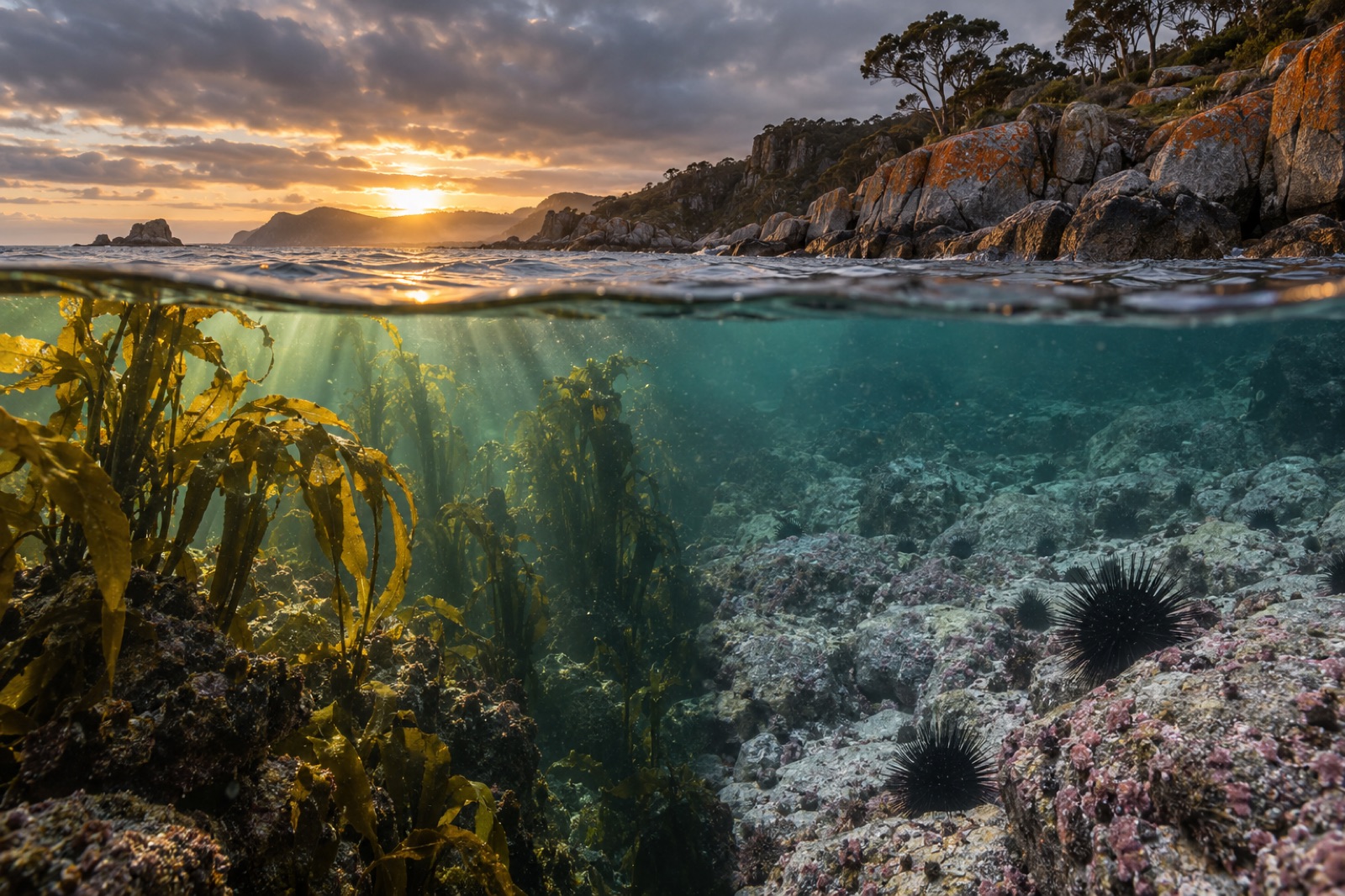
The short version: a monitoring program that depends on a visiting company's dive team is a monitoring program that ends when the funding does. The Kudjela program monitors restoration blocks across a stretch of Tasmania's east coast where kelp loss has been among the fastest in the country — some of that work is machine-done by Drifter survey passes and satellite canopy indices, but the irreplaceable core is divers on transects, counting urchins, measuring canopies, swabbing abalone shells for health checks.
Ranger crews already hold the cultural and ecological knowledge; what the fortnight added was the occupational side: survey technique to a scientific standard, and the safety framework to do it as a day job, in cold water, through a Tasmanian winter.
Week one: the pool tells the truth
We started in heated water, which is where every honest dive program starts, because a pool shows you a diver's actual skill rather than their remembered one.
- Buoyancy before biology. Six of eight trainees were strong open-water divers from abalone and crayfish work; two were newer. Everyone did the same circuit: hover, fin pivot, mask removal and replacement at rest, then again holding a clipboard. The test isn't whether you can do it — it's whether your breathing rate changed. Survey diving is task loading; the pool is where you find out who gets task-loaded.
- Out-of-air as routine, not emergency. Shared-air ascents until they're boring. The first time anyone's heart rate spiked we did it again. By day three the drill drew complaints about monotony, which is the correct outcome.
- Navigation with consequences. Compass swims where an error of five degrees, in the pool, meant an extra lap. On the coast it means the difference between a data point and a lost transect. By the end of week one everyone's reciprocal headings were within five degrees, which is where we hold the standard.
The honest assessment at the end of week one: three trainees lead-ready, four survey-ready, one — a strong freediver from the shellfish side — asked to repeat the scuba skills week, and said so himself before we did. That's the culture you want: one where the diver catches the gap, not the instructor.
Cold water changes the arithmetic
Tasmanian water in late winter sits at 12–13 °C. Everything the pool forgives, cold water bills for: dexterity goes first (try threading a transect reel with 7 mm gloves), air consumption rises, and the window between "fine" and "a problem" narrows. Week one ended with a classroom afternoon on cold-water physiology, gear — the full cold-water kit list logic applies here doubly, because a working diver has no warm-up option scheduled — and the rule the program adopted: any diver may call any dive, at any point, for any reason, with no questions and no paperwork beyond the log entry. That rule was invoked three times in week two. Nobody nobly soldiered on. The rule works.
Week two: transects, and the moment it clicked
Out on the coast the days took a rhythm the rangers set: rangers' country briefing first, dive plan second, weather call third.
- Transect discipline. Thirty-metre lays with a reel, one-metre quadrat counts every five metres: urchin density, kelp stipe counts, substrate notes. The first day produced beautiful, useless data — counts drifted between buddies because nobody had calibrated what counts as an urchin in a quadrat. Half-in, half-out? The fix was an hour of paired counting on the same quadrats until the inter-observer difference dropped under ten per cent. This is the unglamorous core of field science, and it can't be taught from a manual — any team doing citizen-science reef surveys hits the same wall.
- eDNA, from the people who chose the stations. The crew ran the eDNA sampling protocol at stations the ranger program had sited the previous season — into the gutters and sponge gardens the old knowledge picks. Sterile technique in gloves, filter changes between stations, chain of custody initialled on the tailgate. Every bottle from the fortnight is logged under ranger program custody; our lab processes them under licence.
- The call that mattered. On day eleven, a rising southerly, twenty minutes before splash: the trainee dive lead — a quiet 24-year-old the crew calls Nalita (a composite, as with all ranger names in these notes) — stood in front of the weather briefing, looked at the fetch charts, and scrubbed the deep transects in favour of the sheltered block and an early finish. The conditions were within limits. Her judgement was that they wouldn't stay that way, and her crew had a long drive home. The deeper call — the one your instructor wants to see — is the conservative one made early, out loud. I bought her coffee and told her she'd just done the hardest thing in the course. The rangers, entirely correctly, did not seem to think it was remarkable.
What transferred, and what didn't
By the fortnight's end the ranger crew held:
- Survey competency to program standard on transect, quadrat and eDNA methods.
- Full custody of their dive-safety framework — written in their shed, in their words.
- A training pathway: two trainees assessed as future instructors, so the next intake is ranger-taught.
What didn't transfer: me. That's the design. My job for the next season is a weekly phone call, a spare-parts cupboard, and an invitation to be a guest diver on their surveys — which, after watching Nalita run a briefing, they do not need, but which I intend to enjoy.
Key takeaways
- Durable restoration monitoring is ranger-taught and ranger-owned; visiting teams should plan their own obsolescence from day one.
- Pool skills checks beat résumé diving: task loading reveals who gets overloaded, and drills must be repeated until they're boring.
- Inter-observer calibration — paired counts on the same quadrats — is the difference between data and noise in any survey program.
- Cold-water work needs explicit rules: any diver may call any dive, no questions asked. The rule proved itself three times in two weeks.
- The real graduation test is a conservative weather call made early and out loud, by the crew's own lead.
FAQ
Are the Kudjela Rangers and the trainees in this note real?
Tidewright is a fictional demonstration company, and the Kudjela Sea Country Rangers are a fictional partner, with names composited to protect the fictional team's privacy. The training methods, survey protocols and safety rules described are drawn from real occupational dive-science practice and real Indigenous ranger program models.
How long does it take to train a scientific dive team?
For divers with existing open-water experience, two intensive weeks covers survey method, calibration and safety framework to entry standard — as this note describes. Building instructor capability inside the team takes another full season at minimum. The timeline matters less than the culture: programs fail on judgment, not technique.
What does "any diver can call any dive" actually mean in practice?
Exactly what it says: any member of the team, regardless of seniority, can scrub a dive at any point — on the surface or by thumbing it mid-water — and the correct response is the end of the dive, logged cleanly, with no discussion unless the caller wants one. Dive science programs that skip this rule eventually learn it the hard way.
Why not just contract out the survey diving?
Contracted teams are fine for one-off assessments. But the Kudjela program exists to monitor sea country over decades; every season outsourced is a season of knowledge, custody and capability that accrues to someone else's books. Ranger-run monitoring is both better science and the only version that outlasts funding cycles.