Tidewright field notes are first-person dispatches from our crews. The coasts and ecology are real; the company, vessels, crews and numbers are fictional, and written to be honest about what this work involves. Background on this coast is in our atlas guide to Mendocino's lost bull kelp shore.
Winter on the Mendocino shelf is not off-season. It is the season that answers things. Summer tells you what the canopy looks like when conditions are kind; winter tells you what will survive, where the urchin front moved during the storms, and whether the Holdfast lines we laid in autumn are still where we left them. The catch is that winter only lets you look in pieces — two days here, a long morning there, grabbed between systems rolling off the Pacific on a six-to-nine-day rhythm. This is a note about working the gaps: how we read a swell forecast like a work roster, and what three weeks of winter transects taught us about the edge of a barren.
The forecast is the schedule
Out here, "weather window" is too soft a phrase. We work to a doctrine the crews call windows with teeth: a window is not real unless the swell height is under a metre and a half at our working depths, the period is long enough that the surge on the reef is manageable — long-period swell wraps energy into shallow water more predictably than short-period chop, which slams — and the next arriving system is still far enough out that a scrubbed day doesn't strand gear.
Rosa, who runs our Mendocino station, keeps a wall notebook that pairs each forecast cycle with three columns: dive, vessel-only, office. Divers go in when the surge at ten metres won't put a body into the reef. Drifter 11 can run its survey lanes in heavier water than divers will tolerate — the vessel reads the reef by sonar while we stay on deck — so vessel-only days are not lost days, just different ones. Office days are when the transect photos get labelled and nobody pretends otherwise.
Over three weeks in February we got four dive days, six vessel days, and eleven office days. That ratio is normal. Planning a winter program around how many dives you want is how crews get hurt; planning around how many the ocean will offer is how the work gets done.
What we were actually looking for
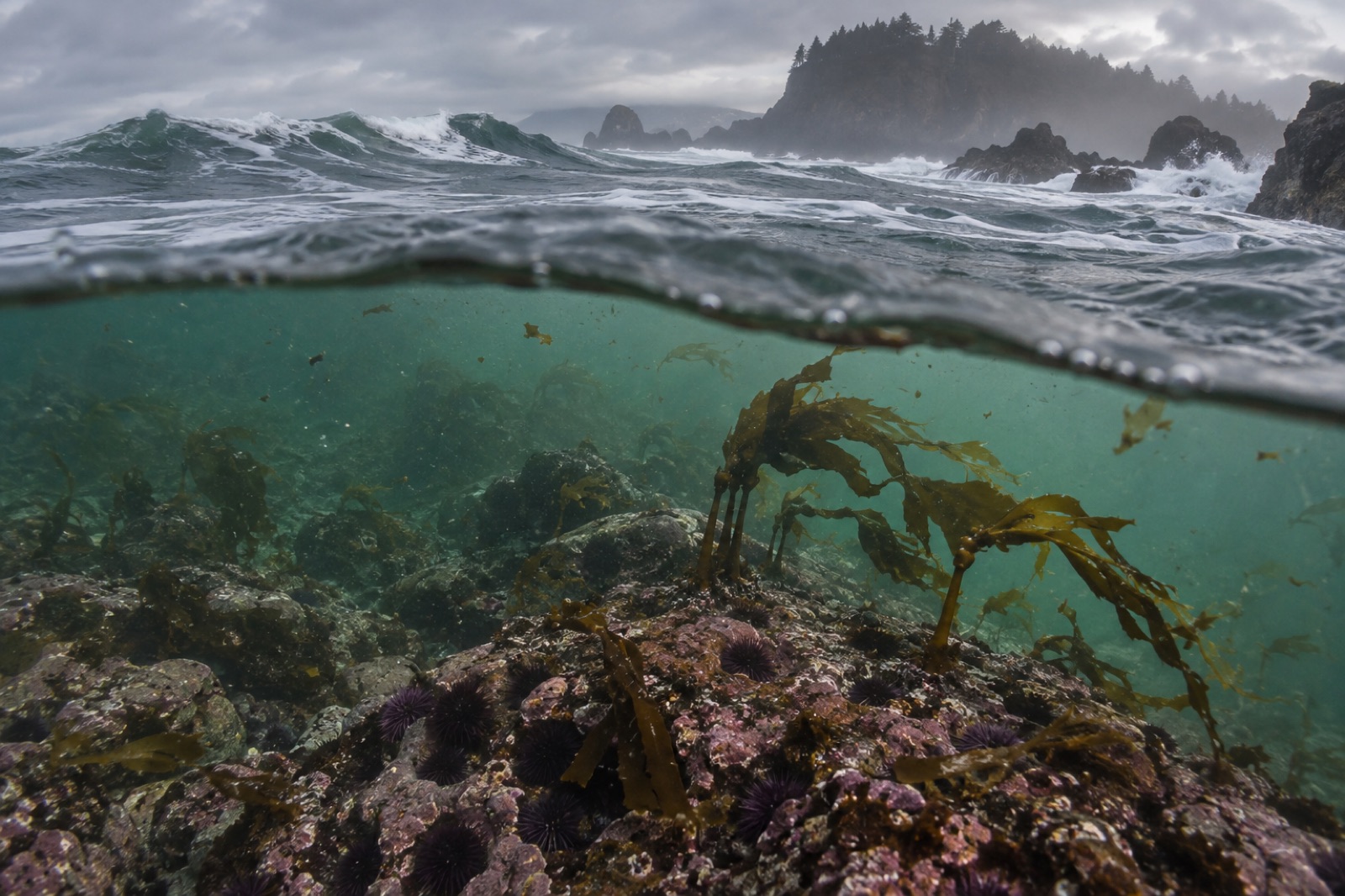
The winter transect set in Mendocino has one job: walk the edge. Our survey lines cross the transition between bull kelp forest and urchin barren — the gradient we've described before in notes from the barren edge itself and the post-storm transect last season. Winter is when the edge tells the truth, because storms strip the ambiguity out. Any bull kelp that recruited weakly in autumn is gone by January; any urchin front that was drifting gets pushed somewhere; the lines we laid either set sporelings or they failed, and both answers are information.
We run eight fixed transects, each one hundred metres, tagged at both ends with coded subsurface markers laid the previous season. Divers swim them with a camera sled and an urchin-count quadrat every five metres — two metres either side of the line, the same footprint we've used since the beginning, so the numbers are comparable across years. That stubbornness about method matters more than any single finding. Change is only visible against a ruler you refuse to move.
What February told us
Three findings came out of the window-days, and I'll give them the weight they deserve — which is to say, preliminary.
The front moved, and then it stopped. Two of the eight transects show the urchin front advanced about fifteen metres into forest that was marginal last summer; a third shows the front retreating by roughly eight metres where the cull crews worked hard in autumn. Both numbers sit inside the range we've seen since the heatwave years remade this coast — the edge breathes. What matters is that the retreat sector is exactly where we paired culling with seeding. One season, one pair of transects: not proof. But it's a mark in the ledger in the right column.
The autumn lines held. Forty-one of forty-four Holdfast line segments survived the storm season, and thirty-six are carrying visible sporophytes — thumb-length bull kelp, where we dived them on the last window-day of the month. The three lost segments all failed the same way, at the same anchor hardware, on the two transects exposed to the long northwest fetch. That's a hardware note, not an ecology note, and it's now in the procurement file with the kind of font size that gets things changed.
The barren is shallower than the map. Sonar from Drifter 11's vessel-days showed grazing scars and urchin aggregations in noticeably shallower water than our working map of the barren had them — the front appears to have moved upslope in one sector during the winter storms, which fits the pattern of storms rolling drift algae into deeper pockets and leaving the shallow rock clean for grazers to work. We'll adjust the spring cull plan to match.
The part nobody budgets for
The thing about working in windows is that the work compresses. Four dive days to do five weeks' worth of transects means dawn starts, shelters rigged for kit-drying between dives, boats cleaned and reset in the dark, and a crew culture where the question "do we push it?" has a standing and non-negotiable answer. We scrubbed one launch this month with the boat already loaded — the period forecast shifted overnight against us and Rosa made the call from the wheelhouse before lines were slipped. It cost us a day and returned nothing but the boat and the crew, and it was the most professional thing that happened all month.
People imagine restoration as planting. Out here it is mostly patience: patiently reading a forecast, patiently repeating a transect somebody laid five years ago, patiently letting sixteen weeks of storms grade one autumn's worth of decisions. The forest works on its own schedule. Winter is the season where we learn to work on it too.
Key takeaways
- Winter is when barren-edge transects tell the truth: storms strip out weak recruits and reveal where the urchin front genuinely moved.
- Windows with teeth: winter fieldwork runs on swell height, period and arrival spacing — the forecast is the work roster, not the backdrop.
- Fixed transects with unmoved method are what make change visible; findings are only as good as the ruler you refuse to adjust.
- This February's preliminary reads: the front advanced on two transects and retreated in the seeded-plus-culled sector; 41 of 44 Holdfast line segments survived, with anchor hardware as the lone failure mode.
- A scrubbed launch is not a lost day — vessel-only sonar work and the discipline to stand down keep the program honest and the crew whole.
FAQ
Why monitor kelp in winter rather than summer?
Storms remove ambiguity: weak recruits, marginal plants and drifting fronts all resolve by late winter, so measurements taken then reflect survival rather than seasonal optimism. Summer surveys complement winter ones, but the winter set is the audit.
What swell conditions allow dive work on this coast?
Thresholds vary by site and exposure, but our working rule combines swell height at survey depth with swell period — long-period swell surges more predictably — plus confidence in the arriving system's timing. When any of the three deteriorates, the day becomes vessel-only or office work.
Are these Mendocino findings real?
The coast, the bull kelp losses, the urchin barrens and the heatwave history are real and well documented. Tidewright, its vessels, crews, line counts and transect numbers are fictional — this note describes honestly what a winter monitoring season would involve.
What happens to the winter data?
Every transect's quadrat counts and camera-sled footage enter the season ledger, where they're compared against the fixed-method time series. The spring seeding and cull plans are then drawn from that comparison, and the methods behind the measurements are the same ones we've published.
Why does the urchin front move during storms?
Storms reshape food supply: they tear kelp loose in one place and dump drift algae into pockets elsewhere, shifting where urchins need to graze. Fronts tend to advance where grazing pressure concentrates and retreat where it relaxes — one reason the barrens can be stable for years without being truly static.