Tidewright is a fictional company created as a design and content demonstration. These field notes are works of fiction written in the voice of our field operations team, and every number in them is illustrative.
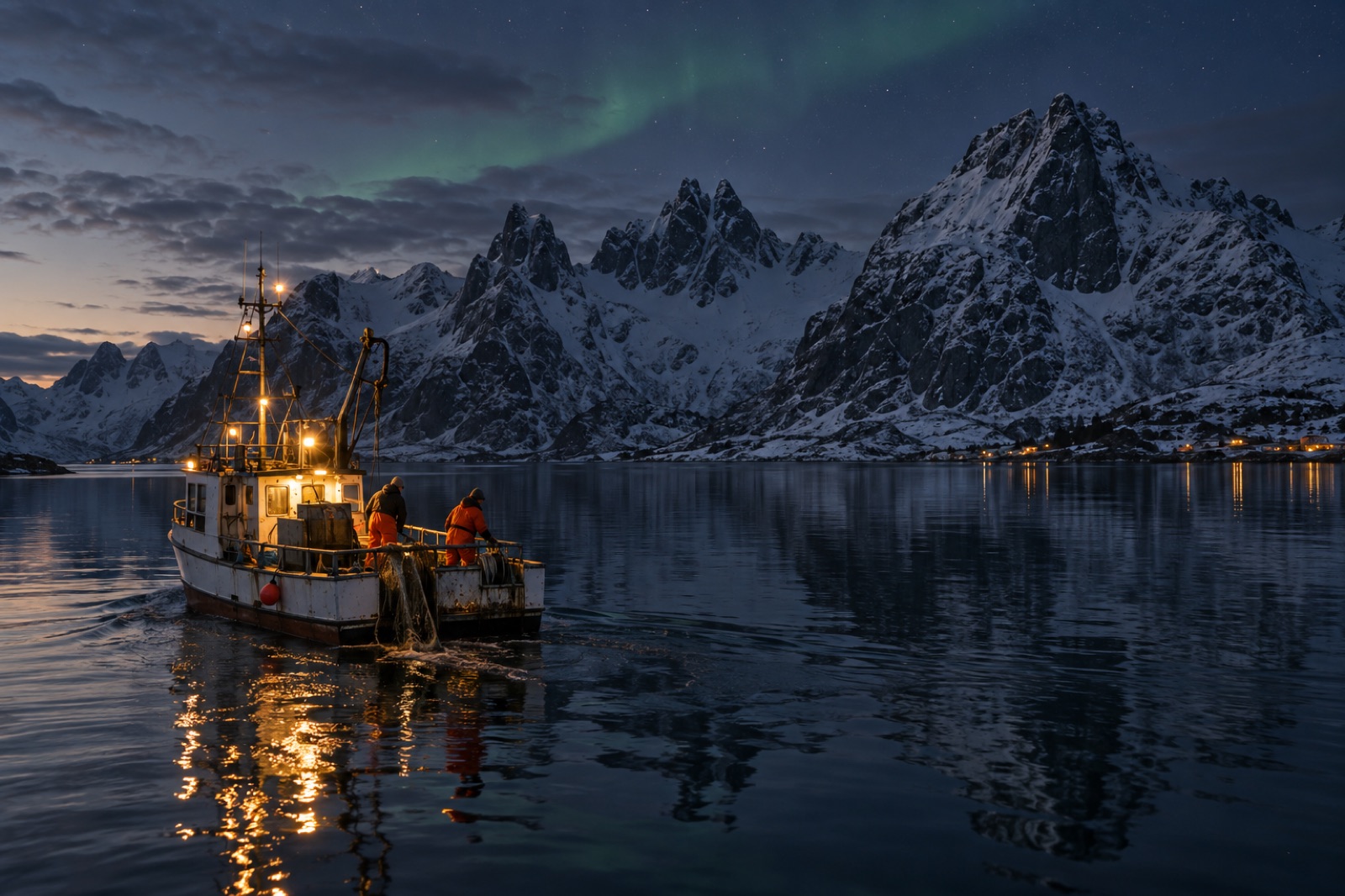
Eighteen months ago I stood on the deck of a fishing boat out of Svolvær in the polar-night twilight, watching Holdfast lines sink into iron-coloured water with sugar kelp seedlings the size of eyelashes on them. I wrote that log up as First Lines in Lofoten, and ended it with a school of juvenile saithe watching the lines go down like a curtain. This May we came back for the other half of the story: the first harvest of the Lofoten Sugar Kelp Belt. The curtain had become a forest. Now it was time to take the forest a wage, carefully, and see whether the numbers on the model could survive contact with a Norwegian spring.
What a restoration harvest actually is
Before the deck stories, the design, because the design is the difference between this and ordinary kelp farming. The Lofoten belt has two kinds of seeded area. The restoration blocks are seeded reefs where the kelp belongs to the reef — nobody crops them, full stop; their entire job is canopy, nursery structure and spore rain. Interleaved between them are the harvest blocks: the same sugar kelp, the same seeded lines, laid on deeper ground where standing crop would outgrow what the reef can hold. The harvest blocks exist to fund the restoration blocks. That is the flywheel architecture of Tidewright Harvest in a single fjord — one seeding campaign, two outcomes, revenue paying for the next round of reef.
The crop rules were written with the fleet association and the county, and the important ones are these: blades are cropped at arm's length above the meristem so every plant regrows; no more than 60% of blade length comes off any plant; no harvest inside fifty metres of a restoration block; and the whole window closes when the water hits 10°C, because above that the summer fouling organisms make the crop unfit for food anyway. The kelp sets the calendar north of the Arctic Circle. The kelp does not negotiate.
The week itself
Here is what eighteen months of polar-night patience looks like in late May, at 68° north, under a sun that has stopped setting: ropes you could lose your forearm in. A healthy sugar kelp blade runs two metres and sells by the kilogram of wet weight that nobody has yet invented a dainty way to move. The fleet association boats — the same skippers who laid the lines in the dark, now working in glittering endless daylight — ran a rotation of small boats cradling the lines while deckhands pulled, cropped with knives, and dropped the cut fronds into landing baskets. Feed boats shuttled baskets to the landing station at Svolvær, where the cooperative's processing shed had spent the winter converting a vacant fish-freezing room into a kelp line: rinse, blanch, chill, pack.
The rhythm differed from fishing in one way every skipper remarked on: the weather window worked for us instead of against us. You fish cod in the weather the cod choose; you crop kelp in a calm you can see coming three days out. We lost no days to weather in the whole harvest week — a sentence no one who fished Lofoten in January will believe, but it's in the log.
The headline numbers, all illustrative, all smaller than the pride around them: 41 tonnes of food-grade blade cropped across nine working days; zero restoration-block intrusions on the diver audits; a first-grade proportion above two-thirds, which the Japanese-trained graders from our Hokkaido program (on exchange, and ruthlessly unimpressed by everything except the kelp) declared acceptable for a first season in the tone one reserves for prodigies.
What went wrong, honestly
Three things, in ascending order of what they taught us.
The braid legacy. The cold-stiffened biodegradable braid that kinked during that first polar-night seeding never fully straightened, and a fraction of lines sat with a spiral set in them — kelp grew fine on the spiral, but cropping a corkscrewed line blind from a boat is slow work. The hatchery's cold-tension braid fix from season two eliminates it; the season-one lines will cost us minutes at every harvest until they biodegrade out of the fleet. Write it down as a three-year tax on a one-week lesson.
Fouling arrived early. A mild spring pushed the bryozoan and hydroid bloom into the last week of May, two weeks ahead of the planning calendar. We closed the harvest at 26°C air and 9.1°C water with roughly a fifth of the crop standing, by rule rather than by quality failure. Next year's window moves earlier. The Arctic is warming fastest of anywhere we work, and "the kelp's calendar" is itself a moving document now — the spring squeeze we've written about in our growing sugar kelp guide is tighter at 68° north than anywhere else on the program.
Cold chain, literal meaning. Kelp for food is spoiled kelp if it sits warm for an afternoon, and May in Lofoten means a harvest shed holding kelp at 2°C while the midnight sun heats the roof. The converted freezing room held — barely, with an emergency rental chiller parked outside like a generator at a festival — and next season's budget has a permanent line for cooling that this season's had as a contingency.
Where 41 tonnes went
The crop split three ways, and the split is the model in miniature. The premium blades — clean, unmarked, first grade — went as fresh and blanched product to a Norwegian food distributor and to a small kombu-style program the fleet association has wanted to try since the seeding season, with whole leaves destined for the curing and dashi-style uses our kitchen team has been writing up resources for. The second grade went to a regional processor for biostimulant extract. The dockside trim — fragments too short or torn to grade — went to a mussel farmer in the Vestfjord trialling kelp-supplemented feed. Nothing organic left the fjord system. Even the rinse water, salt and all, went to a greenhouse trial up the hill; whether that was genius or sentiment, the lettuce will tell us.
And the fleet association got paid — skippers, deckhands, graders, the shed crew — in a shoulder season when their boats otherwise sit. In the cooperative's accounts (which they showed me over coffee, unasked, the way you show someone a grandchild) the harvest week priced out as the fifth-best week of the year for several boats, in May, in a month that used to be a dead zone between seasons. If you want the short answer to why a fishing fleet signs on to grow kelp, that line in the ledger is most of it.
The moment
Last entry. On the final evening, after the tally, the skipper of the boat that laid the very first line in January 2025 took me down to the shed's cold room and pulled two fronds from the premium stack, sliced them thin as ribbon, dressed them with nothing but lemon and oil, and we ate kelp salad standing on pallets at midnight in full daylight. Forty-one tonnes sounds like a spreadsheet. Two minutes on a pallet in the midnight sun is what it tastes like: sweet, mineral, faintly of the sea it pulled those nutrients out of. He considered his own crop with the seriousness of a man reading tide tables, and delivered the review I will take over any grader's certificate: "It tastes of here."
Second winter season lines are already in the hatchery tanks at the Nordkyst Cooperative, grown from the same bays' donor stock. The wheel turned once. The atlas guide to these islands will tell you the mountains are worth the trip; I am telling you the mountains are only the landward half of the sentence.
Key takeaways
- The Lofoten belt's first harvest (fictional; all figures illustrative) cropped 41 tonnes of food-grade sugar kelp over nine days from interleaved harvest blocks, while restoration blocks — the actual reef-forest work — stayed uncropped by design.
- Crop rules protect regrowth: blades cut above the meristem, 60% maximum take, buffers around restoration blocks, and a hard water-temperature ceiling before summer fouling.
- Failure modes were real and instructive: a legacy braid defect from the polar-night seeding, an early fouling bloom that closed the window with a fifth of the crop standing, and a marginal cold chain in the midnight sun.
- Revenue split across food-grade product, biostimulant processing and local feed trials — with every organic fraction staying in the fjord system and crew wages landing in a traditionally dead shoulder season.
- The harvest revenue funds the second winter seeding season now in the hatchery: the restoration flywheel turning its first full revolution at 68° north.
FAQ
Does harvesting conflict with restoring the reef?
The program's whole architecture separates the two jobs spatially. Restoration blocks — seeded reef whose kelp serves canopy, habitat and spore production — are never harvested. Harvest blocks sit on deeper, approved ground between them and exist to fund the restoration work. Diver audits during the harvest week confirmed zero intrusions into restoration blocks.
Why close the harvest at 10°C water temperature?
Above roughly that threshold, fouling organisms — hydroids, bryozoans, filamentous algae — colonise the blades and make the crop unfit for food-grade markets, while the kelp itself shifts energy toward reproduction. Cropping before the fouling window is quality control and stock protection at once; the standing fifth of the crop we left becomes next season's local spore supply.
Is a 41-tonne harvest commercially meaningful?
It's a proof of architecture, not a revenue milestone — meaningful because it paid crews in a dead season, tested the food-grade chain in the midnight sun, and funded the next seeding round. The grower's-economics version of these numbers is what we recommend to anyone modelling their own farm at scale.
Can visitors see the harvest?
The harvest grounds are working fisheries and aren't open to visitors, but summer travellers can see the same kelp ecosystem from Lofoten's snorkel and kayak coves in the brief warm weeks — our Lofoten atlas guide covers where and how, with cold-water safety notes.
What does sugar kelp taste like?
Mildly sweet, deeply savoury, faintly oceanic — the species carries natural glutamates, which is why it anchors broths the way its Japanese relative kombu does. Blanched and sliced, it's nearer to a sea vegetable than to any sushi-wrapper stereotype; at the shed in Svolvær we ate it raw with lemon and oil and it needed nothing else.