Field Notes9 min read
Field Notes: The Harvest That Paid for August
A ranger-led golden kelp harvest on South Australia's Gulf St Vincent just funded an entire seeding season. Field notes from the week the flywheel turned.
Jack Callum ·
Golden kelp drops its spores for two short weeks in Gulf St Vincent. Field notes from a collection week run on the Kudjela Rangers' calendar, not ours.
Field Notes are Tidewright's own dispatches from our (fictional) restoration sites. The Kudjela Sea Country Rangers are a fictional partner nation; the fieldcraft, biology and restraint described here are very much real. All figures are illustrative.
There is a fortnight each autumn when golden kelp fronds across Gulf St Vincent release their spores, and for that fortnight the entire Kudjela Sea Country program suspends its normal schedule and works to the kelp's calendar — or rather, to the rangers' reading of the kelp's calendar, which is older, better and non-negotiable. I spent the collection week with the ranger crew this season, gathering the fertile tissue that becomes next year's seedstock. As a kelp biologist I have run collection weeks on three continents. This is the only one where the schedule was written in country, and it produced the best genetics library I have ever had a hand in. This is the diary of how.
Golden kelp — Ecklonia radiata, the foundational forest species of southern Australia's reefs — carries its fertility in specialised blades near the base of the plant, whose surfaces darken into sori as autumn water cools. Each sorus is an arrangement of millions of spores-in-waiting. When the colony of conditions is right — temperature sliding down through the high teens, day length shortening, swell stirring the canopy — the sori release, and the water column over a golden kelp reef briefly carries the entire future of the forest as a mist of swimming cells too small to see.
Each spore settles within days and grows into not a baby kelp but a gametophyte — the microscopic, few-celled alternate generation through which every kelp forest must pass before a new sporophyte can begin. The kelp life cycle explainer gives the full two-generation architecture; what matters for a collection week is that we are not harvesting kelp, and not even harvesting spores, really. We are borrowing two weeks of a biological cascade and rerouting a fraction of it through hatchery tanks, so that next autumn there are seeded Holdfast lines to lay on the reefs the rangers have chosen for return.
Gulf St Vincent raises the stakes on the timing. The gulf is shallow and warm for kelp water — a broad, sheltered sea that can spike several degrees in a heat spell — and its golden kelp forests live near the warm edge of what the species tolerates. That is exactly why the program exists, and why the gulf's surviving donor reefs hold genetics the whole Great Southern Reef will eventually ask for. It is also why the collection window is short: wait for comfortably cool water and you have missed the fall; go early and the sori hold back.
The week that matters comes before the collection week, on land, in the rangers' shed. The rangers' seasonal calendar for this coast divides autumn differently from ours, and their indicators for sorus ripeness are not the ones in my textbooks: the condition of the frond tips, the behaviour of the sweep schools over the reef, a particular clarity the gulf takes on in the mornings, and the state of the samphire flats at the top of the tide. Two of those indicators correlate with drivers I can name — turbidity and light history; temperature seasonality — and two I cannot yet explain, which is not the same as them being wrong. Last year their called window was eleven days ahead of the one my models gave. Theirs was right.
So the plan this year was theirs from the first morning: seven donor reefs ranked by priority, two of them cut from the list entirely this season — one carrying a stressed canopy after the March heat spell, one within a bay the calendar rests in autumn — and a collection order set by their reading of which reefs would ripen first. My role, and our hatchery crew's role, was to make our logistics fit inside it. I want to record for the wider restoration sector, plainly: every one of those constraints improved the science, and none of them were in my original plan.
The craft of collecting golden kelp for a genetics program is selective foraging under pressure. A collector swims the donor reef with a mesh bag and a slate, looking for fronds whose sori sit at the right corduroy texture — ripe, dark, just pre-release. Each parent plant gets a numbered tag against its chart position, two or three fertile blades taken at most, nothing near the meristem touched. The rangers dive in the lead pairs; our crew work second-diver on the bags, which is another way of saying we fetch and carry for the people who can actually read the reef.
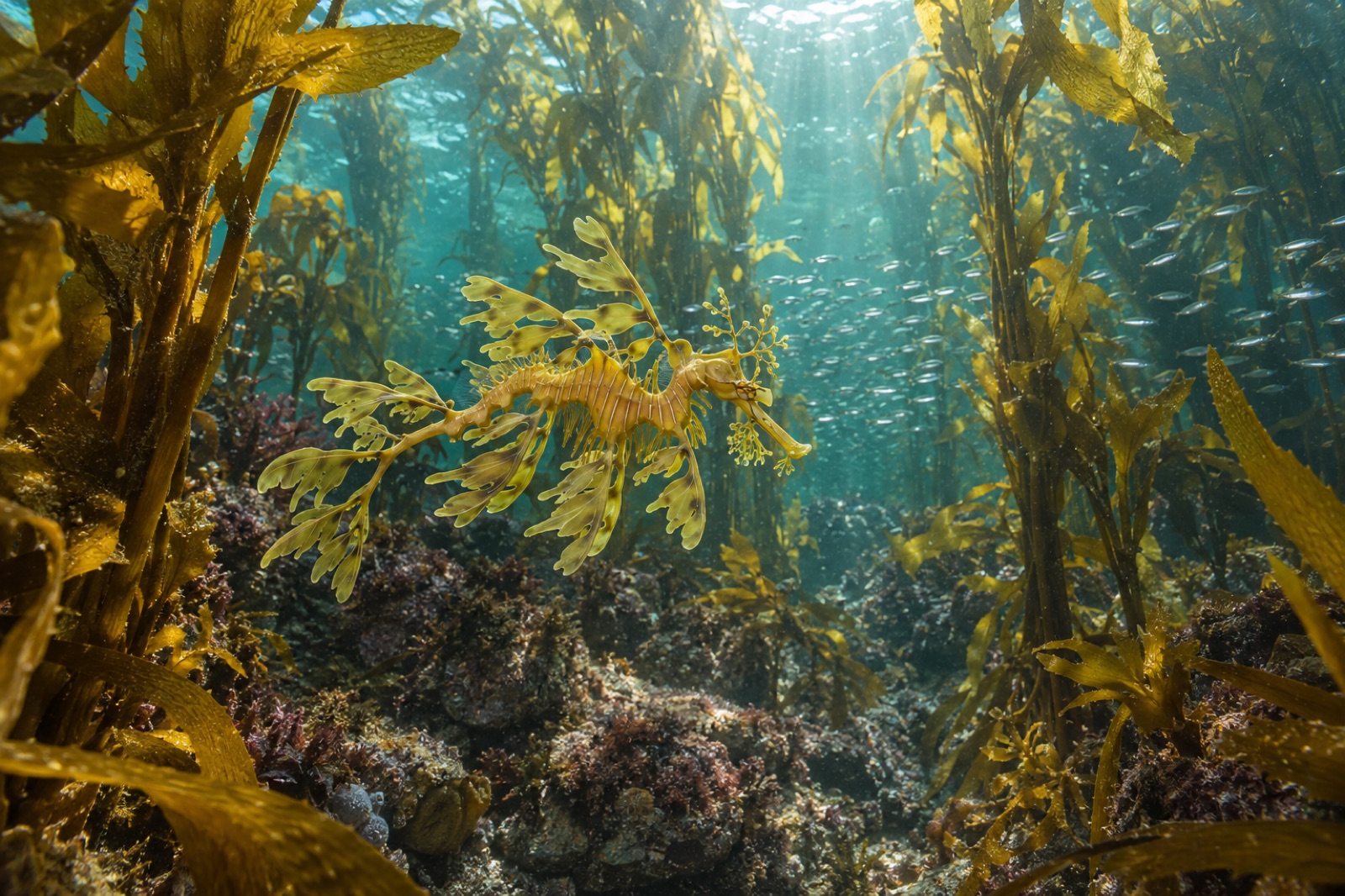
The gulf performed for us. Water at seventeen degrees, visibility a milky turquoise six to nine metres, the Ecklonia canopy overhead turning the light green-gold and dappled — diving a healthy golden kelp forest in autumn light is the closest my profession offers to working inside a stained-glass window that is also a machine for making more windows. On the third reef, mid-morning, a leafy seadragon drifted across my slate at a range of about a metre, going about its ornate and unhurried business among the fronds it mimics, and I received — as every diver on this coast eventually does — the specific humiliation of being ignored by something dressed like a parade float.
Daily numbers, illustrative, from the tally board in the shed: 214 parent plants across five reefs, 480 fertile blades to the hatchery inside the four-hour seawater window, 61 new gametophyte strains into the program bank, and one day — Wednesday — stood down entirely when the wind wrong-footed the small boats, because the rangers' first rule of collection weeks is that the kelp will still be there when the sea settles, and people may not.
At the hatchery the blades met the standard protocol — gentle cleaning, a short air-stress to trigger mass release, chilled release tanks turning faintly tea-coloured within the hour — and then the part of the pipeline this program does differently. Under the partnership's provenance rules, spores from each donor reef are cultured separately and can only go back to sea on the ranger-selected reefs in that reef's seed-shed: the stretch of coast the fall from those parents would naturally reach. Genetically it is conservative in the best way — kids of local parents, re-settled on local ground. Administratively it is a beautiful headache of labelled spools, which the hatchery manager, a woman with the only label printer I have ever feared, runs like an air-traffic control tower.
A third of everything collected this week will never be seeded at all. It goes into the bank: chilled, dim, suspended gametophyte culture, kept against futures we cannot predict — a heat-tolerant lineage for a decade from now, a fast-settler for a storm-stripped reef, a wide reserve of ordinary strains because we have learned, at some cost, that ordinary is the word the past uses for indispensable.
On the final evening the ranger coordinator gave the season's collection a summary I have been unable to improve on: the reef pays wages, the reef raises children, and the reef keeps the ledger — we just read it back. It covers the whole program. The autumn spore fall raises the children — next season's seedstock. The winter harvest pays the wages — the model that funded a full seeding season from five days of blade-cropping under rules the rangers wrote. And the ledger — survey, count, audit, report — is bookkeeping about a reef whose own accounting runs in spores and seasons, tens of thousands of years deep.
I came to Gulf St Vincent to teach a hatchery protocol. I am leaving, as usual, having been taught the correct shape of a working week: talk first, collect second, and never ask the kelp to hurry.
No — Tidewright is a fictional company, and the Kudjela Rangers are a fictional partner nation written for these notes. The partnership practices described (seasonal calendars, data sovereignty, provenance rules) are modelled respectfully on real Indigenous ranger and sea-country programs in Australia, which represent some of the world's most effective marine stewardship. Our communities solutions page outlines how we think such partnerships should be governed.
Kelp populations are locally adapted — to temperature, swell, light and nutrient regimes that differ between coasts surprisingly short distances apart. Seeding with local genetics raises the odds the restored forest tolerates local conditions, and keeps any genetic quirks of one reef from swamping another's. It's why our program enforces a seed-shed rule: offspring of each donor reef return only to waters its spores could naturally reach.
They are left intact and growing. Taking a few fertile blades per plant is akin to pruning — the meristem and holdfast are never touched — and donors are tagged and visited across years. The best-tagged donors become multi-year contributors to both the seedstock pipeline and the program's long-term data on how individual kelp weather heat events.
Because the future is unscripted. The gametophyte phase is microscopic, slow-metabolising and cheap to keep in cold storage, so a bank of it is an insurance policy: heat-tolerant strains for warming decades, reserves against a failed collection season, and raw material for research. A third of this week's collection went to the bank rather than the seeding pipeline, deliberately.
In Gulf St Vincent it lands in autumn as water cools into the high teens — a window of roughly two weeks, shifting with the year. Models can bound it to within a couple of weeks; on this coast the rangers' reading of the season narrows it to days, which is why the collection schedule is theirs.
A ranger-led golden kelp harvest on South Australia's Gulf St Vincent just funded an entire seeding season. Field notes from the week the flywheel turned.
Jack Callum ·
Golden kelp forms the backbone of Australia's Great Southern Reef. Learn to identify Ecklonia radiata and why this habitat-maker is on the move as oceans warm.
Dr. Mara Ellison ·
How kelp alternates between a visible sporophyte forest and a microscopic gametophyte generation — and why that hidden half decides whether forests recover.
Dr. Theo Nakamura ·