Kitchen7 min read
Kobujime: The Japanese Art of Curing Fish in Kombu
How to cure white fish between sheets of kombu: the umami science behind kobujime, fish and kelp choices, timing, serving, and honest food-safety notes.
Sofia Andersson ·
Chef-level seaweed preparations — from kombu-curing and cold-smoke to dashi gels and seaweed 'beurre blanc' — translated for a normal home kitchen.
For a decade now, the world's most ambitious kitchens have treated seaweed as serious culinary material — cured, smoked, powdered into salt, whipped into butter. Dish after dish arrives with a whisper of the coast in it, and the assumption at home is that there's kit behind it: circulators, smoke guns, dehydrators, centrifuges.
Usually there isn't. Strip away the equipment and most restaurant seaweed work is five core techniques, each of which comes down to timing, temperature and restraint. Here they are, translated for a home kitchen with a hob, an oven and a freezer.
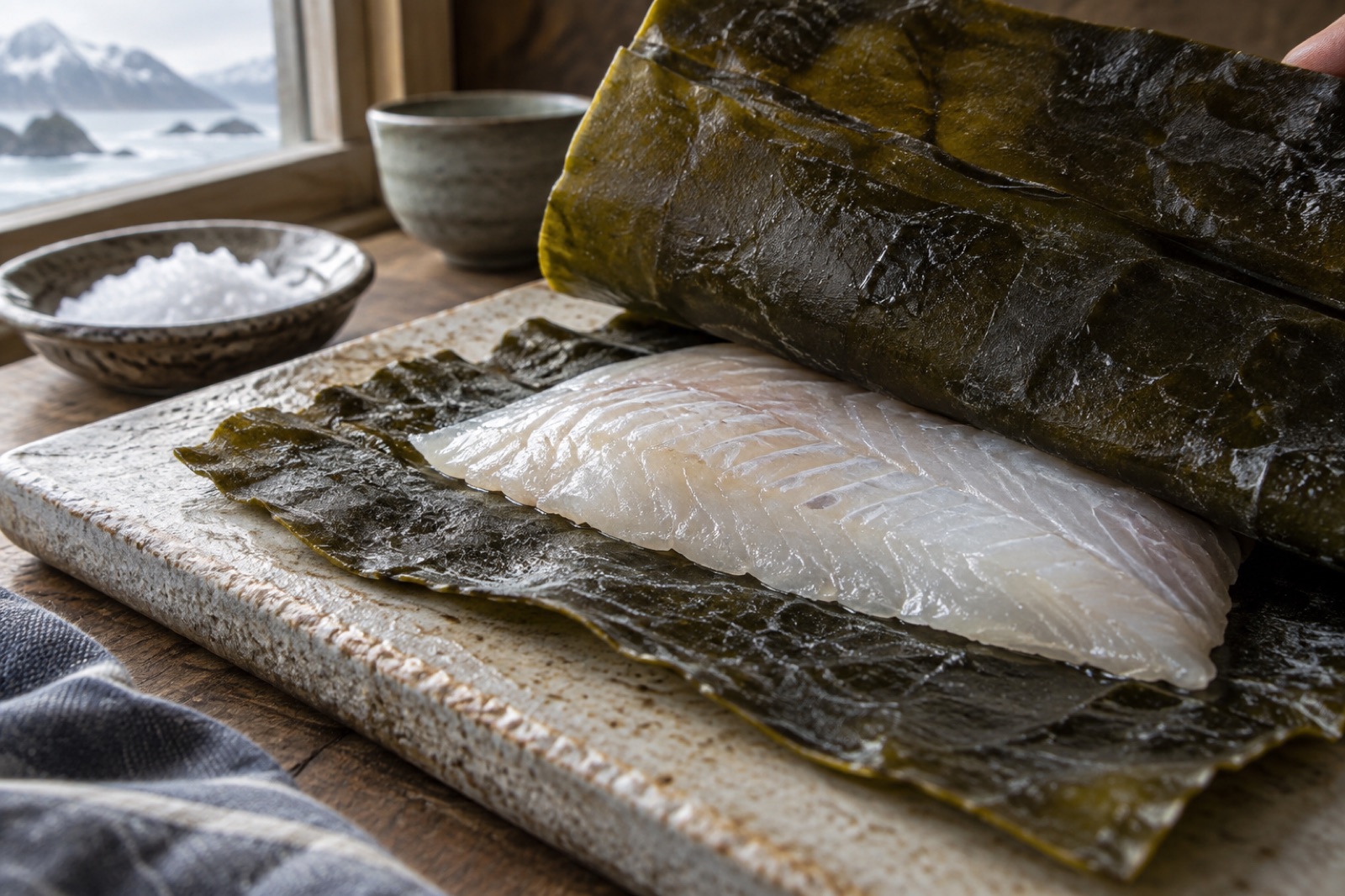
What restaurants do: Lay fish fillets between sheets of kombu for a few hours. The kombu's glutamates migrate into the flesh, firming its surface and seasoning it from the outside in. It reads as "the fish tastes more like itself."
At home: Sandwich a fresh, firm fillet — sea bream, sea bass, snapper, even good salmon — between two pieces of kombu wiped with sake or water. Wrap and refrigerate 2–6 hours for thin fillets, up to 12 for thick loins. Unwrap, slice, serve raw or sear hard and fast. No smoker, no sealer, nothing. The technique is centuries old, and the full method is in our kobujime guide.
The restaurant refinements that transfer:
What restaurants do: Turn a pale, elegant broth into a soft gel — set like the silkiest panna cotta — so a dot of it sits on a plate beside raw fish or vegetables and releases clean ocean flavour as it melts in the mouth.
At home: This is just stock plus a gelling agent, and agar — itself a seaweed product — is the natural choice. Agar sets firmly and holds at room temperature (unlike gelatin), so a seaweed stock gel will sit happily on a plate under warm fish without collapsing.
Where to use it: cubes alongside sashimi-style fish; fluid gel dots under grilled prawns; a set sheet cut into "noodles" and dressed like a salad — a genuine restaurant trick that takes ten minutes of work. Our agar-agar cooking guide covers the setting chemistry in more depth.
What restaurants do: Send out kelp butter or seaweed salt with a haunting, campfire-adjacent aroma. Sometimes it's a smoke gun; often it's just clever dry-toasting.
At home (no equipment version): Make a foil pouch. Put a thin layer of uncooked rice, tea leaves and a little sugar in a wok with a rack above; lay dried kombu or dulse on the rack, cover tightly with foil, and heat until smoke appears — then kill the heat and wait 5 minutes. That's the whole apparatus.
The zero-smoke version: Toast dried kombu squares over a gas flame with tongs for 20–30 seconds a side until they smell nutty at the edges and not burnt. Grind with flaky salt and toasted sesame. It's not smoke, technically — it's the Maillard edge of it — and at the table nobody can tell the difference. The homemade furikake formula is a perfect destination for toasted kombu.
What restaurants do: Serve poached fish under a glossy butter sauce with unmistakable sea depth, but no cream, no stock reduction, no shellfish.
At home: Replace some of the wine in a classic beurre blanc with a concentrated seaweed stock — the frozen cubes from a dashi concentrate batch are ideal — then mount with cold butter as usual. The stock's glutamates behave like a shellfish-fumet shortcut, and the sauce emulsifies exactly as it would with wine alone.
Why it works at a dinner party: the umami is unmistakable but unplaceable. Nobody guesses seaweed; everybody asks about the sauce. The underlying science — glutamate, inosinate and their synergy — is laid out in the science of seaweed umami, which is worth reading if you like knowing why things taste good.
What restaurants do: Finish dishes with a dark, savoury crumble that delivers crunch and a saline kick — the way pangrattato works on pasta, but coastal.
At home: Dry-toast panko breadcrumbs in a little kelp-infused oil or plain butter until deeply golden. Off the heat, fold in finely crumbled toasted nori (see toasting nori), a spoonful of dulse flakes (see the dulse flakes guide), lemon zest and a pinch of chilli. Season with seaweed salt rather than plain salt.
Where it lands: over steamed mussels, on top of a chowder instead of crackers, across grilled leeks, or on a simple bowl of buttered noodles. Keep a jar of it in the cupboard and it will disappear faster than any garnish you've ever made.
Every technique above follows the same three rules, and learning the rules matters more than memorising the recipes:
Seaweed rewards low, slow extraction and hates boiling. Whether stock, cure or infusion, heat beyond a simmer coaxes out bitterness and slime. Restaurants control this with thermometers; you can control it with patience.
Concentration is seasoning's best friend. A mild broth reduced by half, a salt ground with toasted kelp, a butter worked with dulse — small, potent carriers let you dose the ocean precisely instead of hoping a handful of wakame lands the note.
Pair seaweed with fat and acid. Glutamates shine against fat (butter, oil, egg yolk, sesame) and sharpen with acid (lemon, rice vinegar, wine). When a seaweed dish tastes flat, it's missing one of those two partners, not more seaweed.
None of this needs a lab. It needs good raw material — see our guide to buying seaweed sustainably — and the willingness to treat the sea vegetable as a seasoning system rather than a side dish.
Kombu. It carries the cure, the stock, the salt and the toast techniques all by itself, keeps for a year in a cupboard, and is the single highest-leverage item in the seaweed pantry starter kit.
Gelatin works but changes the dish: it melts at body temperature (nice in the mouth, but the cubes weep and collapse under warm fish) and isn't vegan. Agar holds firm up to about 40°C, which is why restaurants choose it for plated broths.
Yes, with care. Open a window, run the extractor, keep the foil seal tight and the smoking time under ten minutes. The aroma is closer to toasted tea than to a bonfire, and it dissipates quickly.
Almost always boiling. Pull kombu before the first simmer bubbles, and stop any reduction the moment a bitter edge appears — concentration amplifies bitterness faster than it amplifies umami.
The crumb. Fifteen minutes, pantry ingredients, keeps for a week in a jar, and transforms anything it touches. Start there; graduate to the gel.
How to cure white fish between sheets of kombu: the umami science behind kobujime, fish and kelp choices, timing, serving, and honest food-safety notes.
Sofia Andersson ·
Kombu led chemists to discover umami in 1908. How glutamate, ribonucleotides and salt work together — and how to use seaweed umami in everyday cooking.
Sofia Andersson ·
How to make seaweed stocks beyond Japanese dashi — Western vegetable broths, shellfish-kelp broths and ramen bases, with freeze-concentrates for the freezer.
Sofia Andersson ·