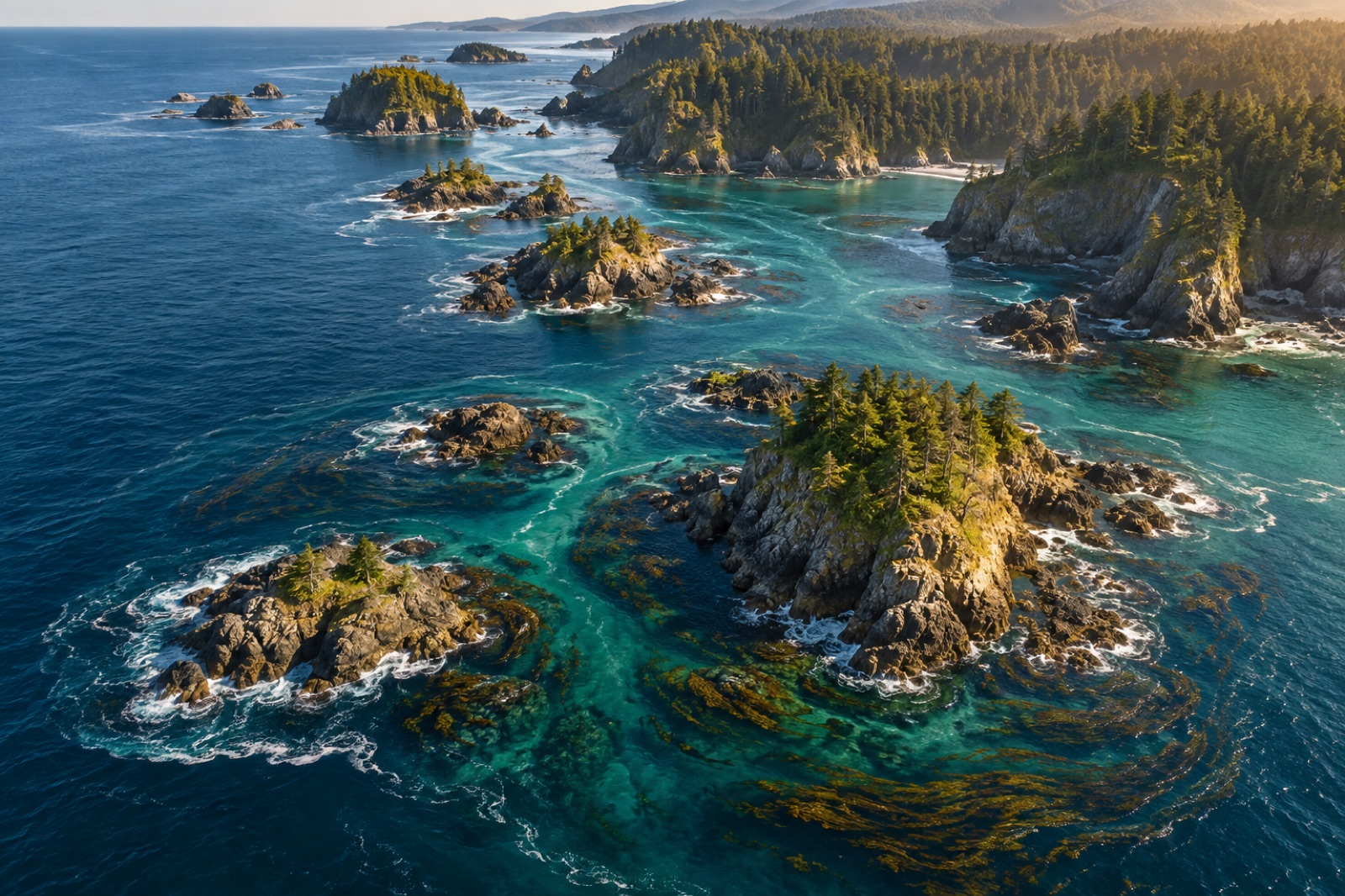
When a kelp forest dies — scoured by a heatwave, grazed to urchin barrens, buried in sediment — the question that decides its fate is geographical: how far away is the next forest, and can anything alive still make the trip? Every reef organism answers that question with a dispersal range, the characteristic distance its propagules can cross. Kelp spores and fish larvae, urchin larvae and abalone juveniles all play the same lottery with wildly different tickets. Understanding those distances — and the connections they weave between reefs — is the difference between a coast that heals itself and one that has to be reseeded by hand.
Dispersal is a curve, not a number
The first thing to retire is the idea of a single "dispersal distance." What biology produces is a dispersal kernel: a probability curve describing how many propagules land at each distance from the parent. For most marine species the kernel is steep — the overwhelming majority of offspring settle within metres to a few hundred metres of home — with a long, thin tail of rare long-distance travellers.
Both halves of the curve matter, for different reasons:
- The steep core governs local recovery. If a surviving forest sits a hundred metres away from a bare reef, recruitment will be heavy and recovery can begin in a single season.
- The thin tail governs rescue and gene flow. A handful of long-range propagules per generation is enough to recolonise a distant patch or keep populations genetically connected — but it cannot rebuild a decimated reef quickly, and it may not happen in a useful decade.
This is why "the reef will come back on its own" is sometimes true and sometimes wishful: it depends on which part of the kernel can reach the bare rock, and that depends on distance.
What sets the distance
Three things shape a marine propagule's travel range: how long it drifts, how the water moves while it drifts, and whether it does anything to help itself.
Time in the plankton
The single biggest lever is pelagic larval duration (PLD) — how many hours, days or weeks a larva spends in open water before it can settle. The spread across kelp-forest species is enormous, and it structures everything else:
- Kelp spores are the homebodies. Zoospores of giant kelp and its relatives swim for hours to a few days, and most settlement happens within tens of metres of the parent plant. Experiments and genetic studies consistently find effective dispersal on the order of metres to very rarely a few kilometres for the spores themselves — though fertile drift fragments, torn loose with reproductive tissue intact, can carry the species much farther, as explored in our piece on how kelp spores travel.
- Short-PLD invertebrates — many snails, some sea stars, brooding crustaceans — settle within metres to kilometres.
- Urchins, barnacles, mussels and many fishes spend weeks in the plankton. Their larvae routinely travel tens of kilometres, and modelled dispersal distances of 50–200 km are common for the long-PLD guilds. The same urchin whose adults carpet a barren may have been spawned on a reef three bays away.
- A few champions of dispersal — some lobsters, tunas, and drifting juvenile stages — connect reefs across entire basins.
The moving water
Duration sets the potential range; currents set the realised one. Alongshore jets, tidal residuals, upwelling-driven surface flows and eddies determine the direction and stretch of the journey, and they reverse, slacken and surge with season and weather. A larva released during a downwelling relaxation event may be carried forty kilometres alongshore; its sibling released a week later may wander in an eddy and settle behind its own parent. Connectivity is therefore not a fixed map of pipes between reefs — it is a time-varying, one-way, sometimes seasonal web, which is exactly how oceanographers describe it in marine connectivity.
Behaviour and buoyancy
Larvae are not passive dust. Many can swim vertically — well enough to choose between surface currents racing one way and deeper return flows; some kelp spores actively settle on crustose coralline algae and other chemical cues of good reef. Floating wrack, drifting fertile blades and rafting on debris extend ranges in ways plankton duration alone never would. Behaviour doesn't turn a homebody into a voyager, but at the margins it decides who makes landfall.
How scientists measure connectivity
You cannot tag a two-millimetre larva, so connectivity is inferred from several complementary lines of evidence:
- Population genetics. Gene flow leaves a signature. If two reefs share genetic variation freely, larvae (or drift) connect them; sharp genetic breaks reveal barriers — a point of river outflow, a water-mass front — that maps of current alone would miss. Parentage analysis goes further, matching juveniles to their literal parents and measuring real dispersal events one family at a time. Our overview of kelp population genetics covers the kelp side of this toolkit.
- Otolith chemistry. Fish ear stones accrete daily, encoding the chemistry of the water the fish swam through as a larva — a natural tag that can assign settlers back to nursery regions.
- Biophysical models. Ocean-current models seeded with virtual larvae, given realistic timing, duration and behaviour, simulate millions of journeys and produce connectivity matrices: the probability that reef A seeds reef B. These models are the workhorses of network planning, validated against genetics and otoliths where possible.
The strongest studies triangulate all three. Where models, genes and chemistry agree — as when genetic breaks align with modelled barriers — the map is trustworthy enough to plan around.
Why distance decides recovery
Connectivity converts a scatter of separate reefs into a metapopulation — a network in which occupied patches seed empty ones. That framing explains observed recovery patterns after marine heatwaves:
- Reefs within the steep core of a surviving source's kernel regrow quickly, sometimes within a season or two for fast-colonising kelps, following the succession sequence described in our piece on reef succession after disturbance.
- Reefs in the thin tail may be recolonised genetically but too slowly to matter on management timescales — a stream of rare settlers can't outrun urchin grazing or repeat heat events.
- Reefs cut off entirely — by distance, by a persistent front, by the loss of every upstream source — simply stay bare. These are the sites where natural recovery is decades away at best, and where restoration stops being assistance and becomes substitution.
It also explains the outsized importance of stepping stones: small, unremarkable reefs that shorten the effective hop between major forests. Lose them and the network's long links silently break — a key argument for protecting thermal refugia that sit mid-corridor, and for the network logic behind MPA network design.
Designing restoration around the dispersal map
For a restoration practitioner, connectivity science compresses into a handful of design rules:
- Restore inside the kernel where possible. A site a few hundred metres from a surviving, genetically suitable forest will seed itself; effort there goes to clearing urchins and preparing substrate rather than planting. The cheapest propagule is the one the ocean delivers.
- Match propagule supply to species. Site spacing that self-seeds an urchin's food web will not self-seed the kelp canopy; kelp's short range means reseeding — on skiffs, by divers, or with systems like Tidewright's fictional Holdfast seeded lines — often has to be done reef by reef.
- Plan for one-way corridors. Because currents are directional, a restored reef should ideally sit downstream of healthy sources and upstream of degraded ones, so it receives help and passes it on.
- Guard the tail. Long-distance connections maintain genetic diversity across the network, so restoration planning should protect stepping-stone reefs and avoid blocking migratory chokepoints.
- Mind provenance. When human hands move propagules beyond natural range, genetics decides what to move — locally adapted seedstock balances fitness against the case for assisted migration of warm-adapted genes.
Connectivity, in short, is the operating system under every restoration decision — invisible in any single dive, decisive across a coastline.
Key takeaways
- Dispersal is a kernel, not a number: heavy settlement near home, plus a thin tail of rare long-range travellers that drives rescue and gene flow.
- Pelagic larval duration sorts kelp-forest species from homebodies (kelp spores: metres to a few kilometres) to voyagers (urchin and fish larvae: tens to hundreds of kilometres).
- Realised connectivity depends on time-varying, often directional currents — measured with genetics, otolith chemistry and biophysical models, ideally in combination.
- Recovery after disturbance is fastest inside a source's kernel; isolated reefs may stay bare without intervention, and stepping-stone reefs hold the network's long links together.
- Restoration design should exploit natural seed supply where it exists, sit sites downstream of healthy sources, and only move material with attention to provenance and genetics.
FAQ
How far can a kelp spore actually travel?
Most kelp zoospores settle within tens of metres of the parent, and genetic studies generally find effective spore dispersal on the scale of metres to a few kilometres. Longer jumps happen, but usually via fertile drift fragments or rafts rather than swimming spores — which is why a bare reef kilometres from the nearest forest rarely reseeds itself quickly.
If urchin larvae travel 100 kilometres, why don't barrens fix themselves with new kelp?
Because the kelp is the short-range player. Urchins can recolonise anywhere; kelp spores can't reach from far away. After a coast-scale heatwave kills the source forests, the herbivores arrive long before their food does — one reason barrens persist, and why distant, isolated sites need deliberate reseeding.
What is a "connectivity matrix"?
A table — usually built from biophysical larval models and checked against genetics — giving the probability that larvae released at reef A settle at reef B, for every pair of reefs. It turns currents and larval behaviour into an actionable planning map: which sites are sources, which are sinks, and which links a protected network must preserve.
Does warming change dispersal distances?
Yes. Larval development generally speeds up in warmer water, shortening pelagic duration and thus dispersal range; currents, stratification and spawning season also shift. Many researchers expect connectivity networks to effectively shrink and rewire as oceans warm — shrinking the radius within which reefs can rescue one another.
How does Tidewright use connectivity science?
Our (fictional) site selection combines biophysical connectivity modelling with population genetics to pick reefs that can both receive and pass on propagules — the logic behind Drifter survey routing and the spacing of restored patches across the programs on our projects map. The modelling methods described here are standard practice in applied marine science.