The northern fur seal (Callorhinus ursinus) is the most pelagic seal of the North Pacific — an eared seal that spends most of its year far from land, sleeping in a famous one-flipper-up posture on the open swell and feeding by night on prey that rises toward the surface after dark. Yet the species is defined by land: in summer, the breeding population abandons the open ocean and crowds onto a handful of island beaches, most famously the fog-bound Pribilof Islands in the Bering Sea. Between those two worlds — pelagic drift and colony bedlam — lies one of the great conservation stories: humankind nearly killed this seal off for its coat, then, in 1911, designed the first international wildlife treaty in history to save it.
Quick facts
|
|
| Scientific name |
Callorhinus ursinus — the only species in its genus |
| Common names |
Northern fur seal; sometimes just "fur seal" in older North Pacific usage |
| Range |
Entire North Pacific: pelagic from the Bering Sea south to California and Japan; breeding concentrated on the Pribilof, Bogoslof, Commander and Kuril Islands, and Russia's Tyuleniy Island; a small colony on San Miguel Island, California |
| Habitat |
Open ocean most of the year; crowded rookery beaches in summer |
| Size |
Extreme sexual dimorphism: adult males to roughly 2.1 m and 270 kg; females closer to 1.4 m and 50 kg — males commonly five times the female's weight |
| Diet |
Schooling fish and squid taken mostly at night: anchovies, herring, pollock, lanternfishes and squid that migrate toward the surface after dark |
| Reproduction |
Highly territorial bulls hold rookery ground June–August; delayed implantation means mating follows a birth; females alternate nursing with multi-day feeding trips at sea |
| Fur |
Among the densest pelage of any mammal — the quality that nearly exterminated the species |
An ocean animal that rents its beaches
Most seals are coastal animals that touch deep water occasionally. Northern fur seals invert the pattern: they are oceanic animals that touch coast only to breed. Pups born on a Pribilof beach in July are weaned by late autumn and head to sea; they may not touch land again for years. Adult females spend roughly eight months annually at sea. Even adult males spend their off-season pelagic, hundreds of kilometres offshore.
What looks improbable from shore becomes sensible in the water column. The seal's night hunting matches the diel vertical migration: squid, lanternfish and small schooling fish rise by dark, and fur seals meet them there with dives usually tens of metres deep — far shallower than a Steller sea lion's — repeated hundreds of times a night. Daytime is for resting at the surface in the "jug handle" position: body curled, one fore-flipper raised vertically to shed excess heat into cool air.
The kelp it touches along the way
Though northern fur seals live mostly beyond the kelp line, their non-breeding life overlaps the kelp coast obliquely and constantly. Young seals riding the continental drift south from the Bering Sea winter over productive shelves — the same shelves that skirt the Commander Islands, the Aleutians, British Columbia's inside passages and northern California's redwoods-to-kelp coast. Observers have long noted young seals rafting among drifting kelp fronds, using the floating weed as a rest platform the way young sea turtles use sargassum. A kelp-bound headland in Alaska's gulf will sometimes hold an adolescent fur seal resting offshore in the kelp slick, kelping its way south.
The strangest footprint on the kelp coast is San Miguel Island, the westernmost of California's Channel Islands and one of the richest giant kelp grounds on earth — and also the site of a small, persistent northern fur seal colony that researchers have watched for decades: seals breeding far south of their ancestral range, on an island ringed by the forests they don't feed under. Whether San Miguel is a relict, an outpost, or an early experiment in range shift, nobody quite knows; what it does demonstrate is that the species will try a kelp coast when conditions allow.
The closest shave any seal has had
The northern fur seal's history with humans is stark and unusually well-documented. Its luxurious underfur makes a coat that seals like few others; commercial sealing from the eighteenth century onward killed millions, treating rookeries as extraction sites. Pelagic sealing — shooting them at sea from spearing boats — made by-catch even worse. By the early twentieth century the breeding colonies had collapsed toward exhaustion, and the species faced the arithmetic of animals that produce one pup at a time.
In 1911, the United States, Russia, Japan and Britain (representing Canada) signed the North Pacific Fur Seal Convention, ending pelagic sealing and apportioning harvest on land. It is widely credited as the first international treaty for wildlife conservation and a genuine outlier: an early case of nations restricting a profitable hunt on scientific grounds. Protection plus a land-based harvest transformed the species' trajectory — its population recovered through the mid-twentieth century to numbers measured in the millions.
Then the story took its more modern turn. From roughly the 1950s onward, Pribilof pup production began a long decline that has been attributed variously to entanglement in fishing gear and marine debris, shifts in prey associated with climate-driven ocean change, competition with fisheries, and subtle mortality increases at sea. Pieces of evidence support each; no single suspect explains the curve. The species is still numerous — but the Pribilof stock remains a fraction of its peak, and the proven possibility of collapse is a standing caution against treating "recovered" as permanent state.
How to tell it from its neighbours
At distance, the northern fur seal reads as a sea lion with fur too thick and colours too rich: males carry a pale, grizzled mane over huge shoulders; females are soft grey-silver with a pale chest; both have the otariid profile of visible ear flaps and long fore-flippers, but the hind flippers are strikingly long — proportionally the largest of any eared seal, adapted for the species' thermoregulation vogue of holding them aloft at the surface. The pointed face, big dark eyes and the absence of the sea lions' bluff forehead narrow it further. Behaviour separates them at sea: the raised single flipper ("jug handle") is essentially diagnostic.
Key takeaways
- The northern fur seal is the North Pacific's most pelagic eared seal, spending roughly two-thirds of its life at sea and breeding on a handful of island rookeries.
- Feeding on night-rising squid and small schooling fish over continental shelves, its diving peaks in the dim upper few hundred metres.
- The fur trade nearly exterminated it by the early 1900s; the 1911 North Pacific Fur Seal Convention — history's first international wildlife treaty — enabled its recovery.
- Pribilof production has declined since the mid-twentieth century under pressure from entanglement, prey shifts and changing oceans — a caution that even protected populations need watching.
- Although oceanic, the species touches the kelp coast at sea and, improbably, at its San Miguel Island outpost among giant kelp forests.
FAQ
Are northern fur seals sea lions or true seals?
They are eared seals like the sea lions — family Otariidae — with visible ear flaps and long fore-flippers used for rowing locomotion. Their dense underfur and specialised pelagic habits set them apart. They are the only living species in their genus.
How deep do northern fur seals dive?
Most feeding dives stay within the upper few hundred metres and are typically much shallower, because the prey comes upward at night via the vertical migration. The species is a night-shift specialist of the near-surface, not a deep diver on the elephant-seal model.
Why did the Pribilof population decline after the treaty worked?
No single cause is settled. Contributing pressures have included entanglement practices (seals caught in net fragments and debris), prey redistribution under climate-driven ocean change, and fisheries relationships. The decline illustrates how cryptic mortality across open-ocean years can accumulate.
Can you see northern fur seals from shore?
Summer on breeding islands, yes — notably permitted viewing on Alaska's Pribilofs during the rookery season. Elsewhere the species is pelagic; along the kelp coast they appear offshore in winter, mostly invisible to land-based watchers without boat trips.
What's their relationship to sea otters?
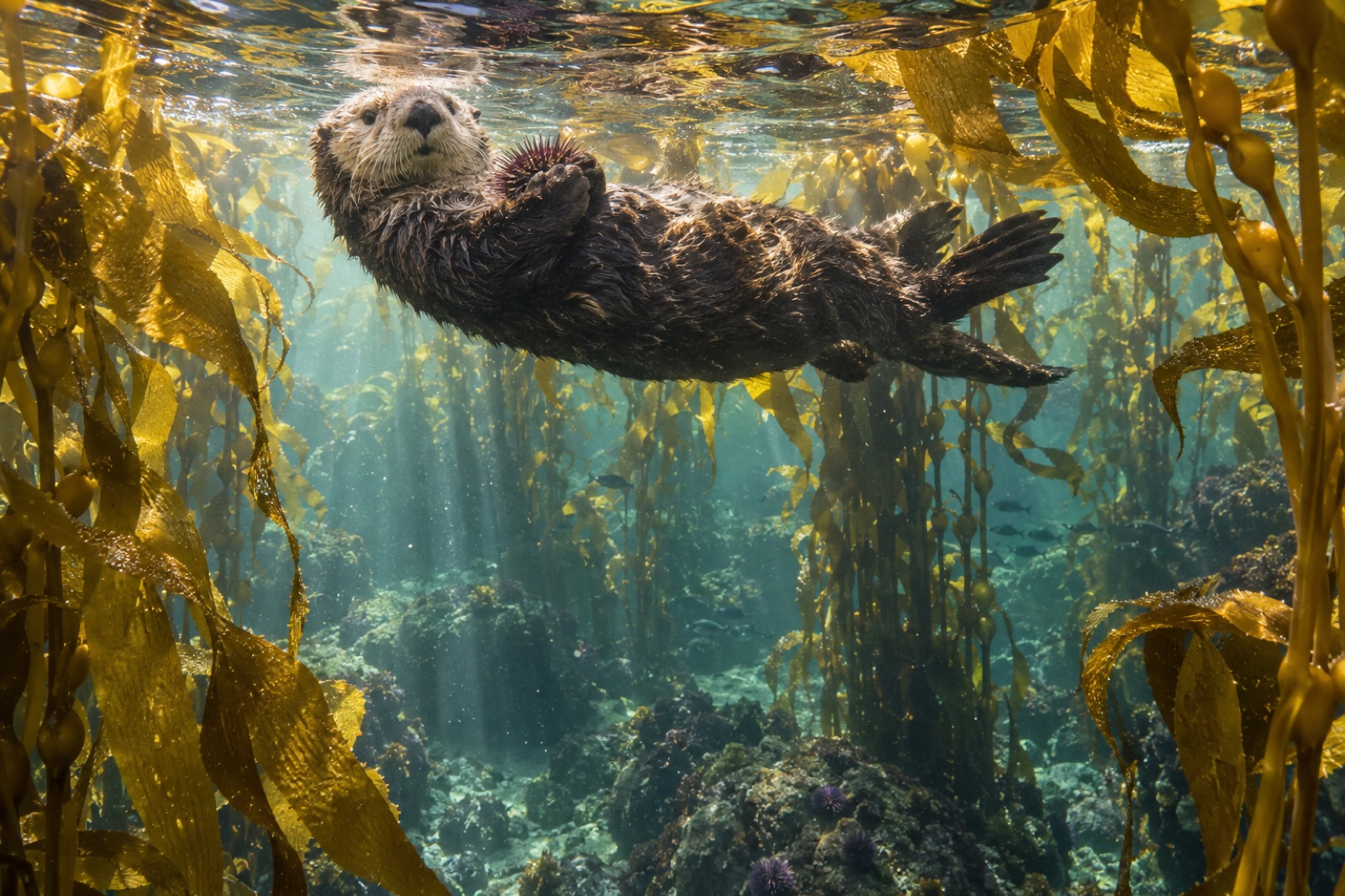
Ecologically distant despite the shared "fur seal" name. Sea otters are mustelids — kelp-forest nearshore residents with the densest fur of any mammal. Northern fur seals are otariid eared seals, oceanic and, by history, the pelt that built and nearly ended an industry.