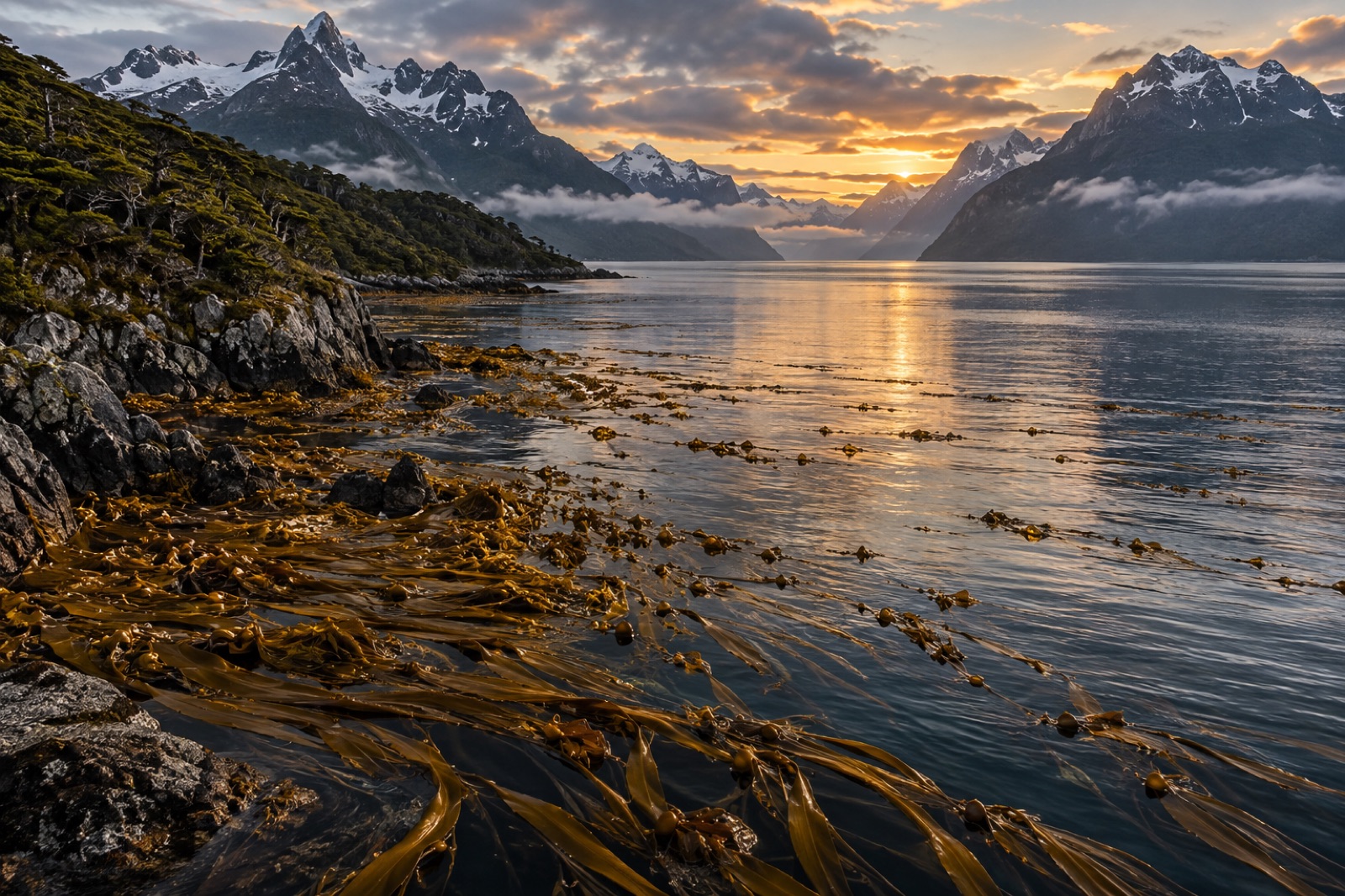
There is a strait at the bottom of South America where the Andes finally lose their argument with the sea and slide beneath it. The Beagle Channel runs about 240 kilometres east–west through Tierra del Fuego, separating the big island from the scatter of smaller Chilean islands to the south, with the Argentine city of Ushuaia on its north shore and Chile's Puerto Williams — the southernmost town in the world — opposite. What matters most here grows along the rocky shoreline: dense, calm-water forests of giant kelp that so struck a young Charles Darwin that he compared them to tropical rainforest. This guide covers the channel's ecology, its human history, and how to experience the forest for yourself.
Where the Andes meet the sea
Geologically, the Beagle Channel is a flooded fault: a tectonic valley carved by glaciers and drowned when the ice retreated, which explains its almost unnatural straightness. East–west channels are rare in this region of north–south fjords, and that orientation gives the strait its character — a marine highway running from the Pacific-influenced Fuegian channels in the west to the open Atlantic at its eastern mouth.
The water is cold year-round, roughly 4 °C in winter and up to about 9 °C under the summer sun, and famously green with plankton in the long days. Tides are modest by Patagonian standards, the shores are sheltered by headlands and islands, and the seabed is a gift for kelp: hard glacially polished rock stepping down in terraces. If you have read our guide to the Strait of Magellan, the next strait north, the recipe will be familiar — the Beagle is the same kitchen, better lit.
Darwin's aquatic forest
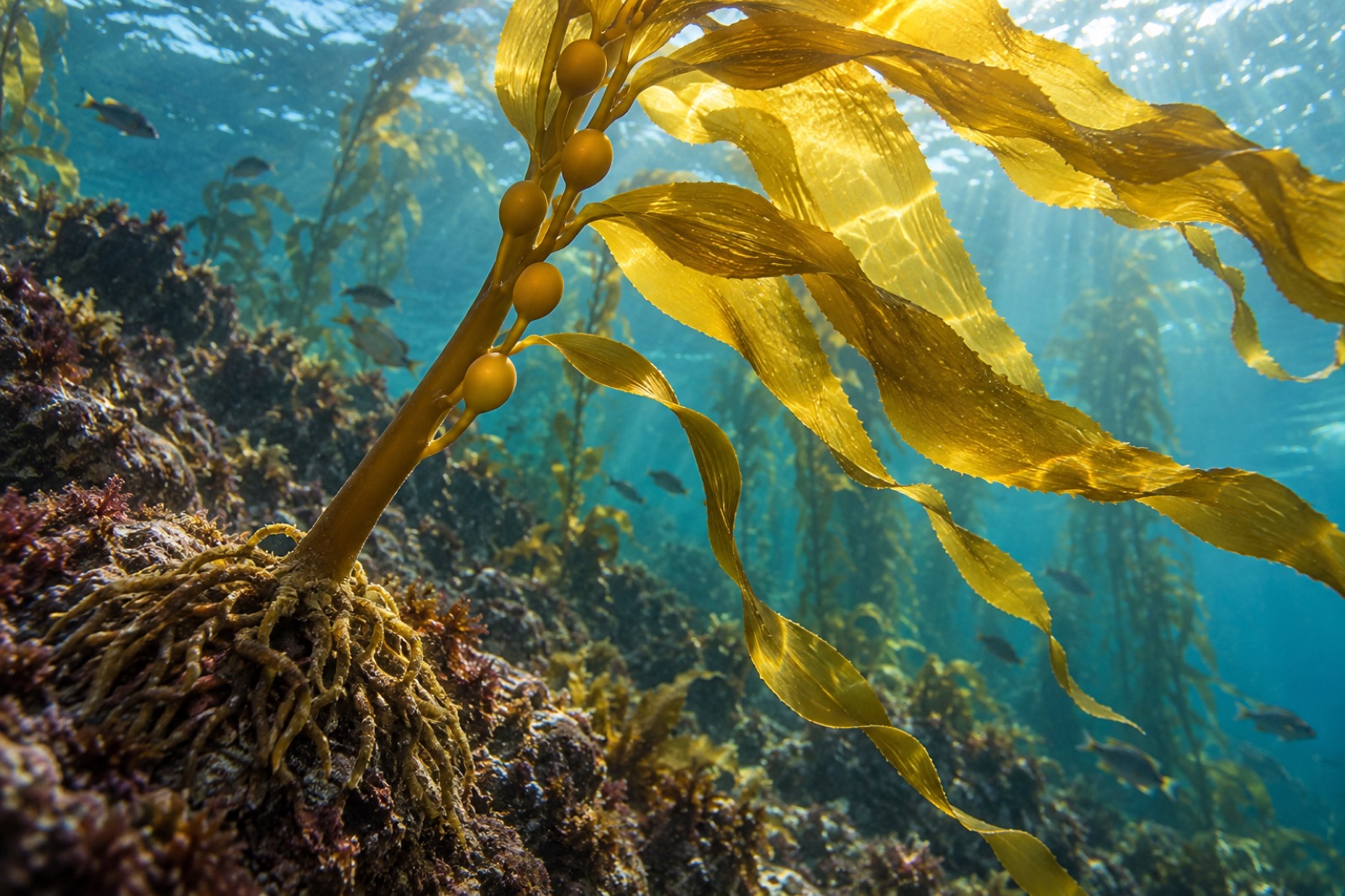
HMS Beagle worked these waters in 1832–34, the strait named for the ship rather than the other way round, and Captain Robert FitzRoy's surveys put the region on charts for the first time. On board was a twenty-something naturalist who spent his shore time waist-deep in tide pools. In his published account of the voyage, Darwin marvelled at the giant kelp of Tierra del Fuego: "The number of living creatures of all Orders, whose existence intimately depends on the kelp, is wonderful" — adding that he could compare these great aquatic forests only with the terrestrial forests of the tropics. It is nearly two centuries later, and marine ecologists essentially agree.
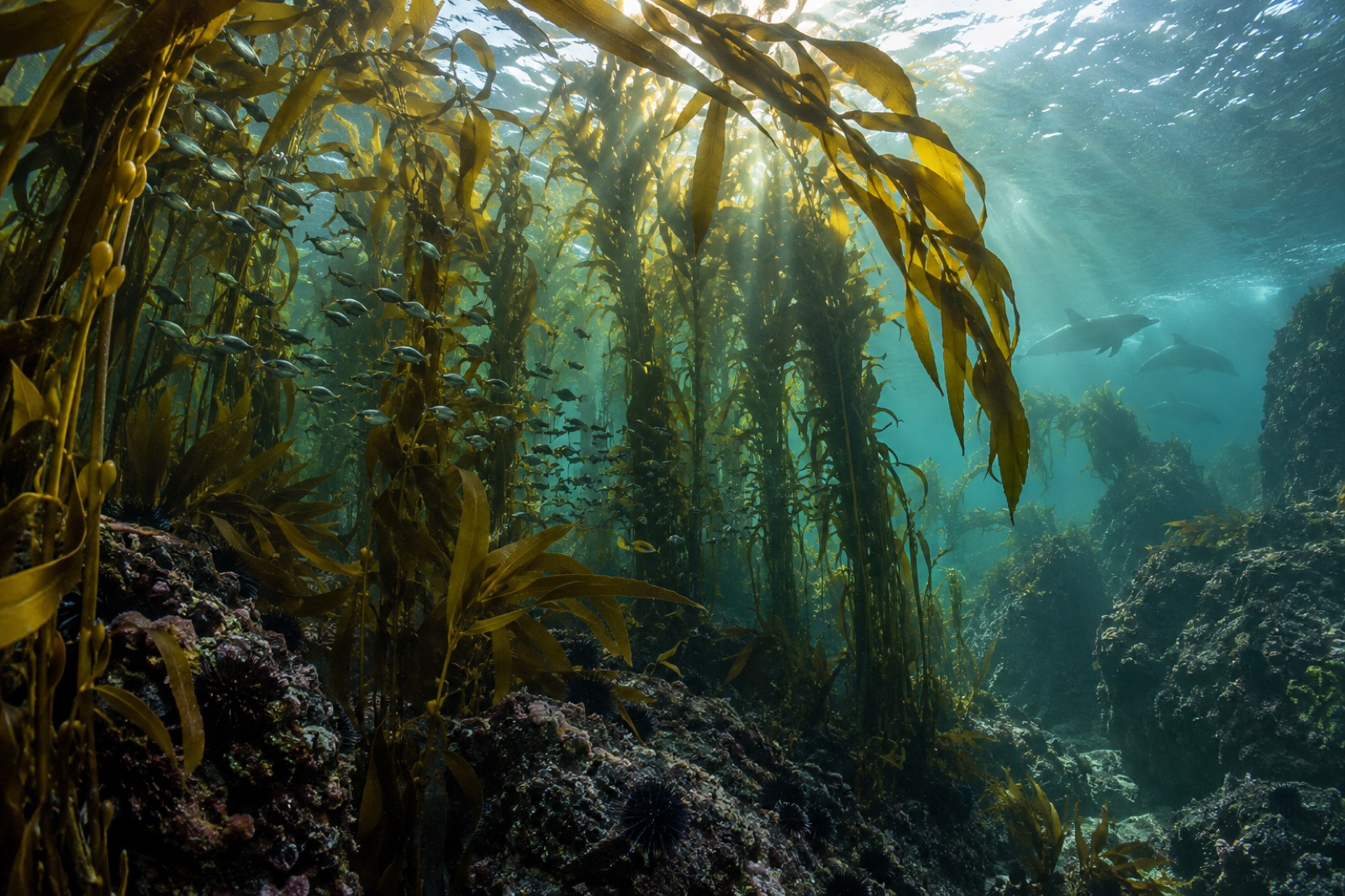
The kelp in question is Macrocystis pyrifera, giant kelp, and in the Beagle it grows to extravagant density: fronds thirty metres long coiling through temperate, ice-scoured water, canopies thick enough to slow a boat. On the exposed outer coasts, leathery southern bull kelp — cochayuyo, Durvillaea antarctica — takes over the surf line, gripping rock through swell that would strip the giant kelp flat. Kerguelen aside, the Fuegian systems may be the largest continuous subantarctic kelp forests on the planet; research has even suggested their genetics are distinctive enough to be a conservation priority in their own right.
Between the blades, the cast is a subantarctic roll-call: large herbivorous green sea urchins (Loxechinus albus, the erizo of local markets), southern king crab (the celebrated centolla), kelp geese and flightless steamer ducks working the kelp fringe, the endangered southern river otter, Peale's and Commerson's dolphins, and South American sea lions hauled out on the channel's islets. Leopard seals come up from Antarctica often enough that they are a listed possibility rather than a rumour.
The sea nomads of the channel
For several thousand years before the Beagle arrived, the channel belonged to the Yámana, a canoe-faring people who may have been the most maritime culture on Earth: families lived in bark canoes, kept small fires burning on a bed of clay amidships, and travelled the kelp lanes fishing, diving for shellfish and hunting sea lion, naked or in loosed sea-lion skins in water that kills an unprotected swimmer in minutes. Their shell middens still line the shores — thousands of years of mussel suppers stacked in the peat.
Contact with Europeans, conducted at the speed of infectious disease, collapsed the population within a century of the Beagle voyages. Today a small community of Yámana descendants lives around Puerto Williams, and the work of recovering language, genealogy and reef-side memory continues — including collaborative science documenting the kelp-forest food web their ancestors managed from canoes. Any honest account of the channel starts with the same acknowledgment: this forest was not discovered; it was lived in.
Reading the water today
The modern channel is shared, worked and argued over. Small-scale fishers take centolla and erizo under quota on both sides of the border — Chilean law divides the south into management areas, Argentine Tierra del Fuego keeps its own rulebook. Sea lice and salmon farming pressures that dominate news from the Chilean Patagonian fjords have met unusual resistance at the channel: in 2021 the Argentine province of Tierra del Fuego banned net-pen salmon farming in its waters entirely — a national first — explicitly to protect the Beagle ecosystem. Mussel farming on small rafts, dive fisheries, tourism and conservation patrols make up a mixed working waterfront that would be recognisable to readers of our Chile Humboldt coast guide, minus the desert.
The channel's kelp, meanwhile, does its quiet carbon arithmetic — fixing carbon in the canopy, shedding blades to the deep basin and the shore. The pathways are the ones we map in where kelp carbon goes, with one Fuegian advantage: the water offshore slopes away fast, and a meaningful fraction of what the forest sheds has a short trip to the deep sea.
Visiting: cities, boats and bubbles
Ushuaia is the gateway: an airport, hotels at every standard, and a working harbour shared by expedition cruise ships, fishing boats and yachts attempting Cape Horn. From here, half-day boats run the channel east to the sea-lion islets and the much-photographed Les Éclaireurs lighthouse, and longer trips reach Estancia Harberton, the region's oldest ranch, with its marine-mammal museum.
Under the kelp: local operators run guided dives and snorkels straight into the forest — the rare subantarctic kelp dive with a café at the end. Water is 4–9 °C; drysuits (or serious wetsuits) are standard, and the long austral winter offers the clearest visibility. Our cold-water dive gear guide and the ethics notes in wildlife ethics in the kelp both apply.
Over it: sea kayaks day-trip from Ushuaia into the sheltered arms of the channel, kelp brushing the hull; crossing to Navarino is for guided expeditions only — weather here does not negotiate.
Season: October to March for services and daylight; winter is cold, closed, empty and, by all accounts, beautiful.
On Tidewright's fictional illustrative roadmap, the Beagle is exactly the kind of intact reference forest — alongside the Falkland Islands — that calibrates what "recovered" should look like for damaged coasts further north: canopy extent, understory density, carbon export. Our Canopy Ledger concept exists, in the story, to measure precisely those things.
Key takeaways
- The Beagle Channel is a glaciated tectonic strait running 240 km between the Andes and the sea, dividing Argentina's Tierra del Fuego from Chile's southern islands.
- Giant kelp grows here at extraordinary density in calm, 4–9 °C water; Darwin's published journal compared these forests to tropical rainforest.
- The Yámana people lived as canoe-borne sea nomads in the channel for millennia; descendants and researchers are rebuilding that heritage today.
- The channel supports centolla king crab and erizo fisheries, and Argentina's Tierra del Fuego banned salmon farming in 2021 to protect it.
- Ushuaia offers genuine cold-water kelp diving and snorkelling — the most accessible subantarctic kelp forest experience in the world.
FAQ
Can you really dive in the Beagle Channel?
Yes. Dive operators in Ushuaia run guided kelp-forest dives and snorkels year-round, with drysuits provided. Water temperatures run 4–9 °C and visibility peaks in the austral winter. It is cold-water diving, but among the most accessible kelp forests in the Southern Hemisphere.
What did Darwin actually say about the kelp?
In his account of the Beagle voyage, published in 1839, Darwin wrote that the number of creatures whose existence depends on the kelp is "wonderful", and compared the aquatic forests of Tierra del Fuego to tropical rainforests — an early recognition that kelp forests are foundational ecosystems, not just seaweed.
Who were the Yámana?
The Indigenous canoe-faring people of the Fuegian channels: sea nomads who lived on the water, dove the kelp forests for shellfish and sea lion, and maintained fires in their canoes. Their population was devastated within a century of European contact; a descendant community persists around Puerto Williams.
Is king crab native to the Beagle Channel?
Yes — the southern king crab (Lithodes santolla, centolla) is native to the cold waters around Tierra del Fuego and is fished sustainably under quota. It is a regional delicacy; the king crab invasions you read about are a different, introduced situation in the Barents Sea.
When is the best time to visit?
October to March, when services run and days are long. Summer water reaches about 9 °C; winter brings the clearest diving but very limited operators. Bring waterproofs regardless of the calendar.