Atlas8 min read
Kelp Forests of Monterey Bay: A Coastal Atlas Guide
Monterey Bay holds some of North America's most accessible giant kelp forests — a canyon-fed, otter-patrolled ecosystem you can dive, kayak or watch from shore.
Dr. Theo Nakamura ·
Carmel Bay pairs giant kelp with some of California's oldest marine protection. Explore its reefs, Stillwater Cove and what decades of sanctuary bought.
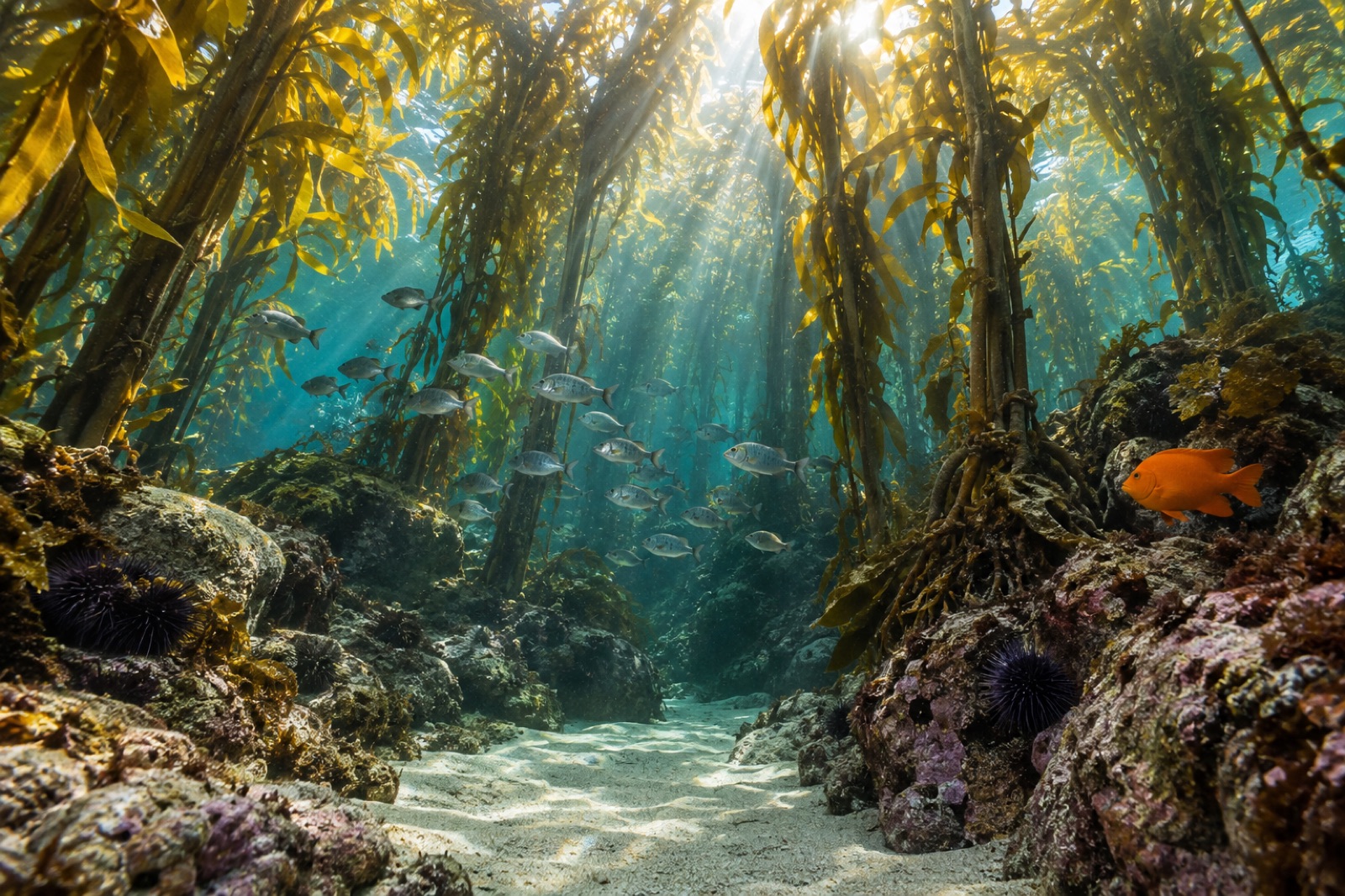
On the Monterey Peninsula's sunny south shoulder there is a bay where the giant kelp never really left. Carmel Bay curves in a pale crescent between Carmel's famous white beach and the granite battlements of Point Lobos, and under its milky-green water lies something quieter than either landmark: a reef community that has had more continuous protection, and more patient study, than almost anywhere on the Central California coast. Where neighbouring Monterey Bay is the region's auditorium — big, theatrical, whale-famous — Carmel Bay is the library. This guide covers its laid-out reefs, its remarkable protective history, and how to get under the water that decades of care have kept standing.
Carmel Bay looks simple from the coastal road: sand in the middle, rock at both ends. Underwater, the map reverses. The sandy middle is a conduit — the offshore end of the great Monterey submarine canyon system swings surprisingly close inshore here, dragging deep, cold, nutrient-rich water within a stone's throw of the beach. On the bay's rocky margins, that structural wealth builds reefs.
The southern edge is the famous one: Point Lobos and its kelp-cathedral walls. The northern edge, past Pebble Beach's headlands, gives way to the granite capes of Stillwater Cove. In between, low-relief reef fingers run through the bay itself — pinnacles and rock platforms at eight to twenty metres that carry the main kelp beds. The bed network is not continuous forest so much as a gorgeous patchwork: individual groves separated by sand lanes, each with its own roll call of fish, urchin custodians and resident otters.
Kelp here grows in the classic exposure gradient the region's science has described for a century: canopy-stranding giants on the outer shelves, stalked kelp understory on the mid-depth reef, coralline-pink rock in the surge-washed shallows. The water stays cold — ten to fifteen degrees Celsius across the year — because deep canyon-fed upwelling keeps nutrients arriving through the season when the shallows elsewhere starve. Our explainer on upwelling covers the physics; Carmel Bay is the physics with scenery.
Protection is Carmel Bay's defining feature, and it is not new. The Point Lobos headland and its adjacent waters passed under formal protection in stages from the mid-twentieth century onward; Stillwater Cove and the bay's kelp grounds sit within the modern Carmel Bay conservation area designated under California's Marine Life Protection Act, with take rules layered on a coast already long managed with unusual care. The result is not a pristine postcard preserved behind glass — this is a working, watched coast with real fishing history, real kelp-harvest memory and real pressure rebounding — but it is a place with an uninterrupted fifty-odd-year record of what happens when a coast gets to heal.
What got to heal, it turns out, is depth of age. Rockfish here reach the sizes of the dealer's-license era. Black-and-yellow and grass rockfish hold shallow territories undisturbed for years. Sea otters — whose recovery arithmetic began along this very stretch — pack the canopy lanes in numbers that make Carmel a reference population for the state. The urchin management arithmetic is run by otters and by sheephead and lobsters in the deeper water, and the result reads clearly in the reef: urchin barrens here are accidents to be studied, not default landscapes.
Long timelines matter in kelp science more than almost any other field, because kelp is fast. A forest can sail through a good decade and collapse in a bad two years; without decades of context you cannot tell signal from weather. The long Central Coast records — in which Carmel Bay's counts are some of the synoptic anchors — are what let researchers show that marine heatwaves are real events with specific fingerprints, and that places with intact predator webs suffer those events differently. Carmel is where several of those fingerprints were first read.
The forest here runs on giant kelp (Macrocystis pyrifera), the surface-canopy architect, with all the structural layering a mature bed carries. Under it, stalked kelp (Pterygophora californica) fills the understory with its strange mahogany trunks; feather boa, whispering understory browns and red algae fill the lower light. This layering is why divers remember Carmel groves as rooms — canopy overhead, stipe-columns at chest height, blade-fields as the floor.
Each grove grows its own personality. The outer beds at Stillwater are wider and wilder, exposed to northwest swell, washed clean and growing fronds like a storm-forged wall. The groves in the bay's middle water sit in calmer lanes and can be season to season the most becalmed, clearest light the coast offers. The beds off the south shore, strung toward Lobos, carry the region's best-documented reef fish communities. A patient diver willing to sit in one grove for an hour may watch a harbour seal ghost through the canopy columns, a cormorant dive-bomb past overhead, and beneath them the entire small economy of kelp-bass, surfperch and nudibranch life ticking along.
The good news: Carmel is also genuinely accessible, in a way Big Sur to the south is not.
Stillwater Cove, off the Pebble Beach headland at the end of the white beach drive, is the classic. A concrete pier, easy parking, an easy walk-in entry and a small boat hoist make it one of California's most civilised shore dives. The kelp starts in four metres and runs out to about twelve inside the cove, deeper on the point; the bed is small enough to learn and beautiful enough to return to for years.
Boat dives out of Monterey or the Monterey Moss Landing harbours reach the bay's middle groves and the pinnacles off Pescadero Rocks in about fifteen minutes — this is where the reef walls, the wolf-eel dens and the big resident rockfish live, in twenty to thirty metres with room to roam. Point Lobos proper, over the hill by the south gate, is the prideful cousin: reservation-required, limited by diver days, and worth planning a month ahead.
Water temperature ten to fifteen degrees year-round. Visibility runs three to twelve metres, best in autumn, worst when the canyon is running sediment after storms. Autumn — September through November — is the golden window; spring runs windy and silty as upwelling restarts. Before any trip, read the forecast like a diver; Carmel's weather is kinder than the coast around it, but it is still the Central Coast.
From the top, the kelp is a walker's gift. From Carmel Beach's south end and from the stairs above Point Lobos you can watch otter rafts, canopy geometry and gray-whale migration closer than anywhere this easy to reach.
Scale and mood. Monterey is the region's big, famous water — vast beds, pelagic megafauna, the canyon — while Carmel is smaller, more protected and more intimate, with groves you can learn by name. They share the same ocean; a single week gives time for both.
Yes — as shore dives on the Central Coast go, it is among the kindest. Concrete stairs at the pier, a straightforward tide-free entry, a gently sloping reef and kelp starting in four metres. Local dive shops run guided acquaints; certification or a professional guide is the sensible prerequisite.
In reliable abundance — the Monterey Peninsula population, one of the densest on the coast. Bring patience and distance: watch from outside the canopy edge, never crowd a raft, and read our guide to watching sea otters without bothering them before you go.
No bay-wide permit; Point Lobos requires a separate dive reservation, and parts of the coast have take rules under the local conservation area — always check the current regulations. The water itself, accessed from Stillwater or a charter, is broadly open to divers.
Like flying through a house of light. Giant kelp columns in ranks, sunlight falling in beams through canopy gaps, surfperch scattering through your exhalation, and the occasional oarweed-like Pterygophora understory that reads as mahogany pilings. It is the reference version of what a Central California kelp grove is supposed to feel like.
Monterey Bay holds some of North America's most accessible giant kelp forests — a canyon-fed, otter-patrolled ecosystem you can dive, kayak or watch from shore.
Dr. Theo Nakamura ·
Point Lobos limits divers to a handful of reserved buddy teams a day. How to get a slot, dive Whalers Cove's kelp, and respect California's oldest rules.
Tom Okafor ·
Anacapa is the nearest of the Channel Islands — an hour from Ventura, a world away underwater. Its kelp beds, conservation wins and how to dive them.
Tom Okafor ·