Atlas8 min read
Kelp Forests of the Oregon Coast: Bull Kelp on the Edge
Oregon's bull kelp rides one of the wildest upwelling coasts on Earth — and its southern forests are on the edge. A guide to the reefs and the fight back.
Dr. Theo Nakamura ·
Cape Arago's sandstone reefs hold Oregon's best tidepools, a sea lion haulout, and bull kelp gardens shaped by wild storms. A coastal atlas guide.
Fifteen miles southwest of Coos Bay, three Oregon state parks sit back-to-back on a tilted shelf of sandstone: Sunset Bay, Shore Acres and Cape Arago. They are separated by less than three miles of road but they are three different faces of the sea — a calm yellow-sand cove, a landscaped garden whose cliffs catch monster waves, and a wild headland with the loudest pinniped chorus on the Oregon coast. The whole complex is hemmed by Oregon's most accessible living reef: broad ledges of weathered sandstone, a rim of bull kelp, and tidepools that rate with the best on the Pacific coast. This guide covers the geology, the kelp and the practicalities.
Cape Arago's submarine terraces are built of the Coaledo Formation — sandstones and siltstones laid down in Eocene deltas some 40 million years ago, then tilted, lifted by the Cascadia subduction zone's periodic jolts, and planed flat by ten thousand years of Pacific waves. The result is a shoreline of layered ledges that weather into rectangles and pools, like a sunken ruin. Flat, tidal, and pocked with cracks that trap water at low tide, the sandstone offers everything a tidepool community needs: microhabitats, wave shadow, and a rough surface the holdfasts of kelp and rockweed can grip.
As almost everywhere on the open Oregon coast, the dominant canopy is bull kelp. It grows not in the calm inside of Sunset Bay but on the outer ledges and boulder fields around the cape — on the seaward fringe of Simpson Reef, and on the reefs south of the headland where the swell refracts and concentrates. In late summer the canopy stands thick and golden on the horizon-side of the rocks; in winter, storms strip it to stipes, and the gardeners of the low intertidal — sea palms on the most exposed rocks, rockweeds in the middle, and the deep red of turf algae below — take over.
The annual breath of bull kelp is worth watching here precisely because Cape Arago's shoreline is so battered: storms both remove kelp and, in a good year, bury some of it back on the beaches as wrack that feeds the shore community. We explore that disturbance-recovery dial in storms and kelp.
Below Cape Arago's headland, Simpson Reef and Shell Island carry Oregon's biggest concentrated marine-mammal haulout. On any given day in spring or autumn the ledges are crowded with Steller sea lions, California sea lions, harbour seals and northern elephant seals — sometimes all four species at once, packed onto benches barely above the surge. The low-frequency roar carries up the cliff on northwesterly afternoon breezes; the basilica is visible from the state park overlook with binoculars or even naked eye. The reef they rest on is classic bull kelp terrain: shallow sandstone ridges, kelp fringe, tidepools.
The kelp matters here in a specific way: the shallow canopy harbours juvenile rockfish and flatfish near the pinnipeds' food engine, and the whole reef system — including the fish the seals are chasing — is part of what the Oregon coast's network of marine reserves is designed to protect. The nearest is the Cape Falcon reserve far to the north; Simpson Reef itself is a protected haulout, not a reserve, so the kelp forests around it see the normal Oregon fishing and urchin pressure.
Sunset Bay State Park guards the cove — a windward-protected scoop of yellow sand where kayakers launch and kids learn what cold water is. The cliffs at its mouth carry a thin kelp fringe and the bay's edge is sometimes good for seeing juvenile small rockfish in summer.
Shore Acres State Park sits atop the headland immediately south of Sunset Bay, on what was timber baron Louis Simpson's private estate garden. The botanic garden survives; below it, the cliffs catch the largest storm swells of any developed site on the coast. During winter storm events — surf advisories above eight metres — the breakers explode eighty feet into the air and soak the observation point: this is the most famous storm-watching site in Oregon, and it is precisely that wave energy that shapes the reef ecology below, prunes the kelp annually, and keeps a succession clock cycling on the benches.
Cape Arago State Park, at the road's end, has the richest tidepools: formal "North Cove" (divers' entry) and "South Cove" (the state-protected Marine Garden, where collecting is barred). On a good minus tide the South Cove floor is a mosaic of giant green anemones, ochre stars and urchin beds; decades ago, the old Oregon Institute of Marine Biology's researchers established long-term study plots here, and some of the sites remain among the best-documented tidepools on the coast.
The reefs around Cape Arago stood the northern edge of the great 2014–2016 bull kelp collapse that warped Oregon's south coast kelp forests. The cape itself kept more canopy than Brookings to the south, but the same pressures arrived: the warm water, the urchin surge, and the disappearance of sunflower stars from a coast where they once piled in by the dozen. By the mid-2020s the tidepools at Cape Arago are coming back — ochre stars are recruiting, sunflower stars are a rare bright sight again, and the bull kelp in good years now closes fully over the outer ledges — but the coast remains a variable, year-to-year system rather than the stable picture a visitor might remember from the 2000s.
Yes. In summer and early autumn, the golden bull kelp canopy on the outer reefs around Simpson Reef and north of the cape is visible from the cliff overlooks; on calm days with binoculars you can watch blades raft on the swell.
Excellent — South Cove is an Oregon Marine Garden, among the most protected tidepool sites on the coast, with dense anemone and sea-star communities. Go at a negative low tide, never leave your back to the ocean, and touch nothing.
Usually yes, in some numbers; the full assemblage — Steller and California sea lions, elephant seals and harbour seals — peaks in spring and autumn. The sound alone is worth the stop.
Sea-star wasting disease removed nearly all of them from Cape Arago between 2013 and 2015, alongside the statewide collapse. Small numbers have been re-appearing since the early 2020s; their return is among the most-watched benchmarks of recovery — see our sunflower sea star profile.
From the observation point and behind the rails, yes — and the wave displays are famous. The dunes and ledges below, and any exposure to the open beach, are not: sneaker waves on this coast have repeatedly swept people out. Enjoy the show from the designated overlook only.
Oregon's bull kelp rides one of the wildest upwelling coasts on Earth — and its southern forests are on the edge. A guide to the reefs and the fight back.
Dr. Theo Nakamura ·
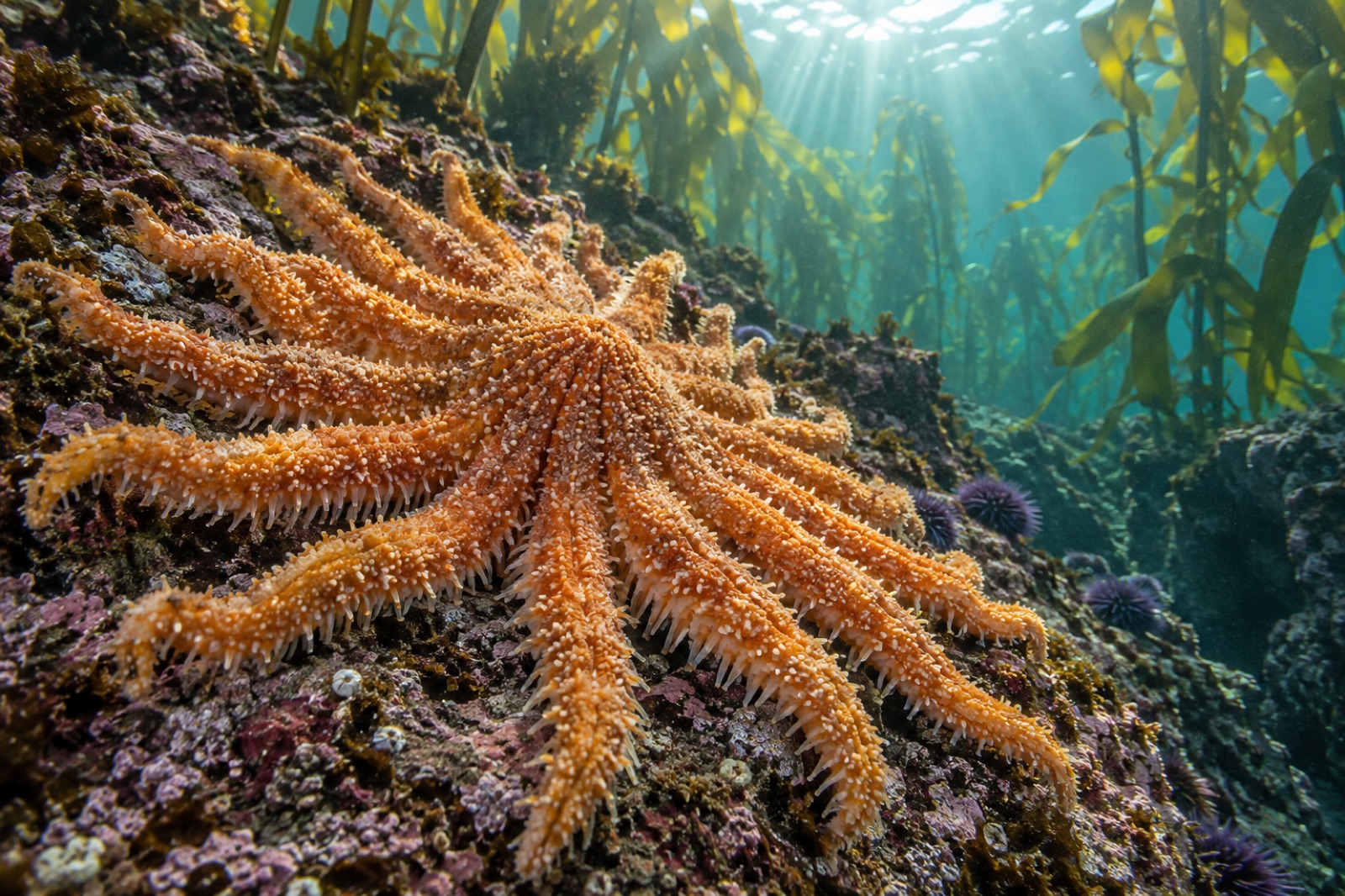
The sunflower sea star was the kelp forest's great urchin hunter. Wasting disease erased billions of them — and the consequences reshaped coastlines.
Dr. Mara Ellison ·
A deep dive into upwelling physics: Ekman transport, the world's great upwelling systems, how scientists track them from space, and what climate change does.
Dr. Lena Fischer ·