Kitchen8 min read
Dashima: The Korean Pantry Guide to Kombu's Cousin
Dashima is the dried kelp behind Korean stock, banchan and temple cooking. How to choose it, store it, and cook with it — from dasima yuksu to braised kelp.
Sofia Andersson ·
Jeju's volcanic coast is Korea's marine frontier — home of the haenyeo women divers, wakame and kombu farms, and a sea warming faster than almost anywhere on Earth.
On a basalt slipway at Jeju Island's eastern end, a group of women in black wetsuits are sitting on a low sea wall, heads bent over buckets of dark dripping kelp. The wall's surface is littered with the small amber shells of turban snails, and beyond them the sea is a slice of cold, vivid northern-Pacific green. The women talk in the rising and falling island tongue that is as close to a language all its own as anything in Korea. One of them rises, checks her mask, walks down the concrete slip into the surge, dives with a soft gasp, and vanishes for two minutes. When she comes back up, the surface is suddenly full of the same strange whistling sound that has been coming from this sea, in this way, for centuries. This is the haenyeo ("sea women") — the most famous diving culture in the world — and this coast is what put them here.
Jeju is South Korea's largest island and its southernmost province, one great volcano rising to the snow-capped crater rim of Hallasan, ringed by a straight, wave-smoothed coast of basalt platforms, black basalt tuff, pocket beaches, offshore islets and the strange chimney-shaped oreum hills that mark old vents. The island is roughly eighty kilometres off the Korean peninsula, so the same shallow Yellow Sea that slows the mainland's ecology flows past on one side, while the other side faces open ocean into the East China Sea. The culture of the coast — haenyeo diving, seaweed farming, anchovy and octopus fisheries — runs right down to the high tide line and beyond.
Jeju sits inside one of the ocean's great crossroads. The island is washed by a branch of the Tsushima warm current, which brings subtropical water and tropical species through the Korea Strait, while in winter the same coast feels the cold reach of the Yellow Sea. Our explainer on boundary currents describes how these ocean rivers set the ceiling on what can live where — and Jeju is living proof. Twenty years ago, tropical fish on Jeju reef were notable news. Today, parrotfish, sergeant-majors, damselfish and lobophytum soft corals are permanent residents, and the sea around the island is among the most rapidly warming on the planet. The coast is phasing, visibly and measurably, from temperate into subtropical.
The island's signature kelp is Ecklonia cava, a tough southern-Pacific member of the genus, forming low golden forests on the rocky eastern and southern coasts — a related forest-former to the golden kelp that carries the canopy further south. Between the Ecklonia and the shore, Jeju's basalt steps carry one of the densest beds of edible seaweeds in the north Pacific: Umbraulva, Chondrus, Sargassum and other brown turfs, with drifts of wakame (Undaria pinnatifida) in season. That similarity is no accident — miyeok is Undaria, and the same plant that grows on Jeju's rocks grows in its farms.
Which brings up the farms. Spread along the coast are thousands of hectares of long-line arrays growing dashima (Saccharina japonica) — Korea's kombu — miyeok and ulva, with the black lines running straight out from coastal villages into open water. Korea's seaweed aquaculture is the most advanced in the world, and Jeju is one of its showcases. For what these crops become at the table, start with cultivated dashima the Korean way via the dashima pantry guide, or — the island's most beloved dish — with our recipe for miyeokguk, the birthday seaweed soup. All of it, farmed and wild, runs through the haenyeo: they dive the farm lines as readily as the reef, and a village haenyeo can identify her way over fifty different seaweeds, octopus, abalone and sea urchins in one breath-length at a time.
No discussion of Jeju's coast honestly begins anywhere else. The haenyeo are the island. For generations — historians trace the practice back centuries, and field accounts from the early modern era already treat them as old — Jeju's diving was done almost entirely by women, for reasons historians tie to everything from taxation and men's shipping to simply that women were better suited to the work. They dove without tanks into the sea around the island, harvesting abalone, turban shells, octopus, sea urchin and seaweed, farming coastal plots on shore, and running a matrifocal economy unlike anything else in East Asia. Their culture — the bulteok communal warming-fires, the village diving cooperatives, the sumsori whistle exhale that vents a breath as a haenyeo surfaces — was inscribed onto UNESCO's list of Intangible Cultural Heritage of Humanity in 2016.
The numbers tell the hard story. At mid-twentieth century, tens of thousands of haenyeo worked Jeju's coast; today, a few thousand registered divers remain, most of them in their sixties, seventies and eighties. Few daughters are choosing the work, and reasons are not mysterious: it is brutally hard, poorly paid by village standards, and modern Korea offers easier lives. The haenyeo are aging out. What is replacing them — foot-for-foot on the reef — is the same subtropicalisation observed in the water: warming seas killing the abalone and sea-urchin grounds in the south, pushing the women further north on the island, replacing hard-won local knowledge with maps of a new sea.
Jeju is a tourist island — orchards, lava tubes, olle walking trails around the entire coast — and the sea is what everyone came for. The coastal path crosses the haenyeo slips, the seaweed-drying basalt flats and the harbour markets where vendors sell sliced raw abalone and sea urchin still wet from that morning's dive. Winter storms carve the coast's famous black basalt into fresh columns, and low tide reveals rock flats dense with seaweed and shore birds. Summer brings the iron-stained clouds of warm-water jellyfish — a growing presence as the Yellow Sea warms — and the sea is hot enough to stand in unprotected all afternoon.
For the visitor, the best of the coast is slow and small: sitting with a morning coffee on a basalt platform watching the haenyeo work; buying soup from a village bulteok; walking an olle trail above the black rock in the offshore wind. And if you want to get in the water — the east coast shore dives are quiet, cold and startlingly rich, and our beginner's guide to kelp forest diving covers the frame for cold-temperate shore diving. Do it the haenyeo way wherever possible: by breath hold, leaving nothing but bubbles, as our guide to freediving in kelp forests instructs.
The haenyeo are the women divers of Jeju Island, a centuries-old culture of breath-hold divers who harvest abalone, turban shells, octopus, urchin and seaweed in worksuits and cotton, without tanks. UNESCO listed them as Intangible Cultural Heritage in 2016; most remaining divers are elderly, and their numbers are falling sharply.
The island's dominant canopy-former is Ecklonia cava, which builds low forests on the rocky coasts, joined by Sargassum beds on the flat basalt. Farmed seaweeds — dashima (kombu) and miyeok (wakame) — grow on longlines along much of the shoreline; they're the same crop families profiled in our species guides to kombu and wakame.
Almost never, and that is by no accident. The haenyeo run village-governed dive grounds with strict rules, and the priority everywhere is leaving them to their livelihood. Watch from the distance, buy at village stalls, and if a local bulteok or co-operative offers a guided dive experience, take it on its own terms.
Yes — the seas around Korea are among the fastest-warming on Earth, and Jeju lies on the front line. Subtropical corals and fish that were not here thirty years ago now breed on the island's reefs, abalone grounds have shifted northward, and the ecology that sustained haenyeo diving for centuries is visibly changing around the remaining divers.
Dashima is the dried kelp behind Korean stock, banchan and temple cooking. How to choose it, store it, and cook with it — from dasima yuksu to braised kelp.
Sofia Andersson ·
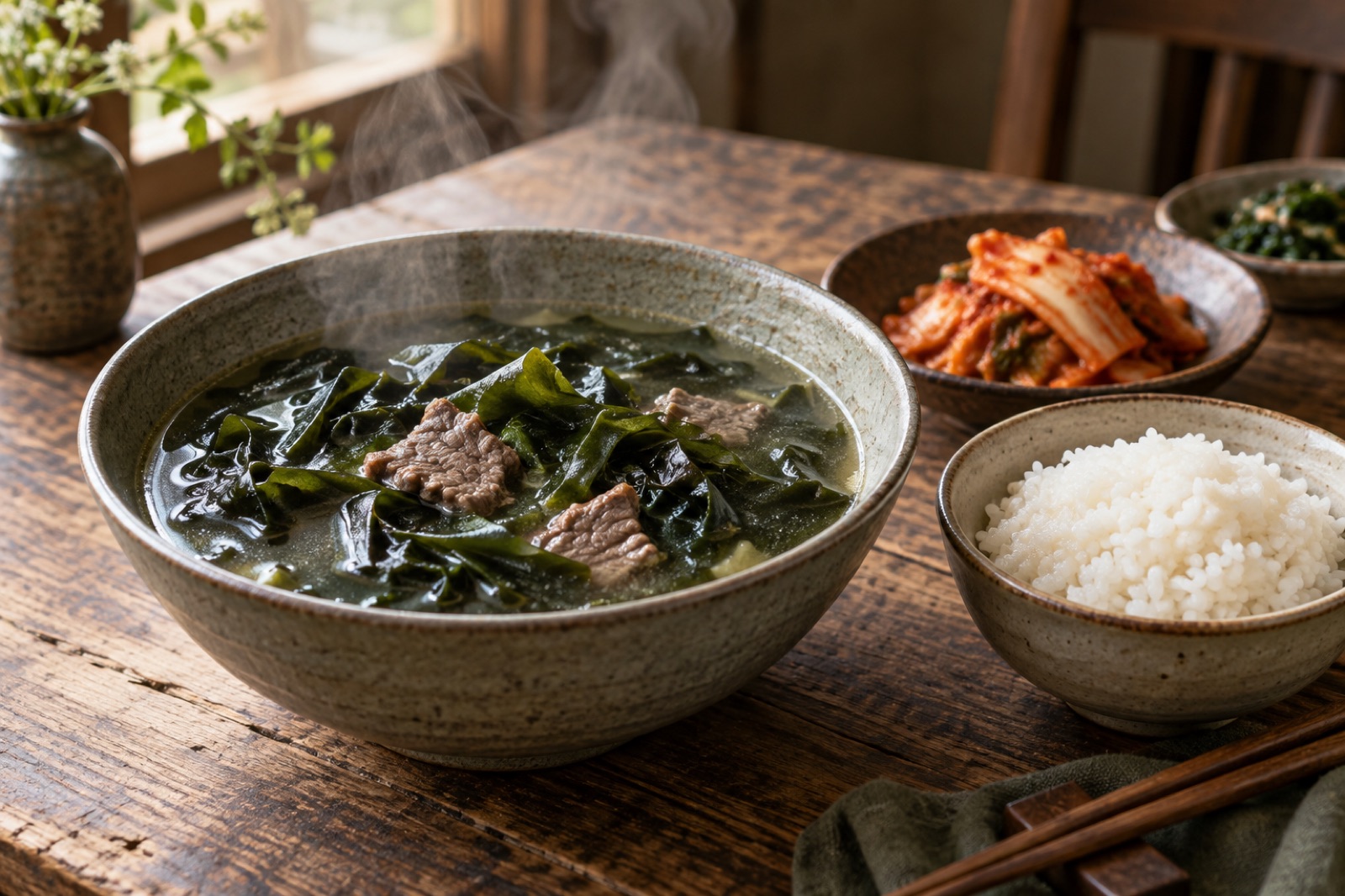
How to make miyeokguk, the Korean seaweed soup eaten to honour mothers and birthdays — with the culture, technique and common mistakes explained.
Sofia Andersson ·
Wakame is a beloved edible kelp in Japan and Korea — and one of the world's most widespread invasive seaweeds. Understand both sides of Undaria pinnatifida.
Dr. Mara Ellison ·