Encyclopedia8 min read
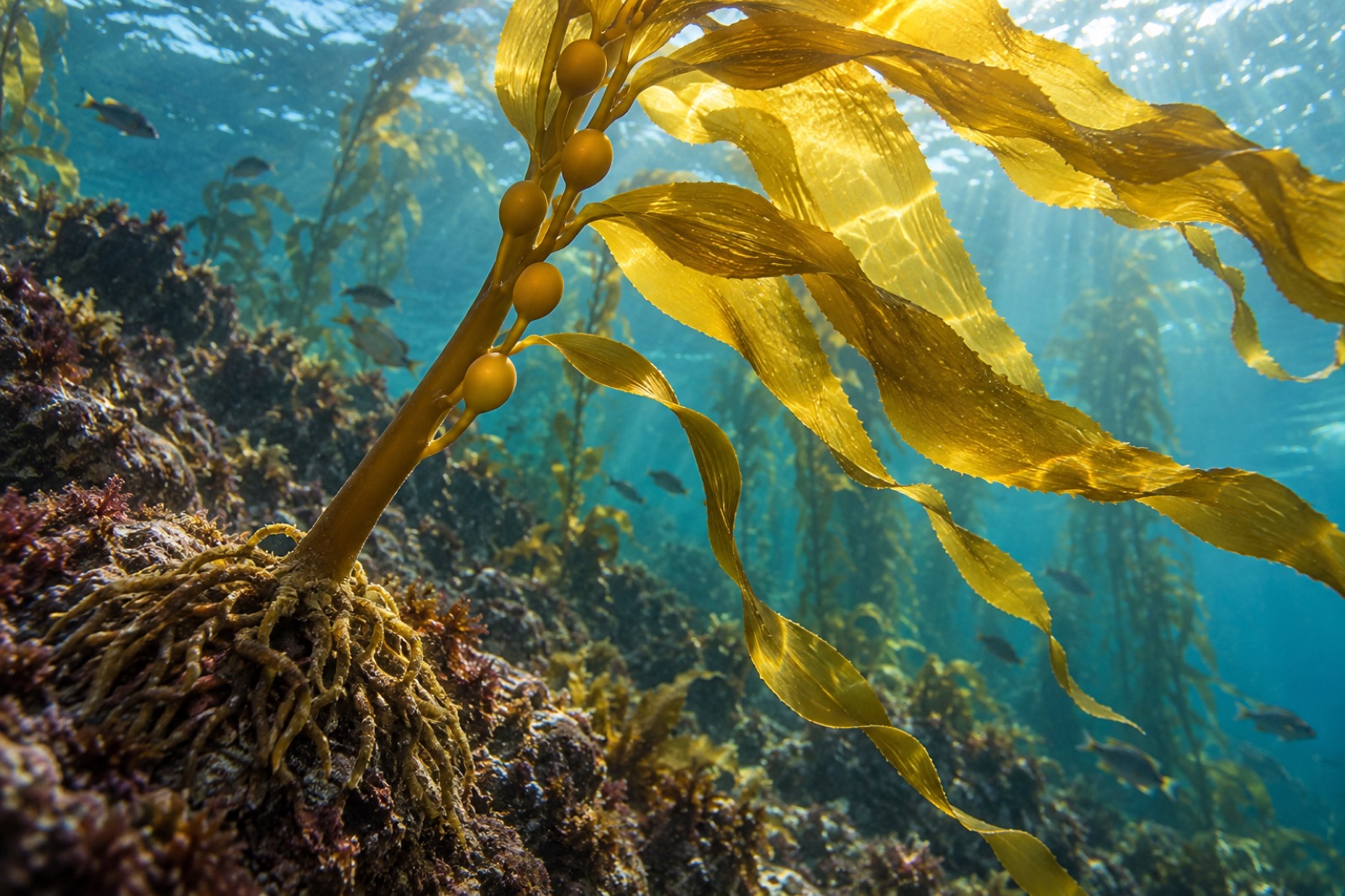
Giant Kelp (Macrocystis pyrifera): Species Profile
Giant kelp is the fastest-growing organism on Earth and the architect of undersea forests. Learn its biology, life cycle, range and why it matters.
Dr. Theo Nakamura ·
Giant kelp forests, rockhopper penguins and a lobster fishery that funds a town: a guide to Tristan da Cunha, the South Atlantic's most remote kelp coast.
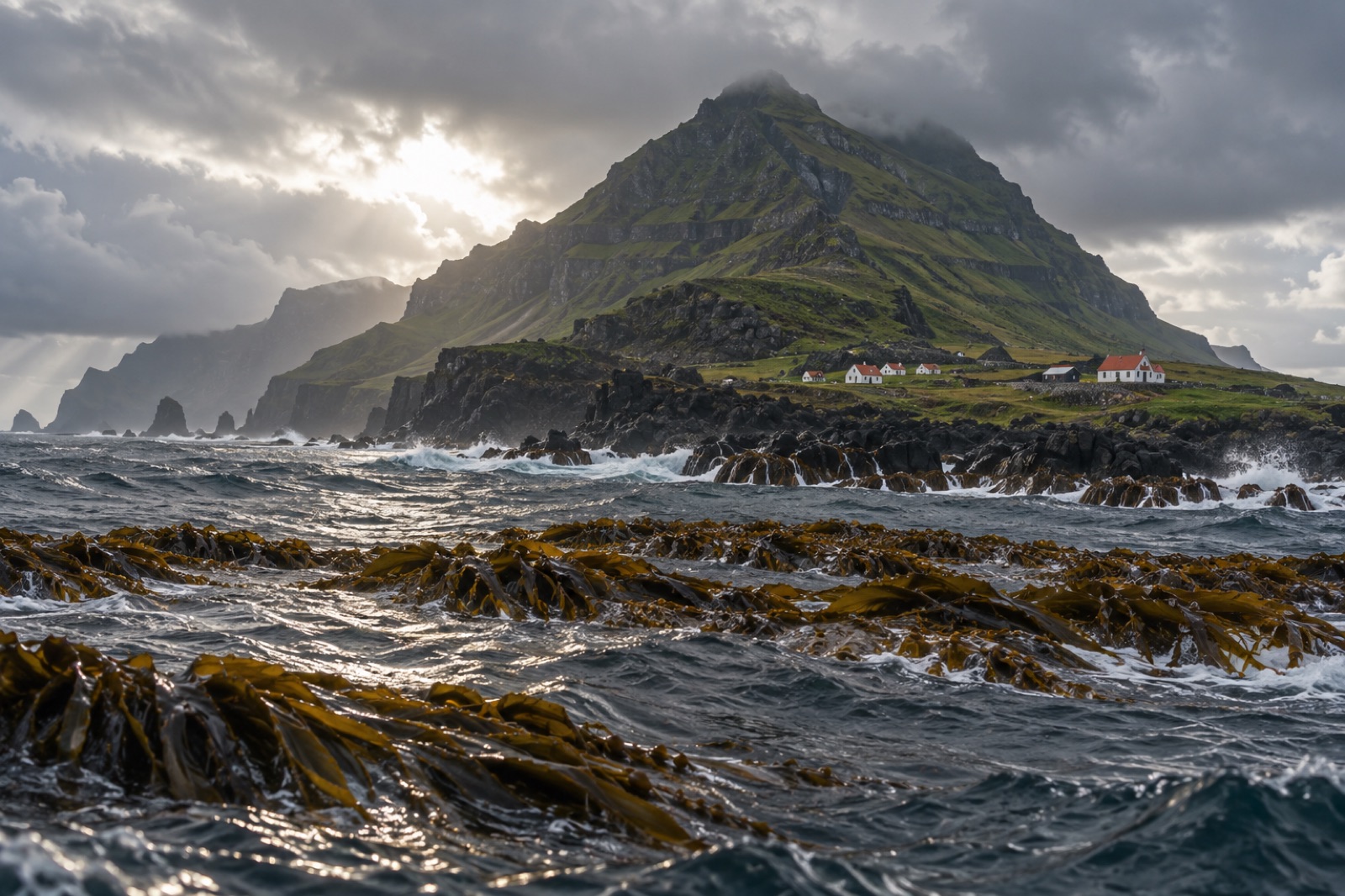
There is a place where giant kelp grows 2,800 kilometres from the nearest continent, around a volcano whose entire human population was once evacuated to English council housing. That place is Tristan da Cunha, and if you arrived here wanting to know whether the world's most remote inhabited island really sits inside a kelp forest — yes, it does, on all sides, and the forest is arguably the healthiest-run fishery backdrop on Earth. This guide covers the island's kelp ecology, its famous lobster, its even more famous neighbours, and the practical reality of going somewhere that has no airstrip.
Tristan da Cunha is the main island of a small archipelago in the middle of the South Atlantic, roughly halfway between Cape Town and Buenos Aires and about 2,100 kilometres from the nearest other inhabited place, St Helena. It is hard to overstate the isolation: there is no airport, and the sea journey from Cape Town aboard the island's ships takes around six days, weather permitting, on a schedule that ocean swell frequently overrules.
The island is a single roughly circular volcano, about eleven kilometres across, rising to Queen Mary's Peak at just over 2,000 metres. Around 250 people live in the only settlement, the wonderfully named Edinburgh of the Seven Seas, on a flat lava triangle on the northwest coast. Almost every family shares one of seven surnames; the community owns much of its land in common; and the whole island runs on a mix of fishing income, stamps, a little tourism and fierce self-reliance.
The volcano is not dormant history. In October 1961 an eruption opened just beyond the village, and the entire population — fewer than three hundred people — was evacuated to Britain, where they were photographed in their oilskins and politely studied as curiosities. Almost all of them chose to come home when the evacuation was lifted in 1963, which remains one of the small, stubbornly hopeful stories of the twentieth century.
The island sits just north of the main belt of the boundary currents that divide subtropical from subantarctic water, and its shoreline water stays cool all year — roughly 13 to 17 °C, depending on season and which way the current eddies. That temperature band, plus hard volcanic rock and relentless ocean swell, is a precise recipe for giant kelp (Macrocystis pyrifera), and Tristan grows it in a near-continuous ring: massive, deep-rooted forest on every exposed coast except where black sand beaches break it.
The ecology will be familiar to anyone who has read our guides to the Falkland Islands or the Strait of Magellan — the same subantarctic cast, edited down by distance. Because the archipelago is so isolated, its marine community is a stripped-back version of richer southern coasts: fewer species overall, a handful of them found nowhere else, and an unusually clean food web for scientists to read. Subantarctic fur seals, once hunted close to local extinction, now haul out on the boulder beaches in large numbers again, patrolling the kelp edges the way South American sea lions do off Chile.
The kelp itself does the work kelp always does. It damps swell against the rocky shore, shelters juvenile lobster and fish in its understory, sheds blade fragments that feed beaches and inshore filter-feeders, and exports some fraction of its carbon offshore along the pathways we unpack in kelp carbon cycling. Around an island this steep, the export pathway is notably direct: beyond the kelp line the seafloor simply falls away into the deep Atlantic.
Tristan's economy floats on one animal: the Tristan rock lobster (Jasus tristani), a cold-water crayfish that lives in the kelp fringe around every island in the group. The fishery has been Marine Stewardship Council certified since 2011 — a real distinction, because it made Tristan one of the smallest communities on Earth to hold that standard and built a formal obligation to protect the ecosystem that feeds it.
The operation is deliberately small. Catches are taken with baited pots, mostly within close reach of the islands, under tight quotas set with independent scientific advice; processing happens at a factory on the edge of the village; and the frozen lobster that leaves on the returning ships is, pound for pound, among the most carefully accounted seafood in the world. There is a pleasing circularity to it: the kelp forest shelters the juvenile lobsters, the lobsters pay for the school, the clinic and the harbour, and the islanders in turn have become some of the ocean's most assertive protectors.
Fishers here will tell you, without romanticising it, that they fish the same grounds their grandfathers fished and intend the same for their grandchildren. In an ocean full of industrial free-for-alls, the Tristan model — one community, one well-managed stock, full traceability — is close to what modern fisheries science prescribes.
As extraordinary as Tristan is, its outliers are wilder. Gough Island, about 350 kilometres to the south-southeast, and Inaccessible Island, a sheer-sided plateau 40 kilometres from Tristan, are jointly inscribed as a UNESCO World Heritage Site for their seabirds. Gough alone holds nesting Atlantic yellow-nosed albatross, spectacled petrels, great shearwaters in their millions and — most famously — the endangered northern rockhopper penguin, which breeds across the group in colonies that scramble link by link up the cliffs.
In 2020 the Tristan da Cunha government declared a marine protection zone spanning roughly 687,000 square kilometres — the entire archipelago's waters — with more than ninety percent fully no-take, making it the largest no-take zone in the Atlantic Ocean at the time. The decision was made by the islanders themselves, in partnership with outside scientists and NGOs, and it reframed what a tiny jurisdiction can do for the sea: a community of 250 people permanently closing an ocean area nearly three times the size of the United Kingdom to extractive fishing, precisely because their lobster, their penguins and their kelp ring are worth more intact.
It is exactly the kind of decision our marine protected areas explainer argues for at every scale: protection decided by the people who live inside the ecosystem, measured in generations.
Distance is a scientific gift. A kelp forest with no coastal cities, no river plumes, no agricultural runoff and one tightly managed fishery is as close to a control plot as the modern ocean offers. Baselines from places like Tristan help calibrate everything researchers measure on busier coasts — canopy productivity, heatwave response, carbon export — because when something changes out here, the list of suspects is short.
That is, candidly, why a fictional restoration company keeps Tristan on its dream list. On Tidewright's own (illustrative) roadmap, remote healthy forests serve as reference sites for Canopy Ledger: satellite canopy maps of thriving systems tell you what "good" looks like when you are trying to grow a forest back somewhere damaged. Islands like Tristan, the Falklands and the Magellan channels form the calibrating ring of the southern kelp world.
People do visit, and the island council welcomes them, but this is expedition travel in the truest sense:
Yes — Macrocystis pyrifera, the same species that builds California's famous forests, forms a near-continuous ring around Tristan and its neighbouring islands wherever hard volcanic rock meets cool, clear water. It is the archipelago's dominant shallow-water ecosystem.
Yes, but within tight limits. There is no airport, so all visitors arrive by sea, usually on the island's own vessels from Cape Town. Berths are scarce, trips take six days each way, and itineraries flex around weather. Co-ordinate with the island's tourism office far in advance.
By independent assessment, yes. The fishery has held Marine Stewardship Council certification since harder-than-most standards were met in 2011, and the community manages quotas conservatively. It is routinely cited as proof that small, community-based fisheries can outperform industrial ones.
Because it is nearly a natural laboratory: a kelp forest with no urban runoff, no industrial coastal pressure and one carefully managed fishery. Measurements taken there — canopy extent, productivity, carbon export — provide the healthy baseline against which damaged coasts can be compared.
The Tristan da Cunha government designated its entire exclusive economic zone — about 687,000 square kilometres — as a marine protection zone, with over ninety percent fully no-take. At declaration it was the Atlantic's largest no-take zone, decided by the island community itself.
Giant kelp is the fastest-growing organism on Earth and the architect of undersea forests. Learn its biology, life cycle, range and why it matters.
Dr. Theo Nakamura ·
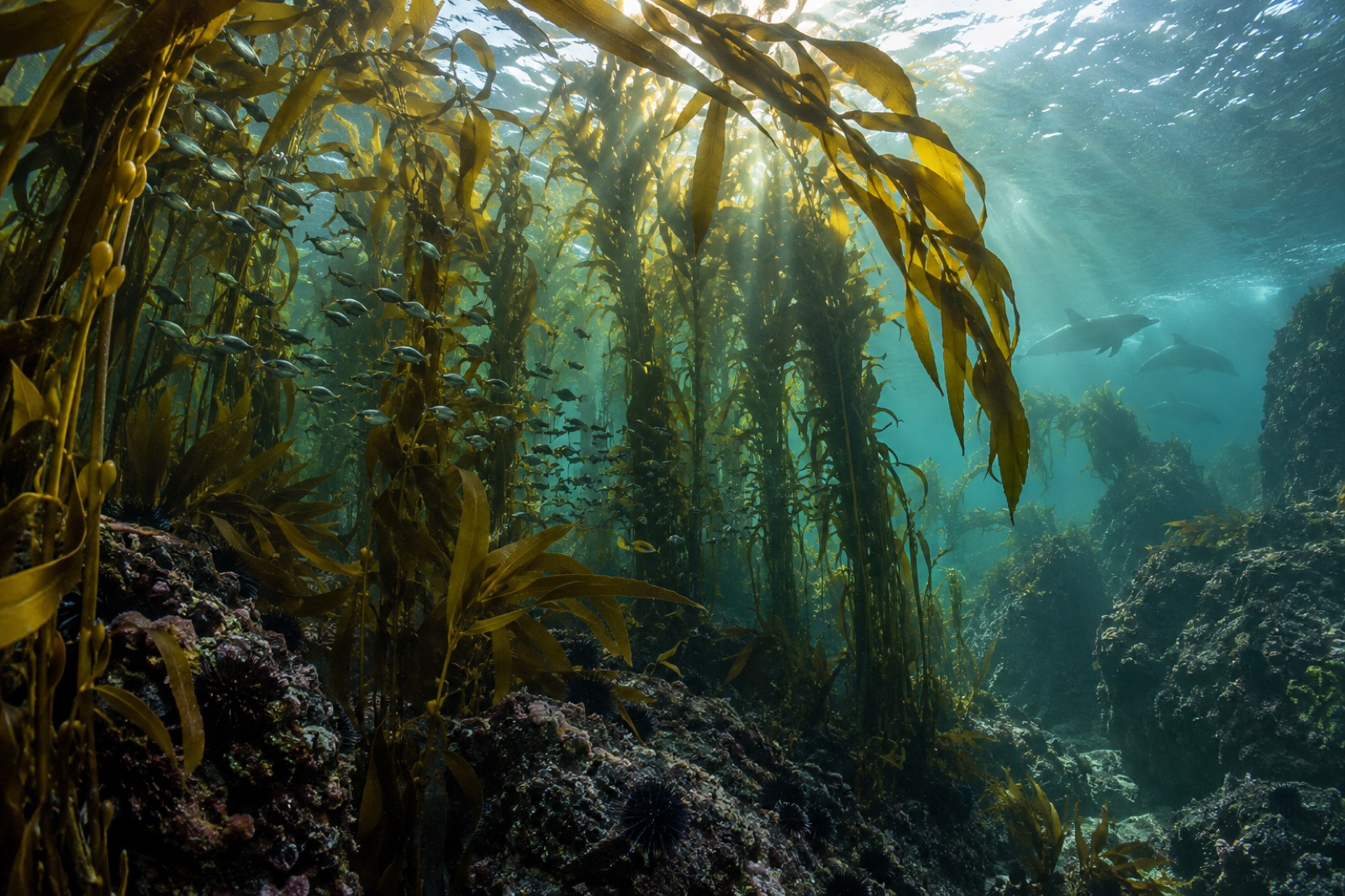
Inside the Falkland Islands' giant kelp beds — among the most extensive on Earth — and the penguins, seals and steamer ducks that run on them.
Dr. Lena Fischer ·
Inside the subantarctic kelp forests of the Strait of Magellan and Tierra del Fuego: cold clear water, drifting kelp highways, and science at the southern frontier.
Dr. Elias Brandt ·