Atlas9 min read
Tristan da Cunha: Kelp Around the Loneliest Island
Giant kelp forests, rockhopper penguins and a lobster fishery that funds a town: a guide to Tristan da Cunha, the South Atlantic's most remote kelp coast.
Dr. Mara Ellison ·
What the kelp ring around the world's most remote inhabited island actually looks like — island by island, season by season — and how anyone ever gets to see it.
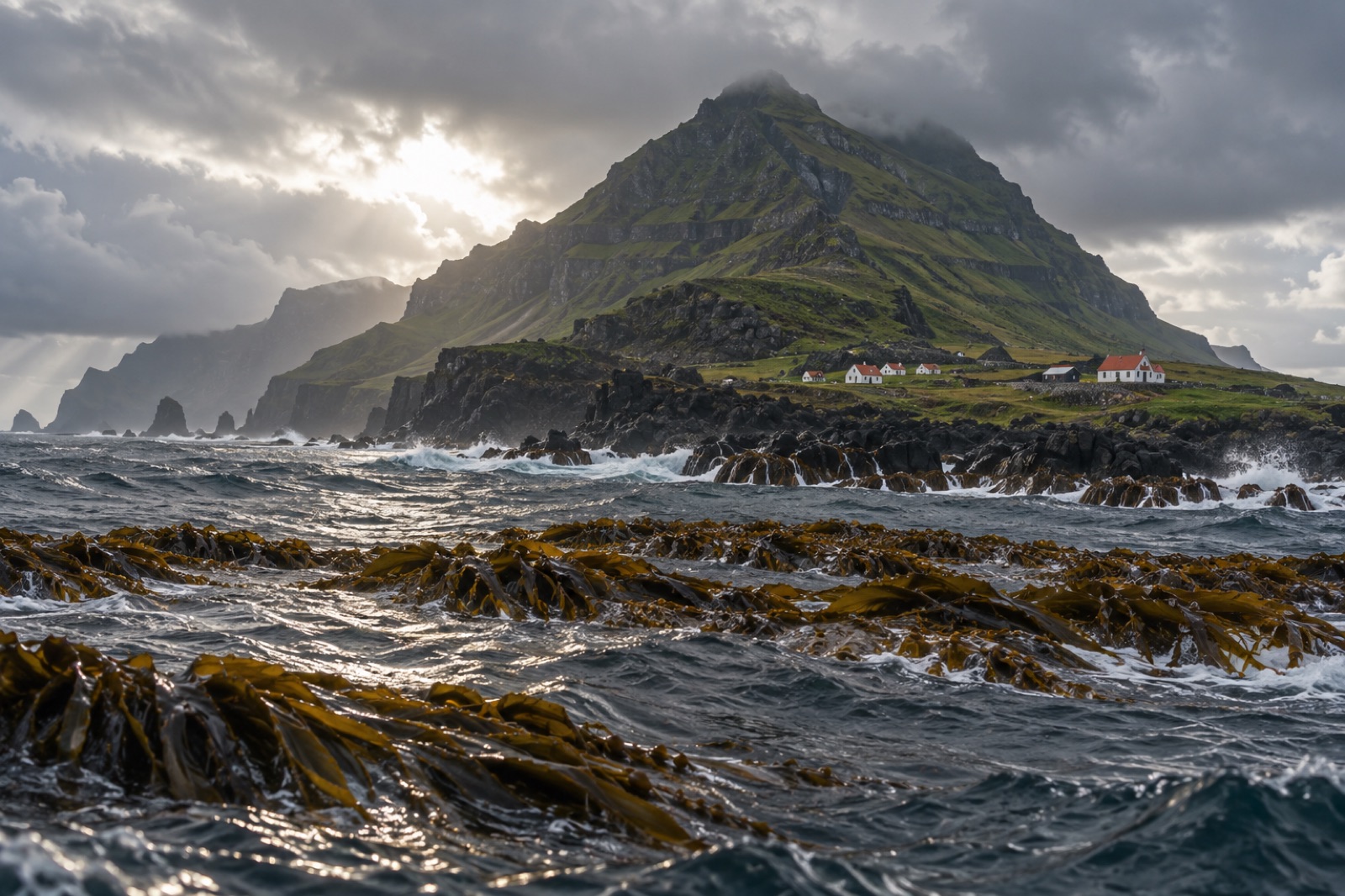
Every kelp coast has a signature view. At Tristan da Cunha, the signature view is from the deck of a ship you have already spent six days on, watching a green-black fringe of giant kelp slide in and out of the swell against a volcano with one settlement and no airport. Our main island guide covers Tristan's remarkable community and its lobster economy. This companion piece is about the kelp coast itself: what the forest is like up close, island by island across the archipelago, what the year looks like underwater, and the practical question everyone asks — how, if ever, do you actually get into that water.
"Tristan da Cunha" is really a small archipelago scattered across the subtropical South Atlantic, and its kelp comes in four chapters.
Tristan itself, the main island, carries the densest continuous band: giant kelp Macrocystis pyrifera in a near-complete ring around eleven kilometres of volcanic coastline, broken only by black-sand beaches and the older lava flows that shelve too shallow for the swell to let kelp settle.
Nightingale, about 35 kilometres to the south-southwest, is the island Tristaners visit for bird eggs and fishing: a low, green, two-islet cluster with kelp in its bays, rockhopper penguin colonies ashore and — the detail that charms every expedition naturalist — a tiny landlocked freshwater pond on neighbouring Middle Island.
Inaccessible, a flat-topped fortress island 40 kilometres out, is ringed by cliffs from fifty to six hundred metres high and has been landed on only a handful of times in history. Its kelp fringe is as close to untouched as temperate reef exists on this planet, shared with Gough as a UNESCO World Heritage property.
And three hundred and fifty kilometres further south, Gough grows deeper, darker, more sub-Antarctic kelp beds in colder water — a different chapter of the same archipelago forest.
All four are United Kingdom Overseas Territory waters, and since 2020 almost the entire maritime zone — some 687,000 square kilometres — has been closed to extractive use, the largest fully protected marine area in the Atlantic. The kelp forests inside it may be the most securely protected on Earth.
From a boat at the kelp edge, the first thing you notice is how hard the waterline is worked. Tristan's coast is steep, the swell is relentless, and the kelp sits where swell meets lava: a living buffer band that visibly flattens broken water — the wave-damping physics operating at full Southern Ocean force.
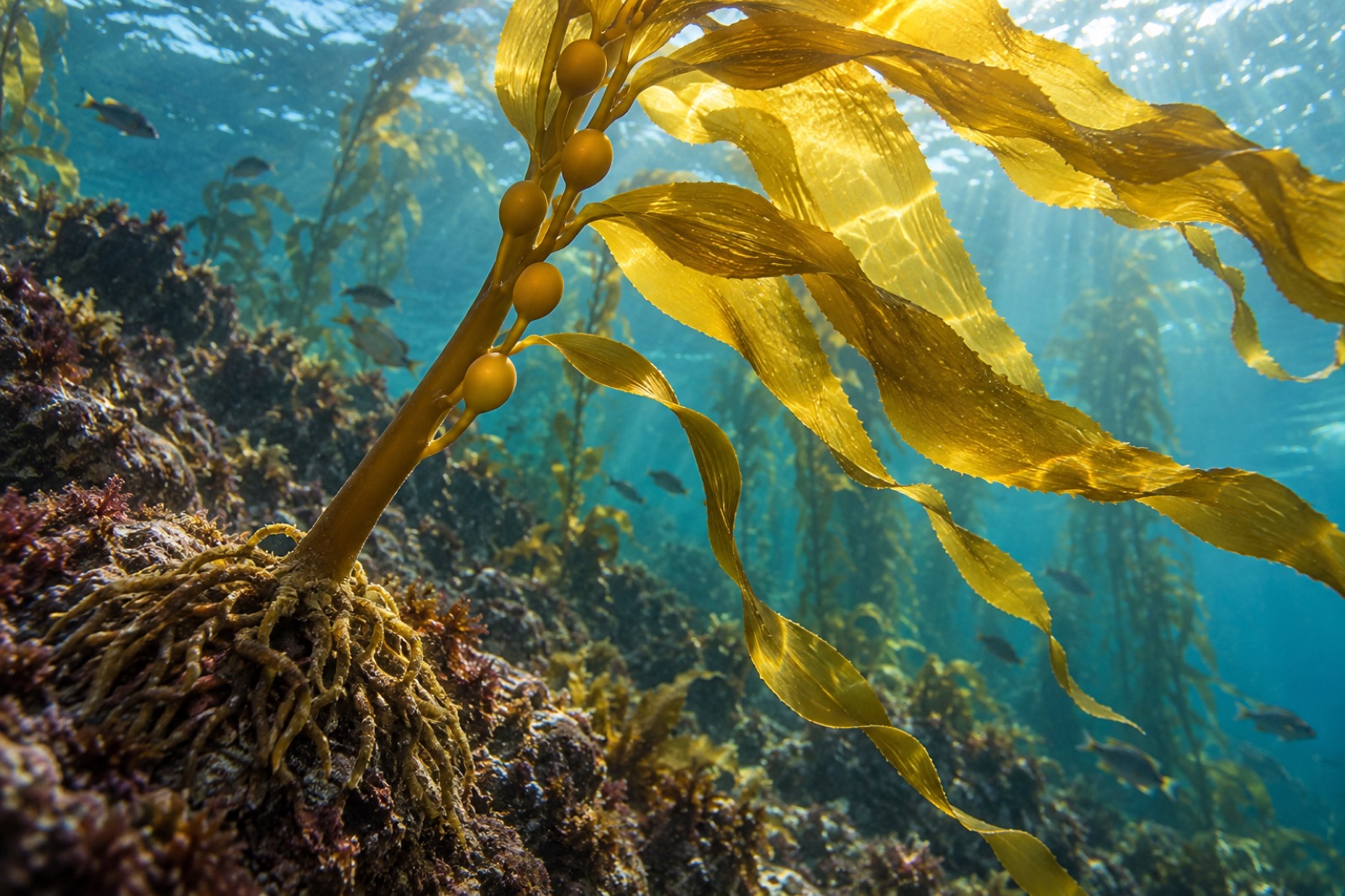
In the water, on the rare calm days the islanders call "down days," the forest is vertical and green-brown, with canopy fronds rattling at the surface and stripes of light dropping deep. Two features set the Tristan ring apart from, say, the Falkland Islands forests to its southwest. The first is depth and clarity: Tristan rises almost vertically from the mid-Atlantic, so the kelp band is narrow and gives way quickly to open blue; visibility on a settled day reaches the kind of distances divers dream about. The second is warmth: sea temperatures run roughly 13–17 °C — firmly in giant kelp's comfort zone, but the warm end of it, noticeably gentler under a hood than Patagonia or the Magellan coast.
Under the canopy the community is a stripped-down sub-Antarctic set, filtered by 2,800 kilometres of loneliness: coralline-encrusted lava, grazing limpets and snails, octopus, wrasse-like reef fish, and the archipelago's star invertebrate, the Tristan rock lobster, sheltering in the kelp fringe as a juvenile and grazing it as an adult. Subantarctic fur seals work the kelp edge in shifting patrols, and northern rockhopper penguins porpoise straight through the band on their way to and from the colonies ashore.
Giant kelp is an opportunist on a seasonal clock — the physiology of it is laid out in our kelp phenology explainer — and the Tristan ring keeps sub-Antarctic time. Through austral winter (June–September) the forest is pruned hard: storms tear canopies, old plants shed blades and the ring visibly thins. Ashore, this is when the beaches fill with drift weed, which islanders have traditionally gathered as a soil dressing for the potato paddies.
Spring and summer (October–March) are the growth season: new fronds climb, the canopy re-closes, and juvenile lobsters and fish recruit into the understory. By late summer the beds are at their thickest, and the sea around each island carries its annual cargo of rafts — whole plants torn free by the autumn storms of the high latitudes arriving in local water, and local plants setting off in turn. That drift is how island kelp populations talk to one another across the basin, a process we trace in the science of rafting dispersal.
What makes Tristan's kelp worth a long article rather than a paragraph is not any single species — it is how little of the system is missing. The top of the food web still functions. Fur seals, recovered from nineteenth-century slaughter, patrol in their tens of thousands across the group. Albatrosses and petrels from Gough, Inaccessible and Nightingale feed over the kelp line and beyond. The lobster that funds the island still recruits exactly where it should. Kelp forests elsewhere pair with otters, or lack them; Tristan's forest pairs with seabirds and seals, and it functions.
And the human layer is still there and still light. Islanders fish the kelp fringe from small boats in weather windows an Aucklander would call lunatic and a Tristaner calls Tuesday; the catch feeds the factory, the factory funds the island, and the island protects the sea around it on a continental scale. If you want the full arc of that story, start with our Tristan island guide.
Honestly: hardly. But not impossibly.
The normal way: sail from Cape Town on one of the island's ships on the roughly six-day passage, bookable by application through the Tristan da Cunha administration and contingent on weather, cargo and berth. Once ashore, you will see the kelp every day — from the harbour, from the lava point called Stony Hill, from any calm-day walk around the Settlement Plain — and island boatmen will sometimes take visitors along the coast through the kelp edge when the sea allows.
The rarer way: a small number of expedition cruise itineraries (usually Saint Helena–Tristan–Gough routes) call at Tristan and offer zodiac runs along the kelp fringe.
Diving is possible only in the loosest sense. There is no dive shop, no compressor for hire, no rescue chamber; only self-sufficient technical divers working their own logistics have dived here, mostly on research expeditions. If your heart is set on immersed giant kelp, the kelp cathedrals of Tasmania, California, Cape Town's Cape Peninsula or the Magellan region are the honest alternatives — the Coastal Atlas keeps a list.
Even for those who will never go, Tristan's kelp is worth knowing about, because it answers a question conservation argues about endlessly: what does "protected" actually buy you? Here, in arguably the most remote waters any government watches over, protection has bought an intact kelp forest with its whole food web assembled — not as a museum piece, but as a working coast funding a community of 250 people. That is the pattern restoration everywhere else is trying to rebuild from fragments, and it is why reference coastlines like Tristan's show up in frameworks like our own impact methodology.
In a near-continuous band around all four islands of the group — Tristan, Nightingale, Inaccessible and Gough — wherever hard volcanic substrate meets the light, from the surf line down to roughly twenty or thirty metres.
Yes — giant kelp, Macrocystis pyrifera, the same species that forms the forests of California, Chile, Tasmania and the sub-Antarctic. Tristan's isolated stand is filtered by its extreme distance from other kelp coasts.
Not as a tourist — there is no dive infrastructure at all. The practical route to the island is a six-day ship voyage from Cape Town, and visitors experience the kelp from shore, small boats, or expedition zodiacs.
Doubly: the islands are UK Overseas Territory with UNESCO World Heritage status for Gough and Inaccessible, and since 2020 the surrounding ~687,000 km² maritime zone has been a no-take marine protected area — the Atlantic's largest.
Surprisingly mild for giant kelp: about 13 °C in winter to 17 °C in late summer — the warm end of the species' range, well above what its Patagonian or Magellan relatives endure.
Giant kelp forests, rockhopper penguins and a lobster fishery that funds a town: a guide to Tristan da Cunha, the South Atlantic's most remote kelp coast.
Dr. Mara Ellison ·
A windswept volcanic island in the sub-Antarctic South Atlantic, ringed by giant kelp and breeding seabirds — and part of one of the most remote marine reserves on Earth.
Dr. Mara Ellison ·
Giant kelp is the fastest-growing organism on Earth and the architect of undersea forests. Learn its biology, life cycle, range and why it matters.
Dr. Theo Nakamura ·