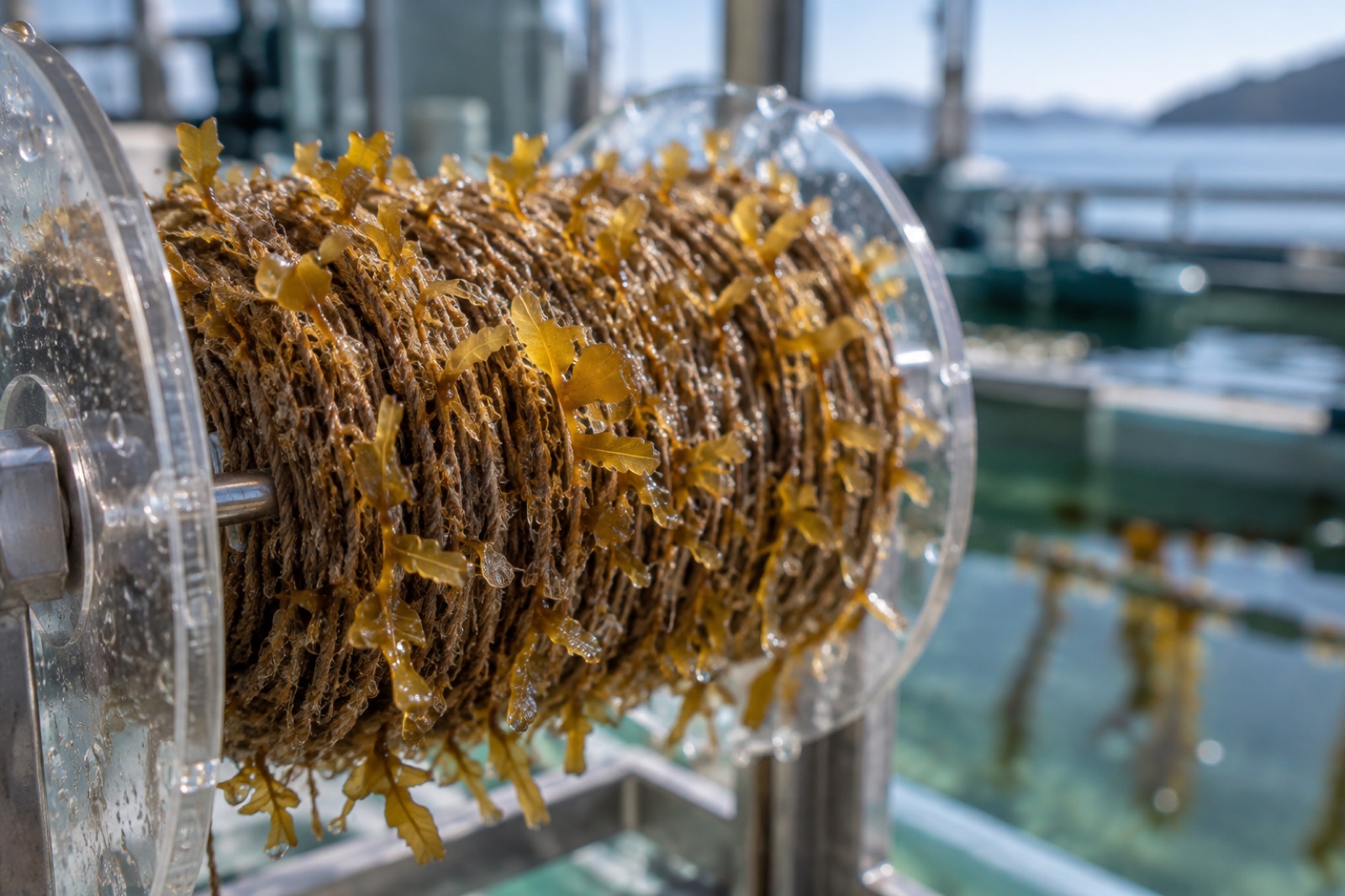
The most consequential purchase a kelp farm makes all year is one most buyers handle over an email and a bank transfer: seeded twine. Get it right and a hectare of longlines fills with crop on schedule; get it wrong and you learn in February that the seed failed in October, with an entire season's mooring, labour and lease costs already spent. Seed string is a living product with a shelf life, which makes buying it different from buying rope. This guide covers what seed costs, how to judge a hatchery, when to order and when to accept delivery, and the checks to run the moment the box arrives.
What You Are Actually Buying
"Seed string" (also called seeded twine, seed string or seeded line) is a thin carrier twine — typically 1–3 mm — that has spent weeks in a hatchery while kelp gametophytes settle on it, fuse, and grow into microscopic sporophytes. By the time it ships, each metre should carry tens of thousands of juvenile sporophytes visible only under magnification. What you are buying, therefore, is not twine: it is a living culture at a defined developmental stage, with local genetics matched to your site and a viability that starts decaying the moment it leaves the hatchery's climate control. The production side is detailed in how seed string is made; this article is about being a competent buyer.
What Seed String Costs
Prices vary by region, species and volume, and any specific number will date quickly — but for planning purposes in most European and North American markets buying off the shelf:
- Commodity species like sugar kelp (Saccharina latissima): roughly €0.10–0.40 or $0.15–0.50 per metre of seeded twine, with meaningful discounts above ~50,000 metres.
- Specialist or slow species (wakame/ Undaria, winged kelp, dulse): often two to five times that per metre, reflecting longer hatchery residence and scarcer broodstock.
- Custom provenance-matched orders — where the hatchery collects parent material from your region and grows seed to your site: a per-order development fee on top of the per-metre price, frequently in the low thousands.
A rough whole-farm sanity check: at 100 m of grow line per twine wrap spacing that absorbs ~100 m of seed string per grow line, a hectare of longlines typically takes 2,000–5,000 metres of seeded twine depending on design — so seed commonly lands between a few hundred and a few thousand euros or dollars per hectare. That makes seed a small line item against whole-farm installation cost — and therefore a terrible place to save money by lowering quality.
Choosing a Hatchery: The Questions That Matter
Good hatcheries welcome hard questions; evasive answers are the signal. Ask:
- What parent material was used, and from where? You want sorus tissue from fertile adults collected locally — close enough that the genetics match your site's temperature and light regime. Provenance rules and why they exist are covered in native seedstock rules.
- How many parents went into this batch? Genetic diversity in the spore mix is insurance against disease and heatwaves; single-parent batches are a red flag for anything but research trials.
- What is the seeding density and developmental stage? "Heavily seeded" is not a specification. You want sporophytes per millimetre of twine, or a validated proxy, and a stage description that tells you whether they're ready for your outplant date.
- What are the hatchery's water conditions for this batch? Temperature, light cycle and nutrient regime through production — a record, not a verbal answer. Good producers live by their hatchery water quality discipline and will hand over logs.
- What is the batch's track record? References from previous buyers, percentage that took, and honest note of any batches that failed last season and why.
- How is it packed, and how long is the guaranteed transit window? Chilled, dark and humid, with a stated maximum transit time and an agreed acceptance test on arrival.
Timing: Backwards From Your Outplant Window
Everything runs downhill from the date the twine hits your longlines. Work backwards:
- Outplant window: set by your site's temperature regime — usually when the sea cools below a threshold (commonly 12–15 °C for sugar kelp in autumn in temperate Atlantic/ Pacific farms) and storm season hasn't yet arrived. Choose a target week, then a fallback week.
- Transit: 24–72 hours of chilled transport depending on distance and method. Never let the delivery land on a Friday, or you'll spend a weekend watching a warming box and your blood pressure.
- Hatchery residence: sugar kelp typically needs 4–8 weeks from spore release to shippable sporophytes; slower species longer. The hatchery books its broodstock collection before that, which in turn happens at fertile season in summer.
- Ordering deadline: for autumn-outplanted sugar kelp, order by late spring to early summer; for confirmed custom provenance orders, a season earlier still. If you are calling a hatchery in August hoping for October delivery, plan on taking whatever other farmers rejected.
Order with some slack — 10–15 % over your calculated need lets you discard weak sections and still seed the full array. Similarly, have a fallback hatchery named in your plan; batches fail, and February is a bad time to discover your supplier had a lathe accident in September.
Acceptance Checks When the Box Arrives
Accept delivery formally. The moment the insulated box hits the dock, run through:
- Temperature log or indicator. Chilled chain maintained (usually 4–10 °C depending on species and protocol)?
- Moisture state. Twine damp, not swimming in water, not dry. Free-floating condensation pooling is a warning sign of warming en route.
- Visual inspection under magnification. Twine under a 40× loupe or a cheap digital microscope should show sporophytes attached at or above the stated density, with no bare metre-long stretches and no obvious contamination — diatom films are common and usually tolerable; heavy green or blue-green films are not.
- Smell and feel. Clean seaweed odour, no sour note, twine supple not slimy.
If anything fails, photograph it, note the time, and phone the hatchery before doing anything else. A good producer either replaces, refunds, or talks you through an on-farm rescue protocol; seed arrivers in dispute that go straight onto longlines become nobody's problem and everybody's argument. On arrival responsibly handled, you are straight into transport to the farm and the outplant day itself.
For a second line of budget certainty, some hatcheries offer viability testing and certification with the batch — a lab count of attached sporophytes per unit length before dispatch. Our viability checks guide covers what those numbers meaningfully tell you.
Budgeting Seed Into the Farm P&L
Seed costs scale with the area you plant but not linearly with every other cost. Double the farm and seed cost doubles, but mooring, labour and equipment don't; so per-metre seed as a share of total cost falls with scale. For a small operator, seed might be 2–5 % of a year's budget; at industrial scale, under 1 %. Either way, the price is trivial beside the cost of seeding twice because the first order failed. Buy the best seed you can get, from someone who answers questions with logs instead of adjectives, and put the savings energy elsewhere — farm economics rewards seed certainty more than seed discounts.
Key takeaways
- Seed string is a living culture at a defined stage — judge it like one, with density, provenance and batch records, not like rope.
- Budget roughly 2,000–5,000 m of seeded twine per hectare and expect seed to be a low single-digit percent of total farm cost.
- Interrogate the hatchery: parent material, parent count, seeding density, water logs, batch history, transit protocol.
- Order early — late spring to early summer for autumn outplant — with a 10–15 % margin and a named fallback supplier.
- Run acceptance checks on the dock: temperature chain, moisture, microscopic density check. Dispute in writing before seeding, not after.
- Spend savings energy anywhere but here; seed failure costs a season, seed discounts don't save one.
FAQ
How much seeded twine do I need per hectare?
Depends on design — grow-line spacing and how the twine wraps — but a typical temperate longline farm uses 2,000–5,000 metres of seeded twine per hectare. Ask the hatchery to check your layout maths; they do this daily.
Can I make my own seed string instead of buying it?
Yes, but treated as a business decision: a licensed hatchery costs real money to run, broodstock collection takes permits in many jurisdictions, and your first years are better spent learning the growing side. Our setting up a hatchery guide sizes the undertaking honestly.
What does "provenance-matched" seed actually mean?
Spore parents collected from your region — often specified by a regulator as a radius, sometimes as a named population — so the seed temperature and daylight responses match your site's conditions. It matters more as climates warm and heatwaves bite.
What if my delivery arrives warm?
Quarantine it chilled, count sporophytes under magnification against the stated density, record everything, and contact the supplier the same day. Don't seed a disputed batch onto lines; you lose the evidence and usually the claim.
Are there seasonally cheaper times to buy seed?
Not really — the price is set by the hatchery's year, not the market's week. The cheapest seed is the seed you ordered early, with a fallback supplier named, that arrives viable the week you need it.