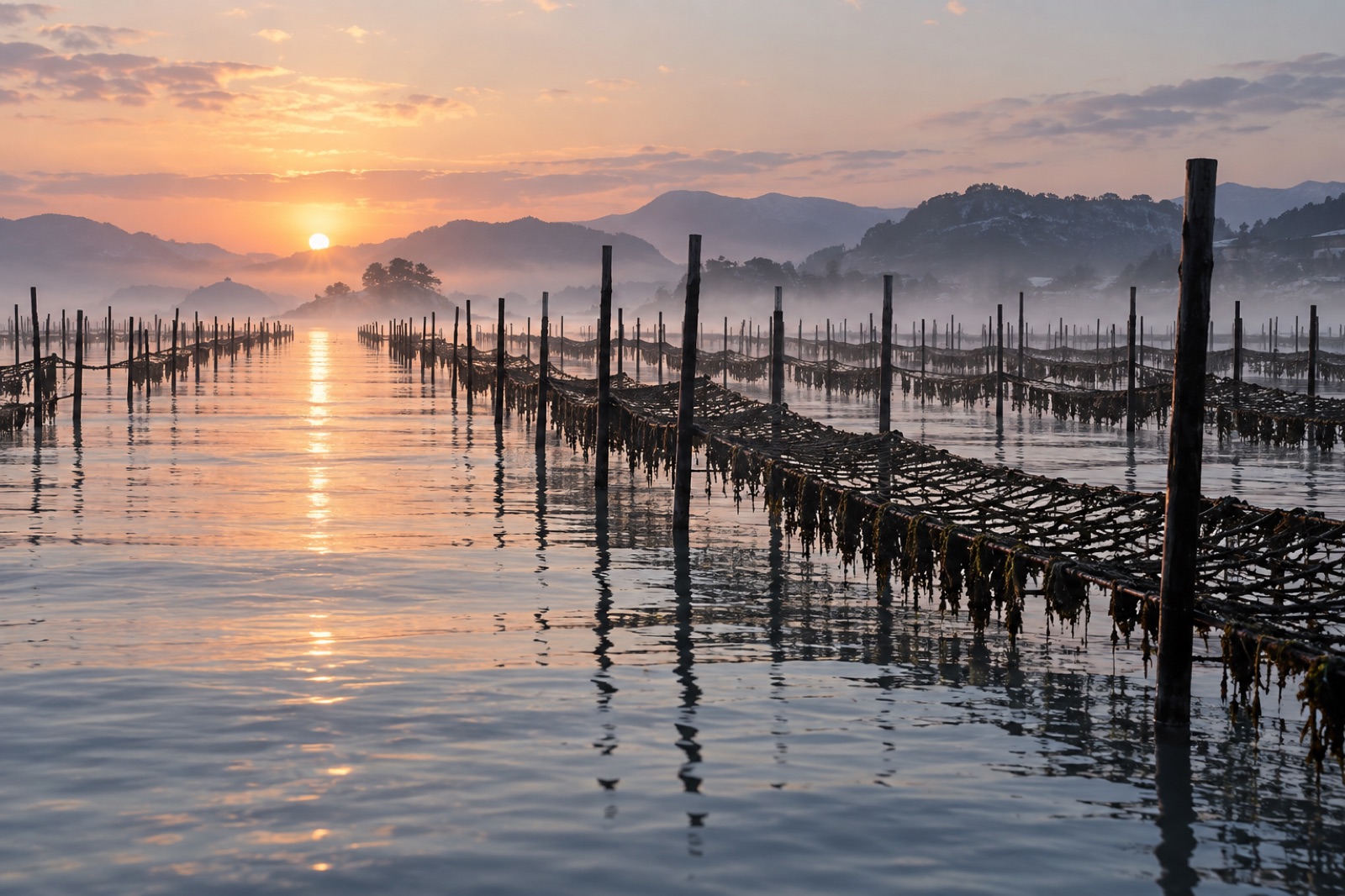
Nori — the crisp, umami-dark sheet behind sushi — is the most farmed seaweed on Earth by value, and also the strangest to grow. Unlike kelp, which you seed onto a rope, nori spends half its life living inside the shells of oysters and scallops as a pinkish, thread-like colony few people ever see. Get your head around that hidden stage, and nori farming becomes legible: a summer spent cultivating shellfish shells in hatchery tanks, an autumn seeding of floating nets, and a winter of repeated harvesting as fast-growing blades regrow again and again in cold water. This is the beginner's map of that whole system — what the two life stages are, how nets are seeded, what the winter season looks like, and where new farms succeed and fail.
For a deeper species-level treatment, see our full guides to growing nori and the blade-and-shell life of Porphyra cultivation, plus the nori encyclopaedia profile. This article is the orientation you read before those.
Two Seaweeds in One: The Life Cycle That Runs Everything
Until the middle of the twentieth century, Japanese nori farmers seeded their nets from wild sporefalls and simply hoped. The discovery that transformed the industry — made by the British phycologist Kathleen Drew-Baker, whose work unlocked reliable cultivation in post-war Japan — was that nori's life alternates between two utterly different generations:
- The blade (gametophyte). The familiar thin, dark, paper-like fronds that grow on nets in winter. This is the crop.
- The conchocelis (sporophyte). A microscopic, filamentous stage that bores into shell and other calcareous surfaces. In summer, mature conchocelis releases spores — conchospores — which settle on nets and grow into new blades.
Every operational decision in nori farming flows from this split. Summer work is conchocelis work, done in tanks. Winter work is blade work, done at sea. The hatchery and the ocean are one factory with two sites.
Summer: The Shell Hatchery
From spring through summer, the conchocelis stage is maintained in shallow tanks — traditionally on thousands of cleaned oyster and scallop shells, increasingly on synthetic substitutes and netting that make handling and sterilisation easier. The work is environmental control:
- Temperature and light are the levers. Warmth and specific photoperiods push the conchocelis to maturity; hatchery managers essentially schedule the autumn spore release by adjusting both.
- Cleanliness is existential. Filamentous contaminant algae love the same conditions, and a contaminated shell batch can miss the whole seeding window. Tank hygiene, filtered seawater and quarantine of new shell stock are standard practice, as in any seaweed hatchery water-quality programme.
- Strain selection matters. Farmed nori is a crop with named cultivars — selected for colour, gloss, flavour, yield and harvest timing — maintained as living conchocelis lines year to year, much like kelp hatcheries maintain gametophyte lines. A new farm typically begins by sourcing stock from an established hatchery or cooperative rather than founding its own strains.
Seeding the Nets
When conchocelis matures in autumn, the shells (or their synthetic stand-ins) are brought to the seeding facility. Seeding methods vary — oscillating seeding machines that slosh shell-laden water over nets, or immersion of nets in tanks of spore-rich water — but the goal is uniform settlement of conchospores across the mesh. Seeding density decides blade size, thickness and quality: thin seeding gives thick, coarse blades; dense seeding gives the fine, thin blades that grade highest as sheet nori.
This is the pressure point of the year. Conchospores are viable for a short window after release, so seeding runs on tight daily schedules, and farms commonly hold reserve shell stock as insurance against a weak release.
Autumn to Winter: The Ocean Phase
Seeded nets go to sea on floating frameworks — poles and floats holding nets at the surface — arranged in the sheltered bays and estuaries where traditional nori farming lives. Three site realities shape success:
- Nutrients come from the outside. Unlike kelp sites chosen for cool upwelled water, classic nori grounds are shallow, nutrient-fed bays, often estuarine. Nitrogen is the difference between stiff, flavourful dark blades and yellowed, thin ones. Where bay waters have oligotrophied, modern farms actively manage nutrient supply.
- Salinity fluctuates. Estuarine sites swing with river flow; nori tolerates moderate swings that would punish kelp, but big freshwater pulses after storms still damage blades. Reading river forecasts becomes part of farm craft.
- Air exposure is a tool, not a hazard. Nori evolved on intertidal rock and tolerates desiccation remarkably well. Farmers use it: nets are raised or dried periodically to kill fouling algae and grazers that cannot handle air, keeping the crop bed clean without chemicals.
Winter monitoring is constant — fouling, ice, duck and goose grazing, and disease all patrol the nets with you.
The Winter Harvest: A Crop That Cuts Again and Again
Here is nori's great agronomic gift: blades regrow from the base after cutting, so a single seeding yields multiple harvests across the cold season — commonly every two to three weeks, sometimes across three or four months. The rhythm transforms both economics and quality:
- First cuts are the premium. Early-season blades are the thinnest, glossiest and most aromatic — the grade that becomes high-end sheet nori. Later harvests are thicker and typically route to seasoned, shredded or processed products.
- Harvest is mechanical. Modern farms use harvesting frames that run along the nets and snip blades, feeding raw nori into boat-holds of chilled seawater. It is emphatically a cold-chain crop from that moment onward.
- The day doesn't end at the dock. Raw nori goes straight to processors who wash, mince, sheet and dry it into the familiar rectangles — a process that resembles papermaking more than cooking and is described step by step in our seaweed processing guide.
The scale of this industry is genuinely remarkable — our kitchen piece nori beyond sushi puts some numbers to how thoroughly one seaweed built a global pantry staple.
Disease, Cold Snaps and the Modern Pressures
Two problems dominate modern nori agronomy. First, disease: microbial infections of blades can sweep a net field in weeks during warm winters, and management still leans on vigilance, rapid cutting, fallowing and, where available, resistant cultivars — the same philosophy as in the broader seaweed pest and disease playbook. Second, climate: warming winters shorten the season, shift spore timing and increase disease pressure. Japanese and Korean industry bodies now fund breeding and forecasting work explicitly aimed at warming water, and researchers track outlooks the way kelp scientists watch marine heatwaves.
For a prospective grower outside East Asia, the honest summary is: nori is a mature, high-value crop with a high technical floor. The conchocelis hatchery is its own profession; the sea phase rewards years of local knowledge. Pilot small, partner with an established hatchery for stock, and expect your first season's job to be learning what your bay's winter actually does.
A Beginner's First-Season Checklist
- Secure conchocelis stock from a hatchery or cooperative well before summer; do not plan to found strains and farm in the same year.
- Walk the site through a full winter first, if you can: nutrient pulses, river plumes, ice, bird pressure.
- Learn your region's seeding window from local farmers, not from a textbook; a fortnight early or late is the difference between a crop and a clean-up.
- Plan processing before the first cut. Nori is worthless wet and unsheeted; your offtake arrangement is part of the crop plan.
- Keep a reserve of shell stock across multiple batches — the cheapest insurance in the industry.
Key takeaways
- Nori has two generations: the winter blade on nets, and the summer conchocelis living in shells or synthetic substrates in a hatchery. Farming it means running both.
- Autumn net-seeding is the pressure point: conchospores must settle densely and evenly in a short window, and cultivar choice shapes quality all season.
- Site selection favours nutrient-fed, sheltered, often estuarine water; farmers use deliberate air-drying of nets as a fouling tool.
- The crop regrows after cutting: one seeding yields repeated harvests through winter, with the earliest cuts grading highest.
- Disease and warming winters are the industry's two live battles; new growers should pilot small and buy experience before scale.
FAQ
Is nori the same as kelp?
No. Nori is a red alga (genera Pyropia and Porphyra), while kelp is a brown alga. They differ in life cycle, farming method, season and even cuisine — kelp grows on submerged lines through spring, nori on surface nets through winter. Our seaweed colour guide explains what the red-brown-green division actually means biologically.
Do I need shells to farm nori?
Traditionally, yes — oyster and scallop shells host the conchocelis stage, and shell strings are still widely used. Increasingly, hatcheries use synthetic substrates or fine mesh to host conchocelis, which simplifies sterilisation and handling. A new farm will almost always buy in seeded nets or stock from a specialist hatchery rather than run shells itself in year one.
Why is nori farmed in winter rather than summer?
The blade stage is a cold-water crop: it grows fastest in short days and cold sea temperatures, and warm water brings disease, fouling and quality collapse. Summer belongs to the conchocelis phase in the hatchery, where warmth is a tool rather than a threat.
How many harvests does one seeding give?
Typically four to eight cuts across the winter season, spaced two to three weeks apart, depending on site, cultivar and weather. Quality steps down with each successive cut, which is why the earliest harvests command premium prices for sheet nori.
Can nori be farmed outside East Asia?
It has been piloted and commercialised at modest scale in several regions — parts of the Atlantic and Pacific coasts among them — using local Pyropia species. The bottlenecks are hatchery expertise, cultivar availability for local conditions, and access to sheeting and drying capacity. It is feasible, but it is not a first-farm crop: kelp or dulse are far more forgiving entry points (see choosing your first seaweed species).