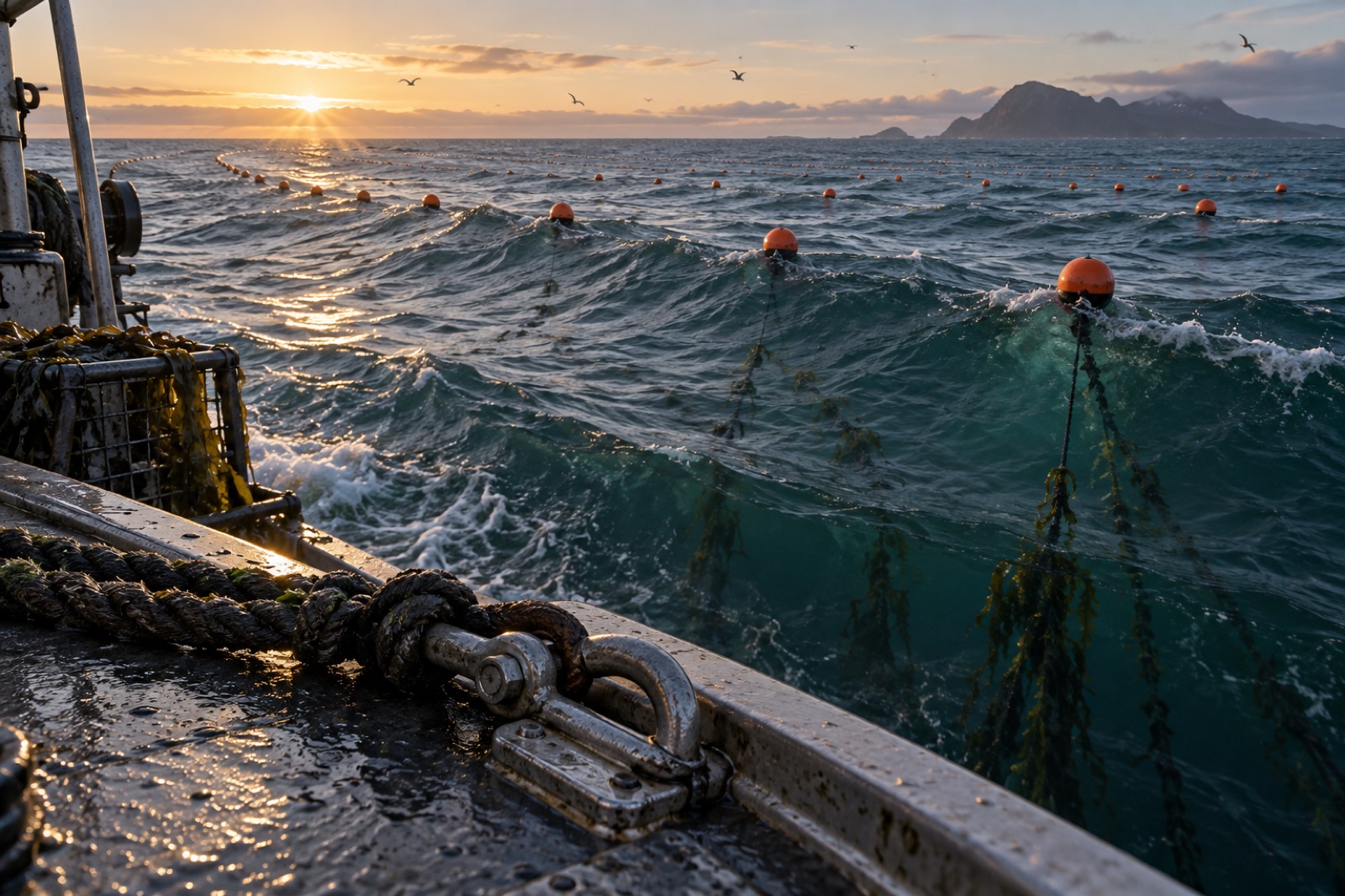
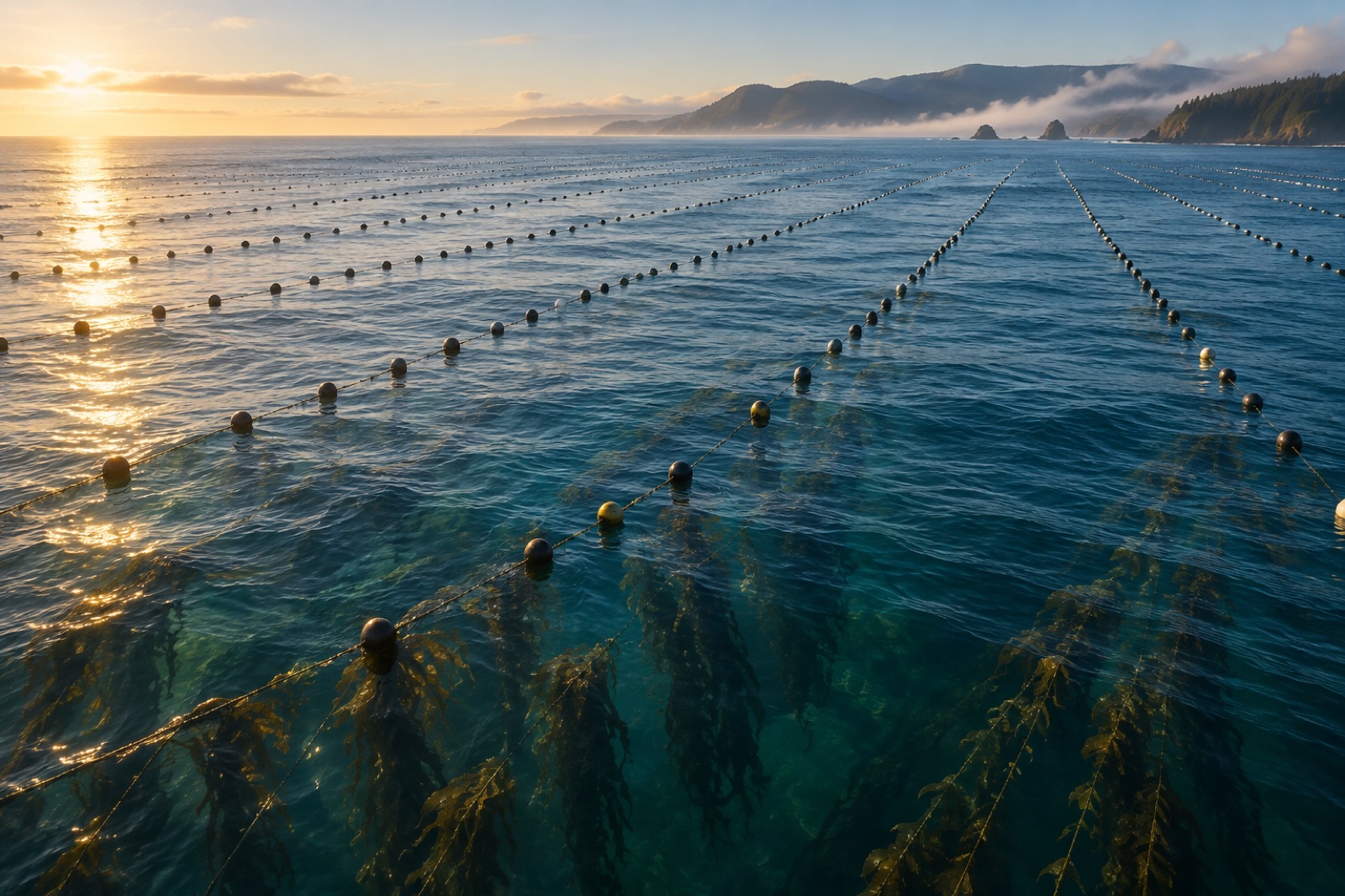
Ask an offshore kelp farmer what the job is, and the honest ones say: it's a structural engineering project that happens to grow food. The crop is nearly free — seawater, sunlight, nutrients arrive by themselves. What you are paying for is the gear that holds a tonne of moveable, growing, drag-adding biomass in water that occasionally tries to take it to Iceland. This article is the engineering workflow behind farms that survive: how to gather the right site data, set design criteria, estimate loads, design for fatigue and corrosion, and scale up without learning your lessons at 40 hectares. It pairs with offshore seaweed systems, which covers submerged-longline architectures and automation, and with storm-proofing a kelp farm, which covers the load philosophy. This one is the process itself.
Step one: measure the water, not the brochure
Every offshore design starts with metocean data — the statistical description of wind, waves, current and water level at your actual site. Skipping this step is how farms get designed for a bay that doesn't exist.
- Deploy instruments for at least a year. A directional wave buoy and an ADCP (acoustic Doppler current profiler) through one full winter teach you more about your site than any desk study. One season is a minimum, not an ideal.
- Buy or build hindcast series. Decades-long wave hindcasts let you estimate extremes you haven't measured. A one-year record tells you what winter looked like; a 30-year hindcast tells you what winter can look like.
- Measure currents at crop depth. Surface current and current at 5 m often differ dramatically. Kelp lines spend their lives at depth and your loads follow the water they sit in; how waves shape reefs explains why wave energy decays with depth — the entire physical basis for sinking a farm.
- Log the non-storm baseline. Everyday drift, tide cycles and seasonal current reversals decide anchor orientation, header directions and workboat access windows. The storm is the design case; the baseline is the operations case.
Step two: set design criteria in writing
Before hardware, write down what the farm must survive and what it must merely do. Offshore design lives and dies on these numbers:
- Return period. Statistically rare storms are quoted as 1-in-25-year or 1-in-50-year events. Choose yours by consequence: a farm near shipping or infrastructure wants 1-in-50; a remote trial bay might accept 1-in-25. State it explicitly and design to it. "It should handle storms" is not a criterion.
- Design storm vs operating limit. Two different numbers. The farm must survive the design storm (no failures) but only operate — harvesting, access — up to a modest sea state, typically a couple of metres significant wave height for small boats. Confusing the two is how people oversize workboats and under-size moorings.
- Fatigue life. Offshore farms cycle under load millions of times per winter. Specify a fatigue life: e.g., components survive the worst season's load spectrum several times over between inspections.
- Crop-state assumption. Design loads must assume peak biomass plus biofouling — the farm at its heaviest, ugliest wettest — not the clean grid you installed.
Step three: estimate loads honestly
You don't need a full hydrodynamic model for a small farm, but you do need ordered arithmetic. The physics is drag-dominated: force scales with the square of water velocity past the structure and with the projected area of everything in the flow — ropes, buoys, crop, fouling.
Practical implications:
- Wet biomass is the load. A hectare of grown-out kelp presents enormous drag area. Load grows all season while nothing on the farm visibly changes — then the winter storm meets your heaviest crop.
- Fouling multiplies area. A rope fouled with hydroids has several times the drag of a clean one. This is why the mid-season biofouling management routine is a structural task, not just a cosmetic one.
- Snatch loads are the peak. Caught between a dragged-under buoy and a wave trough, slack lines take up with impacts well above mean loads. Elastic elements (nylon risers, stretch sections) exist to absorb these.
- Safety factors across the whole load path. Sizing convention: minimum breaking load five to ten times the maximum expected working load, applied to every component — shackle, thimble, splice, chain, anchor. The famous strong parts die because a cheap connector in the middle wasn't specified.
For anything beyond a modest trial grid, commission a numerical model or a naval architect experienced in aquaculture moorings. The cost of modelling is a rounding error against the cost of a failed 20-hectare grid.
Step four: design the grid for depth, stretch and inspection
Three design patterns dominate exposed-water farms:
- Submerge the crop. Wave energy falls steeply with depth. Grids that sit a few metres down — emerging to the surface only at service buoys — escape the worst of storm seas. The trade-off is harvest complexity and light for young plants; longline design covers the depth and spacing mathematics, and submerged architectures in detail in offshore seaweed systems.
- Elastic where motion needs absorbing, stiff where alignment matters. Nylon risers absorb snatch; low-stretch headers keep rows aligned; chain near the seabed resists abrasion. Material choice per segment is covered in rope and line materials.
- Orient to the dominant direction. Rows laid parallel to dominant swell shed load; rows perpendicular invite it. Use your measured directional data, not the chart that came with the lease.
Step five: design for the two killers nobody photographs
Storms get the attention; fatigue and corrosion do the killing. Both are silent, cumulative, and present in every offshore season.
Fatigue. Every wave is a load cycle. A small farm cycles millions of times per season. Ropes fail in fatigue well below their breaking strength, especially at terminations where fibres bend sharply over thimbles. Mitigations: generous bend radii, splice quality assurance, replacing cyclic-load components on a schedule rather than on failure, and retiring lines that have seen multiple winters regardless of appearance.
Corrosion. Galvanised chain in warm, oxygenated splash zones can lose material fast; stainless in oxygen-starved crevices pits. Mitigations: segregate metals with isolation links or sleeves; oversize the sacrificial sections ( seabed chain, shackles) deliberately; adopt a corrosion allowance in the design (assume sections thin measurably per season); inspect and photograph rated components every season against their as-new condition. A farm's most valuable photo album is its hardware inspection record.
Step six: prototype, instrument, then scale
The single most reliable pattern in successful offshore farms is staged scale-up:
- Pilot bay (one to a few lines, one full season). Instrument it: a load cell in a riser, a temperature-and-motion logger on a buoy, a camera. The pilot's job is not biomass; it's data. Compare measured loads against your Step-three arithmetic and recalibrate.
- Operating bay (a hectare or few). Prove crew logistics, access windows, harvest-at-sea technique and maintenance cadence.
- Scale. Only after two winters at operating scale — including at least one storm past your operating limit — expand boldly.
The instinct to skip stage one reads as efficiency until you price a grid replacement. Every serious offshore program on Earth has this shape for a reason.
Step seven: documentation, marking and the paperwork that protects you
Offshore engineering has a compliance layer, and farms that treat it as part of the design fare better with insurers, regulators and neighbours:
- As-built drawings and component certificates. Record every MBL certificate, shackle batch and rope lot. When something fails — and eventually something will — this record is how you learn from it and how insurers evaluate claims (insuring a seaweed farm covers what underwriters ask for).
- Aids to navigation. Corner buoys, lights, AIS markers and chart notification are required in most jurisdictions; design them into the mooring plan rather than bolting them on.
- Maintenance manual. A one-page-per-bay inspection schedule with photographs of correct terminations. Crew changes happen; the manual is the farm's memory.
- Emergency plan. What drags, what drifts, who calls whom. Exposed sites owe neighbours a plan for breakaway gear, especially toward shipping or shellfish grounds.
Tidewright applies the same discipline on restoration sites — Drifter's survey-before-deploy philosophy and the load-rated Holdfast lines it lays on rocky substrate borrow heavily from this offshore farming engineering canon, which is one reason the two industries learn from each other so fast.
Key takeaways
- Start with a year of measured metocean data plus a long hindcast; estimate extremes, currents at crop depth, and the everyday baseline.
- Write down your design criteria: a return period, a design storm vs operating limit, a fatigue life, and a peak-crop fouled load assumption.
- Loads are drag-dominated and grow all season; apply 5–10× safety factors to every component in the load path, not just the famous parts.
- Fatigue at terminations and corrosion in splash zones kill more farms than dramatic storms; schedule component replacement and maintain an inspection photo record.
- Scale in stages across two winters — pilot, operating bay, then scale — and let instrumented measurements, not optimism, justify each step.
FAQ
How much does offshore site characterisation cost?
Instrumenting a site with a directional wave buoy and ADCP for a year typically runs into five figures; adding hindcast analysis and reporting pushes it higher. It's the single most-resented cost in early budgets and the cheapest money a serious farm spends — far less than one replaced grid.
Do I need a naval architect for a small offshore farm?
For a single exposed bay, sound engineering judgement plus conservative safety factors may suffice. For anything intended to scale, a moorings-experienced engineer pays for themselves in design iterations avoided. The dividing line is consequence: if failure endangers navigation, neighbours or your season's revenue, hire the engineer.
What's the most common single engineering failure on exposed farms?
Underspecified terminations — the shackles, thimbles, splices and connectors. Ropes are specified by catalogue breaking load and installed with hardware that wasn't. Audit the whole path from anchor soil to crop line, and weight extra scrutiny on anything that bends, twists or turns.
Can I retrofit an existing nearshore farm for exposed water?
Partially. Grid orientation and submergence can be retrofitted; anchoring and fatigue-aged components often can't, and older line stock should be replaced rather than re-rated. Most retrofits end in a rebuild of the load path, so plan it as one.
How do offshore farms affect marine life?
Properly designed farms tend to be neutral-to-positive for local fauna — lines act as fish-attracting structure — but the real answers are site-specific and measured: baseline surveys before installation, monitoring during operation. The broader ecosystem interactions of big kelp installations are covered in kelp farm ecosystem effects.