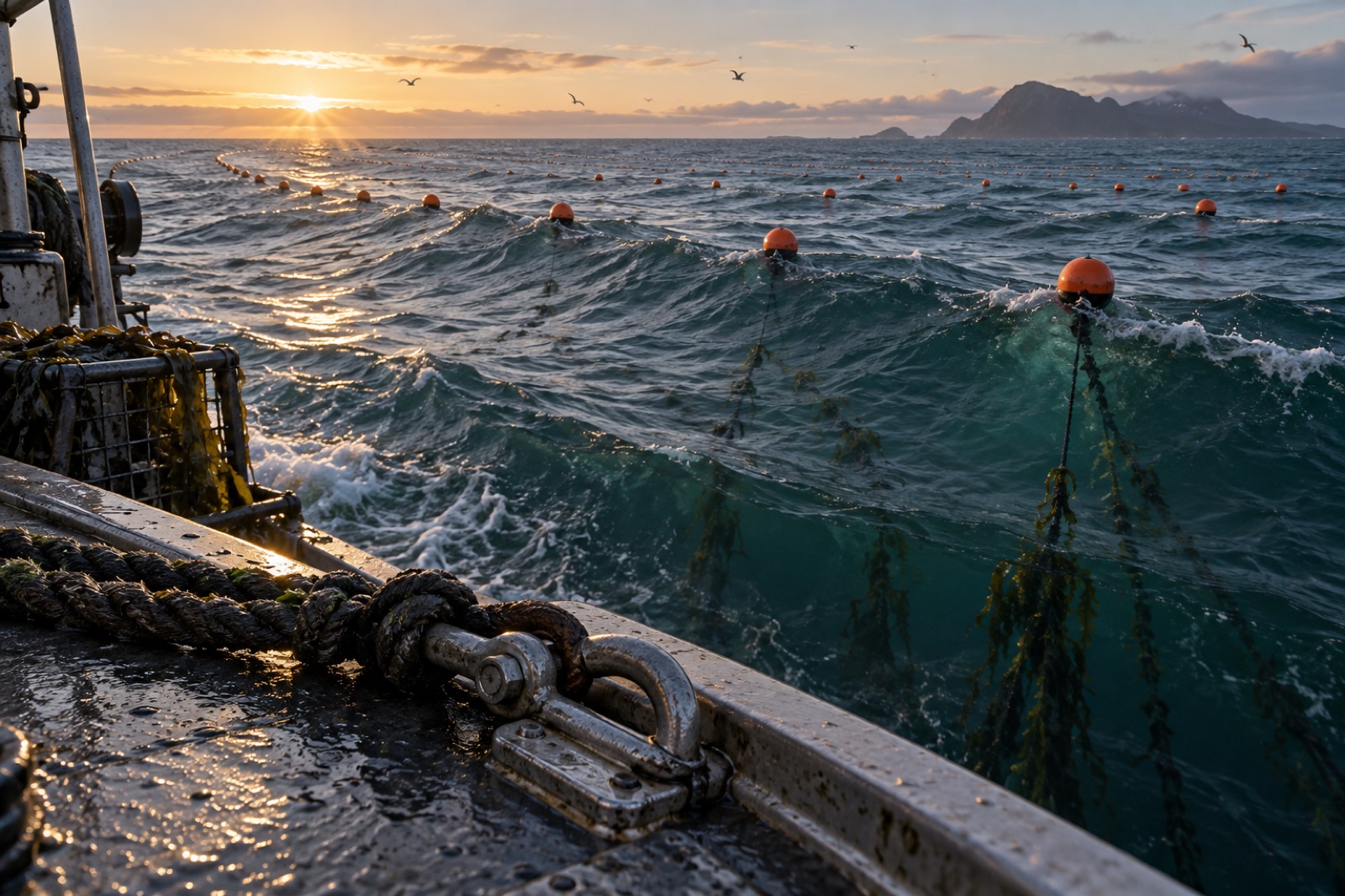
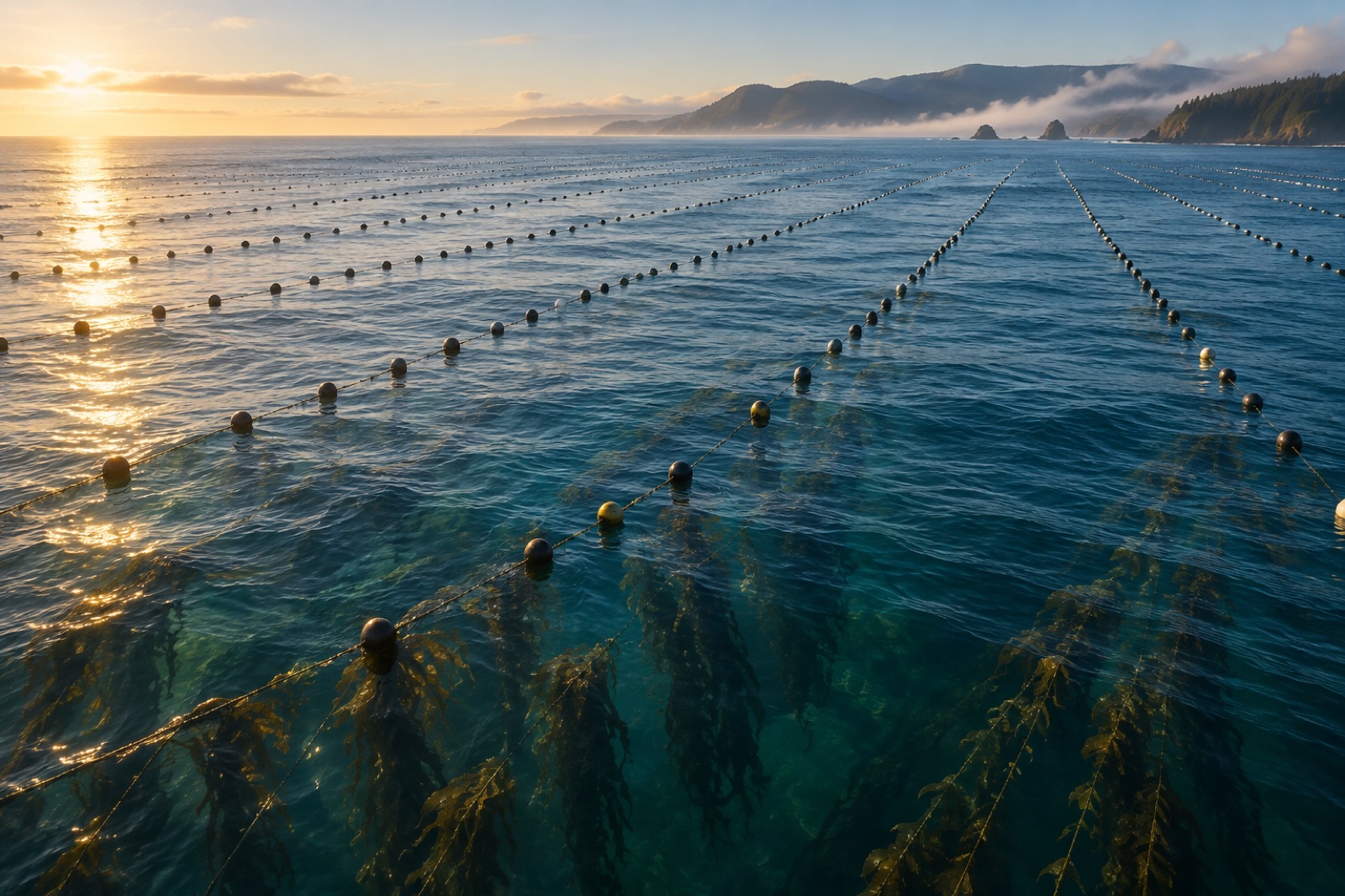
The single most powerful idea in exposed-water seaweed farming can be written in one line: wave energy dies with depth. The orbital motion that hurls a surface buoy through a three-metre arc shrinks to a gentle sway five metres down, and to almost nothing at fifteen. Every serious offshore kelp design — submersible longlines, sinking grids, depth-adjustable arrays — is a way of putting that sentence to work. This article is the design handbook: how deep is deep enough, how to build lines that can travel between the sunlit surface and the storm-shelter below, and how to operate a farm that changes depth like a submarine changes trim.
It assumes you have absorbed the metocean workflow in offshore kelp engineering and the case for going offshore in offshore seaweed systems. Here we open the drawings.
Depth is the design variable
Surface waves move water particles in circles — orbits — whose diameter decays exponentially with depth. The engineering rule of thumb: orbital velocity at depth z is roughly the surface value multiplied by e^(−kz), where k depends on the wavelength. In plain terms, for a typical storm swell:
- At half a wavelength down, wave motion has fallen to a few percent of the surface value — effectively calm.
- At an eighth of a wavelength, motion is still around a third of the surface value — survivable but working hard.
- Short, steep local chop — the 20–40 m waves of an inshore storm — is essentially gone by 3–5 m. Long-period ocean swell of 150–250 m wavelength reaches much deeper; sheltering from it takes 10–20 m.
This is why site characterisation decides architecture, not taste. A farm whose design storm is locally generated chop can hide in shallow submergence; a farm facing oceanic swell must engineer for real depth. How waves shape reefs covers the physics from the ecology side, and wave exposure and kelp explains what the same energy does to wild forests — your crop feels the same forces the forest does, minus a kelp plant's hundred million years of flexible engineering.
The light trade-off: how deep can the crop live?
Kelp pays its rent near the surface. Growth is fastest in the top few metres where light saturates photosynthesis, and juvenile sporophytes — newly outplanted on seeded line — are especially light-hungry. Light underwater lays out the attenuation curve; the practical numbers for design:
- Outplanting phase (first 4–8 weeks): keep seeded lines shallow — 0.5–2 m in clear water — while sporophytes establish. Young plants deep-sunk in turbid water may stall or die.
- Grow-out phase: adult sporophytes tolerate and often benefit from 2–5 m of submergence in clear offshore water, with reduced fouling and epiphyte pressure as a bonus.
- Storm events: the crop can survive days at 8–15 m without meaningful physiological cost, provided the excursions are occasional. Temperature and light at those depths are tolerable for short periods; it is mechanics, not biology, that limits storm submergence time.
The design synthesis that follows: an adjustable farm lives shallow by default and drops only when it must. Every metre of permanent submergence costs you growth; every metre of available drop buys you storm survival.
Three architectures for going under
1. Static submerged grids
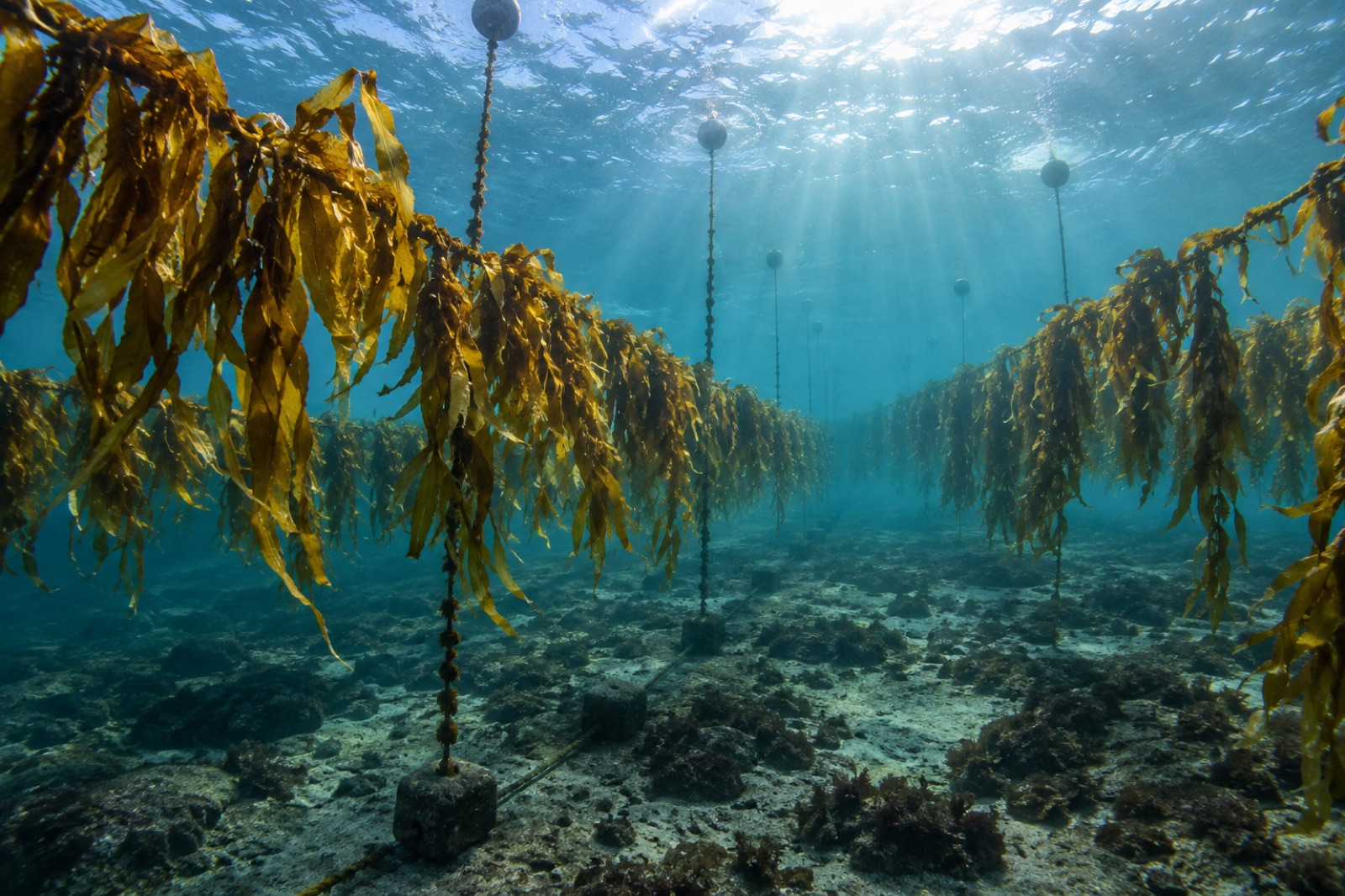
The simplest: the whole grid — headers, grow lines, floats — hangs permanently at 3–8 m on weighted risers, with only small service buoys at the surface or none at all. Loads at that depth are a fraction of surface loads; the design case becomes current drag plus fatigue, not storm slamming.
Trade-offs: harvest requires lifting lines to the surface mechanically (see below), surface marking becomes critical for navigation (which is why sub-surface farms lean heavily on lit, AIS-marked corner buoys — covered in farm anchoring and mooring), and outplanting must be done on a temporarily raised section or a separate shallow nursery grid. Best for sites with consistent moderate exposure where "always a bit deeper" is a permanent lifestyle.
2. Winch- or counterweight-adjusted grids
Each line, or each module of lines, hangs from risers whose length can be changed: deck winches on a workboat, or — more elegantly — fixed surface buoys with multiple riser attachment points, so moving a line from "growing depth" to "storm depth" is a fast operation per module. Counterweight systems invert the logic: a drop-weight hangs from each line and pulling the weight up sinks the line; release returns it.
The design disciplines:
- Standardise the drop operation to a small number of steps per module; a farm of 60 lines that takes 20 minutes a line does not get dropped in a 36-hour forecast window.
- Design the storm-depth geometry so lines cannot tangle: deeper lines converge toward the mooring ends, so neighbouring lines need more vertical or horizontal separation at storm depth than at growing depth.
- Fail to safety. If a winch cable parts or a crew member is late, the line's default state should be down, not up. Design drop to be the unpowered state wherever possible.
3. Buoyancy-controlled lines
Pioneered at the experimental end of the industry: lines whose floats are inflatable, ballastable bladders. Pump air in to raise the crop for growth or harvest; vent air to sink it before a storm. Per-line compressors can be solar-powered, making the depth change remote and automatic — no boat required — which solves the labour-window problem entirely.
The engineering cost is complexity: umbilical air lines on every riser, valves rated for years of splash-zone duty, and a control system that must itself survive the storm it is hiding from. The discipline for these systems is redundancy: two independent vent paths per line and pressure sensors on every bladder, because a partially sunk line in a rising sea is the worst state of all — deep enough to snag, shallow enough to slam.
Wave loads on a submerged grid: the arithmetic that shapes everything
Drag on a line scales with projected area and with the square of water velocity past it. Submergence attacks the velocity term. Worked example with round, illustrative numbers:
- Design storm at surface: orbital velocity 2.0 m/s under the crest.
- Same storm, five metres down on short-period seas: 0.7 m/s.
- Load ratio: (0.7 / 2.0)² ≈ 0.12 — nearly nine-tenths of the load gone, for five metres of depth.
That squared term is why submergence outperforms beefing-up so decisively. Doubling your line's breaking strength doubles your survival; halving the water velocity quarters your load. It is also why the top metre of any riser — the part that never leaves the energetic zone — deserves the best rope in your inventory; rope and line materials covers where nylon's stretch and polyester's low creep each belong.
Currents ignore all this. Tidal and storm-surge currents reach full depth, so your deep design case is peak current plus peak biomass plus peak fouling — the arithmetic engineers dread and beancounters bless, because it argues for harvesting on time and keeping fouling under control (biofouling management is load management, not cosmetics).
Operating a depth-adjustable farm: drop protocols
The mechanism is only half the design; the protocol is the other half. Farms that survive write theirs down:
- Trigger on forecast, not on weather. Define the sea state at which lines go down (say, forecast Hs above 3.5 m within 48 hours) and who is authorised to call it. Subjective calls in deteriorating weather are how drops get skipped.
- Drop early, rise late. Growth lost to two extra days at depth is trivial; gear lost to one early storm is not. Log every drop and rise; your own history becomes your calibration, and your insurance documentation (see parametric covers for storm events) becomes straightforward.
- Rise gradually. A line surging up through surface chop takes snatch loads; rise at slack water or the calm side of the storm's passage, and check every riser before re-loading.
- Rehearse in the calm season. The first full drop of a new grid should happen on a flat day in spring, not in November's first gale.
Harvesting from beneath
Submerged design forces harvest method decisions early. The workable patterns: lift lines mechanically to the surface and cut at the boat (familiar deck work, heavier hardware); strip-cut in place with cutters passed along a lifted header; or raise single grow lines sequentially onto a handling drum. All three are engineering choices with crew-safety consequences, and they belong in the original design brief, not the second season's retrofit list. The harvesting systems end of this question is covered in mechanised kelp harvest.
Tidewright applies the same depth-first thinking to restoration gear: the seeded Holdfast lines Drifter lays are specified to sit below the wave base on exposed reefs, borrowing the offshore industry's hard-won lesson that the cheapest structural material on the coast is water above the gear.
Key takeaways
- Wave orbital motion decays exponentially with depth; a few metres of submergence removes most storm loading, and because drag scales with velocity squared, depth beats strength as a survival strategy.
- Juvenile kelp needs shallow, well-lit water; adults tolerate storm-depth excursions of days. The optimal farm lives shallow and drops on forecast.
- Choose an architecture to match your exposure: static submerged grids for consistent moderate exposure, winch/counterweight systems where boats can respond, buoyancy-controlled lines where remote or rapid drops are essential — and always fail to the down position.
- Design the drop protocol with the same care as the hardware: written triggers, early drops, rehearsed crews.
- Depth solves waves, not currents: the deep design case remains peak current plus peak fouled biomass.
FAQ
How deep should I sink longlines before a storm?
There is no universal number — it depends on your design storm's wavelength. As a working guide, 4–6 m shelters you from short-period local seas, while long oceanic swell may keep meaningful energy down to 15 m or more. Base the target on your site's measured wave climate, and verify it with a load cell on a riser during the pilot season rather than trusting the desk study.
Do submersible farms need different surface marking?
Yes, and regulators will insist. A farm with no surface crop still has anchors, risers and lines a shallow-draught vessel can foul. Expect requirements for lit corner buoys, AIS markers and chart notification; the exact rules live in your lease conditions and with the navigation authority.
Is depth adjustment worth it for a small inshore farm?
Usually not. Below roughly one hectare in moderate exposure, conservative surface design — elastic risers, generous anchors, sparse float strings — plus a disciplined storm-prep routine is cheaper and simpler. Depth adjustment earns its complexity when the design storm is big enough that surface engineering reaches absurd sizes, or when crew cannot safely reach the site in the forecast window.
What is the most common failure mode of adjustable systems?
Mechanism degradation from marine growth and corrosion: seized sheaves, fouled buoyancy bladders, air lines choked by biofouling. Anything that must move after months submerged must be designed to move under fouled conditions — oversize the actuation force, protect moving parts, and operate every mechanism monthly in the off-season to prove it still works.
Can I retrofit depth adjustment onto an existing surface grid?
Partially. Mooring legs and anchors often carry over; headers, risers and flotation usually do not, because the load paths change completely. Most retrofits end as rebuilds of everything except the seabed hardware, so plan and permit them as new installations rather than modifications.