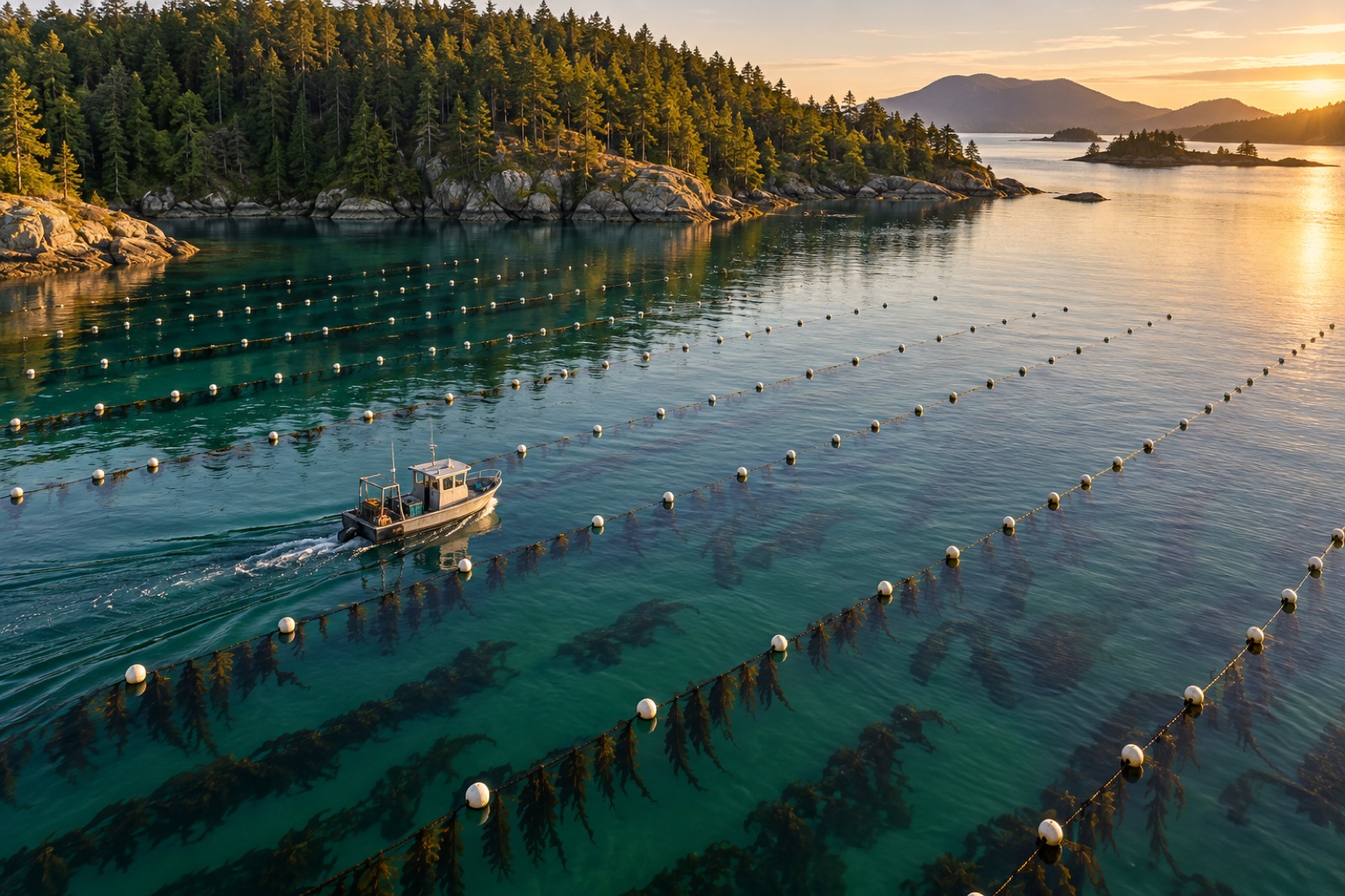
A seaweed farm is not, at bottom, a farm of kelp. It is a farm of moving water. Kelp grows by stripping nitrate and phosphate out of the water that passes over its blades; blades that sit in still water deplete their own microenvironment within minutes and stall. Everything else — rope, anchors, buyers, storm seasons — matters after this fact, not before it. The layout decisions you make at drawing-board time — line orientation, spacing, depth, block shape — are in reality decisions about how your farm will exchange water, share light and behave under load. Get them right and the site looks effortless. Get them wrong and no amount of workboat hours will grow a crop.
The physics you are farming
Think of a kelp blade as a diffusion device in a current. As water moves across the blade surface, the thin boundary layer hugs the frond and is steadily stripped of nutrients; current speed and turbulence renew that layer, and with it the blade's access to nitrogen. Below some low-flow threshold, blades starve in plain sight; above a high-flow or high-wave threshold, blades tear and drag loads climb into anchor-pulling territory. Between those limits is the productive band, and a well-sited farm site spends most of its growing season inside it.
Light is the paired argument. Kelp photosynthesises only where photons survive — read light underwater for the physics — and in a farm layout the canopy itself steals light: a dense top-down harvest row at two metres depth shades anything beneath it or immediately behind it relative to the sun path. Farm design is a trade between water exchange, light access and drag load, on every line, in every season.
Line orientation: ride the current, don't fight it
The classical rule is to run grow-lines parallel to the dominant current, and it is right more often than not. A line parallel to flow presents the minimum silhouette to water, generates the least drag, and lets each blade hang into the passing current edge-on like a vane. Drag on a parallel-oriented farm scales gently with current, whereas drag on a perpendicular farm scales brutally — and drag is what breaks anchors, snaps bridles and writes insurance claims.
Where the current turns — tidally reversing channels, eddying embayments — the design rule shifts from a single axis to accepting the mean-flow vector and considering a second principle: blades on lines parallel to a reversing current self-flip with the tide, delivered with a sort of built-in passive turbulence on each turn. Many successful farms in reversing channels simply accept the dominant axis; the loss at the off-peak half of the tide is usually small next to the drag penalty of a cross-current lay.
One complicating factor: at some depths and sites, the strongest current axis and the dominant swell-readied storm axis are not the same. When that happens the layout must answer storm loads first (see offshore kelp engineering for the design logic under real weather), because a storm-oriented farm that survives and grows moderately beats a current-optimised farm that fails in December.
Spacing: the mutual-shading maths
Spacing is where most first-farms go wrong, and the errors come in both directions.
Line spacing (between grow-lines parallel to flow) couples nutrient supply and light. If lines are too close relative to current speed, each row of kelp acts as a filter that the next row downstream must live on: nitrate drops, water slows, and the rear rows run at a deficit. Layout practice in working farms has converged on many metres between main lines — on the order of four to ten metres for kelp longlines, widening at sites with slower flow. There is no free spacing: wider gaps increase the anchor and mooring footprint per crop tonne, decreasing yield per hectare even as per-row yield climbs.
Grid spacing (between structures on a longline) shapes blade density. Seeding density on the line sets the demand, but geometry sets survival: blades that tangle against their neighbours abrade themselves into stringy loss, and dense interior sections of an over-full line end up growing in the shade of their own canopy. Designing for the adult canopy, not the juvenile seeding, is the discipline here.
Block spacing (between farm blocks) is the forgotten dimension. Two adjacent five-hectare blocks with no gap can behave as one shadowed ten-hectare massif regarding nutrient drawdown and light. Farm blocks need unattended water lanes among them — typically tens of metres wide — that let current flush the gaps, sun reach the interior, and the workboat navigate without fouling a crop line. Those lanes are also the farm's safety margin: they are where gear swings in a storm, and they define the paths to access a line for harvest or maintenance at any tide.
Depth: where in the water column the farm lives
Depth decisions are layout decisions because they override everything else. Kelp culture depth is a response to three forces:
- Light: blades need to sit shallow enough to photosynthesise to their potential. Rule-of-thumb working depths for sugar kelp culture run from one to several metres, tracking water clarity; a turbid site grows best in the top couple of metres, a clear oceanic site can carry blades productively ten metres down.
- Wave exposure: shallower means more orbital motion from waves, more blade whip, more breakage risk near the surface in a blow. Deeper rides steadier but starves light. Depth selection is this tradeoff, made once, and the answer depends on the worst expected storm, not the calm-season average.
- Fouling: the well-lit surface layer is where the biofouling community — barnacles, bryozoans, hydroids, filamentous algae — also wants to live. Dropping lines a metre or two below the brightest water during peak fouling season is one of the oldest tricks in biofouling management, and it is a layout decision made at the design stage, not a mid-season afterthought.
Drawing the whole board
A design that survives translation from bathymetric chart to planted farm follows an ordering. First, map current speed and direction through the growing season — cheap current meters, even a drogue and a GPS over a tide, give you the basis of practice; reading the water is the companion skill. Second, map light: depth and seasonal clarity, plus where the farm itself will shade. Third, lay the blocks, oriented to the flow, spaced to flush the interior. Fourth, draw the work lanes, the turning circles and the storm-swing room. Fifth, only then, size the hardware: line type, anchors, buoyancy — the subject of dedicated longline design and anchor and mooring guides.
The result is not just a productive farm but a legible one. A layout that respects flow and light is almost always a layout that harvests quickly, suffers less drag damage, keeps fouling manageable and — not incidentally — reduces the farm's own footprint on the bay around it. The question of what a big farm does to a bay's shading, flow and water chemistry is its own subject (see kelp farm ecosystem effects), and the bite-sized version is this: well-designed internal spacing does double duty. It grows kelp, and it keeps the farm permeable to the ecosystem that hosts it.
Key takeaways
- Kelp farms live or die on water exchange: a blade in still water starves inside its own depleted boundary layer.
- Orient lines parallel to the dominant current minimum-drag axis, accepting reversing flows as they come rather than fighting them.
- Space lines to protect downstream nutrient supply and interior light; spacing rules are functions of current speed, not just neatness.
- Block gaps of tens of metres are essential infrastructure — flush lanes, light lanes, boat lanes and storm-swing room in one.
- Set culture depth for the worst expected storm, the clarity of the water in season, and the biofouling window — depth is a design answer, not a fix later.
FAQ
How do I measure current at a candidate site cheaply?
A series of timed drogue drifts with GPS over a full spring–neap cycle gives you directional and speed ranges for free surface flow; a cheap acoustic current meter on a mooring for a few weeks gives depth-resolved data. You are not generating an oceanography paper — you are checking that flows sit in the productive-and-survivable band and identifying the dominant axis for layout.
Should lines be exactly parallel to peak flow?
Naturally near enough, not exactly. Tidal flows swing in direction; the layout aligns to the mean-flow vector over the strongest part of the tide cycle. A few degrees of offset barely matters; a cross-current lay always does.
Does closer spacing ever pay off?
At very fast-flow sites with nutrient-recharged water, tighter spacing can raise yield per hectare. But on still embayments it guarantees downstream suppression and tangled canopies. Spacing is a flow-index dial, not a yield dial.
Is it worth modelling flow properly before committing?
On any farm over a hectare or two, yes. Simple hydrodynamic models of current, wake and nutrient depletion are now standard tools, and running one against a proposed layout is cheap compared to re-mooring a failed farm. For very small farms, careful current measurement and conservative spacing covers it.
Generously. Permeable layouts — current-oriented lines, adequate interior flushing lanes — function as flow-through structures and impose much less shading and drag on the host bay than dense monoblock farms. Good layout is ecosystem precaution as well as agronomy.