Field Notes8 min read
Field Notes: Counting the Neighbourhood Inside a Holdfast
Inside a kelp holdfast census at Tinderbox: bagging, sieving and counting the hundreds of small animals that tell us whether a restored reef is alive.
Dr. Mara Ellison ·
Field notes from a winter holdfast census across a Tasmanian reseeding site: urchin counts on treated vs control transects, and what we changed for next season.
Field Notes are Tidewright's own dispatches from our (fictional) restoration sites. Everything in this one — the counts, the sites, the crew and the decisions — is illustrative, written to show how a winter census actually runs and what it can teach.
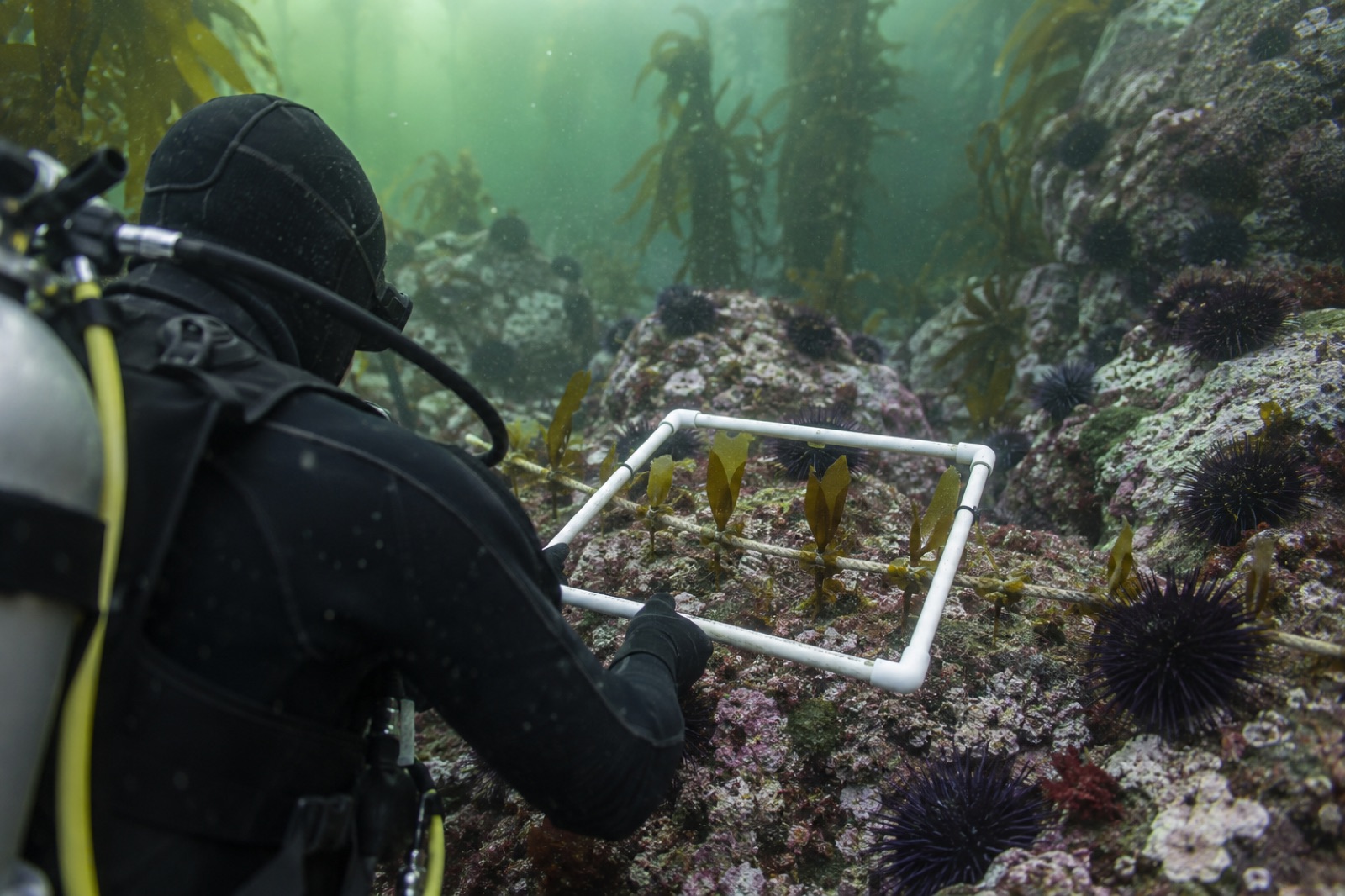
Every June we do the census nobody photographs. Not canopy mapping — the drones have that shift — but the winter holdfast census: two weeks on our knees at the bottom of the Lumeriah Coast program, counting what lives inside the grip of every Holdfast line we seeded, and counting the urchins waiting to eat everything we planted. This year the census ran the full length of the urchin zone, and the split it showed between treated and control transects has already rewritten next season's work plan. All figures below are illustrative; the pattern they describe is the one we manage by.
A kelp holdfast is not a root; it is a lattice of hollowing fingers gripping rock, and once a plant is established that lattice becomes an apartment block — amphipods, isopods, polychaete worms, small crabs, bryozoans, the whole floor of the reef's food web compressed into a handful of tangled haptera. Our holdfast biology explainer covers the anatomy; we published a first close look at this hidden neighbourhood in an earlier census note. The winter census exists because holdfast community richness is the earliest leading indicator we have that a seeded forest is becoming habitat, not just biomass — often one to two seasons before fish surveys show it.
The method, in one breath: along each 30-metre belt transect we measure holdfast basal diameter and survival for every seeded plant, lift a subsample of holdfasts for a community count in tubs on the boat, and run a parallel urchin count on the same transect line. Belt transects and quadrats are the same humble tools every reef ecologist on Earth uses — we describe why in how ecologists count a kelp forest — which is entirely the point: anything a verifier or a council scientist wants to rerun, they can rerun with a tape and a slate.
The census blocks sit across three treatments:
Winter is census season because the long-spined urchin is slowest and most visible in cold water, storm season has already pruned weak plants (so survival numbers mean something), and the water, while never warm, is at its clearest for one grey month.
I'll give you the census in the compressed form it went onto the whiteboard back at the shed — per-transect means, illustrative figures, across the urchin zone blocks:
| Block | Urchins per 30 m transect | Seeded-plant survival | Mean holdfast basal diameter |
|---|---|---|---|
| Seeded + suppressed | 9–14 | 71% | 18 cm |
| Seeded, no suppression | 58–71 | 34% | 9 cm |
| Control barren | 64–76 | — | — |
Read that middle row twice. Seeding alone, without suppression, buys you a forest growing under a lawnmower. The plants recruit on our lines exactly as designed — germination is not the failure point — and then a surging front of long-spined urchins shaves the juveniles to the haptera through their first winter. The unsuppressed blocks aren't useless; they're data. They tell us the seed stock is sound and the bottleneck is grazers, and they keep us honest about which half of the intervention is paying the bills.
If the mechanics of that stand-off are new to you, our explainer on urchin barrens and why they stay barren covers the hysteresis — once a reef flips to barren, it resists flipping back without pressure relief.
Three decisions came directly off the census board.
The number that will matter in five years is not on the whiteboard rows above. It is what's inside the holdfasts: on suppressed blocks, subsampled holdfasts ran double-digit community counts — amphipod swarms thick enough to cloud the tub, juvenile abalone tucked into haptera gaps — while unsuppressed-block holdfasts, stunted by grazing, held a fraction of that life, and the barren offered almost none. A holdfast's community scales with its architecture, and architecture scales with protection from mouths. The census argues, from the bottom up, that grazer suppression is not one half of the restoration recipe. It is the precondition the other half stands on.
Two weeks of cold hands and slate pencils, and the program's next season bends around what a handful of numbers said. This is the least cinematic work we do, and the most consequential. The drones get the photographs; the transects get the truth.
A structured count of the kelp anchoring structures and the animal communities living inside them along fixed underwater transects. Because a holdfast's lattice of haptera hosts much of the reef's small-animal life, its size and occupants reveal whether a restored forest is functioning as habitat — often seasons before canopy or fish counts show the change.
No. Tidewright is a fictional company, and every count, survival rate and diameter here is illustrative — Field Notes exist to show how restoration monitoring is actually done and what it teaches. The underlying pattern is real science: urchin suppression responding fast, holdfast communities tracking habitat recovery, and barrens resisting reversion without grazer relief.
Because without them we cannot separate the interventions. The unsuppressed blocks prove the seedstock germinates and survives the nursery-to-reef handover; their failure under grazing isolates the urchin front as the bottleneck rather than letting us blame the stock or the lines. You need controls that hurt to look at for the numbers on the good blocks to mean anything.
Two divers per transect, working the standard belt-and-quadrat method that any reef ecologist knows: 30-metre tapes, fixed quadrats, waterproof slates. That is deliberate. Third-party verifiers, council scientists and our ranger partners can all rerun the census with the same tools in a day — repeatability by an outsider is a design requirement, not a courtesy.
Inside a kelp holdfast census at Tinderbox: bagging, sieving and counting the hundreds of small animals that tell us whether a restored reef is alive.
Dr. Mara Ellison ·
Join Tidewright's dive survey team as they count an advancing urchin front on Tasmania's coast — the methodical, cold, essential math of kelp restoration.
Jack Callum ·
The science of alternate stable states on rocky reefs: how kelp forests collapse into urchin barrens, why barrens resist recovery, and how reefs flip back.
Dr. Mara Ellison ·