Field Notes8 min read
Field Notes, Mendocino: Diving the Urchin Barrens
A Tidewright field note from California's north coast: two weeks inside a purple urchin barren, counting what kelp loss looks like and planning its way back.
Jack Callum ·
Dawn on Tasmania's east coast: four divers, two hammers, and a barren the size of a football pitch. What an urchin cull actually looks like from inside the vis.
The alarm goes at 4:40 and the thermos never had a chance to be full enough. By 6:15 we're idling over the mooring at the southern end of the Lumeriah coast project, and the sounder is painting the picture we've come to work on: hard reef at fourteen metres, flat as a benchtop, and — according to last week's survey — carrying long-spined sea urchins at densities that keep it that way.
This is a cull morning. Four divers, two hammers each, one spool of float lines and mesh bags that will mostly come up empty, because the plan today isn't harvest. The plan is subtraction.
If you haven't read our explainer on urchin barrens, the short version is this: a kelp reef flipped to urchin barren is a stable state, not a pit stop. The urchins — here the long-spined Centrostephanus rodgersii, marching south on a warming East Australian Current — crop every kelp sporeling before it can stand up. Left alone, a barren can hold for decades. The forest doesn't come back because the mechanism that would bring it back keeps getting eaten at two millimetres tall.
The ecological lever is the number itself. Research out of this coast's science community has long pointed at a threshold effect: get urchin density below roughly a couple of animals per square metre and kelp recruitment can get ahead of grazing. Above it, the barren defends itself. Our job this morning, on this particular half-hectare block, is to push the number through the floor and hold it there long enough for the Holdfast lines we'll lay next month to take root.
(All the project figures in these notes are Tidewright's own operational numbers — illustrative of how we work, not independent science. The science is linked throughout.)
You kit up in the dark and slide in as the light comes slantwise. First thing you notice, always: how clean a barren is. A healthy reef is cluttered — kelp, sponges, ascidians, fish weaving through. A barren is a geometry problem. Bare rock, pink crustose coralline, and urchins parked in every crevice like rivets.
The method is unglamorous. You work a grid line, buddy pair either side, and you crush in place. Hammer, once, through the test. The animal seals its own fate — punctured tests are cleaned out by wrasse and leatherjackets within the day, and what goes back into the reef stays in the reef. That's the credo the science crews drilled into us: the nutrients were borrowed from this bottom, so they go back to this bottom. Nothing comes up except the ones in the bags, and the bags are for the contingency plan.
The contingency plan is quality. Every fifth string of crevices, you find an urchin that's actually fed — gonads worth keeping. Those go in the bag, and the bags go to our partner processor, because a cull that occasionally pays for its own air fills is a cull that can afford to run more mornings. It's not ranching — there's a whole separate operation for turning barrens into uni, which involves holding and feeding rather than removing — but the overlap is honest: the best roe pays for the work that removes the worst empties.
By the second tank your forearms know about it. By the third, you've developed opinions about hammer handles and the personalities of crevices. The dive profiles are easy — fourteen metres, nitrox, long bottoms — and the discipline is all in the grid. Miss a corner and that corner is next season's seed bed of barren-holders.
We log everything per hundred-metre transect: animals crushed, animals bagged, time, and a quick crevice check on the way out. This morning, between four divers and six tanks, the slate said 4,100 animals off the block. That sounds like a lot until you do the survey maths and remember what densities we're starting from. It will take three more mornings like this one on this block alone, and then — the part people forget — we come back. Culls aren't events, they're subscriptions. We'd rather run a small maintenance cull every season than a heroic one every five years, because the maintenance cull is the one the budget survives.
The sensation I keep from mornings like this is from the swim back to the anchor line: you look back over a block of pink rock that is, for the first time in years, empty. It doesn't look like recovery. It looks like nothing. The recovery is too small to see — kelp spores already settling out of the water column, looking for exactly this: clean coralline crust without a mouth sitting on it. The crustose coralline algae under the urchins is the recruitment cue the forest has been broadcasting all along; the barren just had a standing army parked on the message.
The sequenced plan on this reef is the standard Tidewright stack, adapted with the local science crew: cull to threshold, hold the threshold, seed with locally matched giant kelp and golden kelp lines, and monitor with fixed transects and the Canopy Ledger drone passes. Predators are the long-term answer — this coast's southern rock lobsters are among the few animals that will take a large long-spined urchin apart — but predator recovery works in decades and the canopy works in seasons. We do the hand-work so the ecology gets its window.
On the steam home, someone produced the flask that had actually stayed hot, and the talk turned, as it does, to the reef across the bay — the one that still has its forest. Barrens are a lesson in asymmetry: the forest takes decades to build, the barren takes one warm decade to make, and the way back is measured in hammers. But the way back exists. That's the whole reason for the thermos.
Tidewright's Tasmania program is run with local fisheries, scientists and Traditional Owners; cull operations are conducted under permit with independently surveyed thresholds.
Removal costs boat time and disposal, and a barren's urchins are mostly 'zombie' animals — starved, with little roe — that no market wants. Crushing in place is fast, lets reef scavengers recycle the biomass within days, and reserves lifting for the minority of quality animals that can offset cost.
No — a punctured test is fatal, and scavengers clean the shells out quickly. What returns is the population, via larvae from surrounding reefs, which is why density has to be held below threshold with repeat visits until kelp is tall enough to resist grazing.
It's done under permit with specified methods — a single rapid penetration is immediate. The alternative the science describes is a slowly expanding barren in which the urchins themselves starve in place; the trade-off is part of every approved plan.
We do both. Large lobsters and, elsewhere, sea otters can suppress urchins, but rebuilding predator populations takes many years and won't reach every barren. Manual removal is the bridge tool that works on the timescale kelp needs.
Fixed survey transects measure urchin density per square metre before and after each pass; the target threshold comes from the regional science, adapted per site with our research partners. When kelp recruitment starts outpacing grazing on the monitoring transects, the maintenance visits can stretch out — that's the number that actually ends the subscription.
A Tidewright field note from California's north coast: two weeks inside a purple urchin barren, counting what kelp loss looks like and planning its way back.
Jack Callum ·
Join Tidewright's dive survey team as they count an advancing urchin front on Tasmania's coast — the methodical, cold, essential math of kelp restoration.
Jack Callum ·
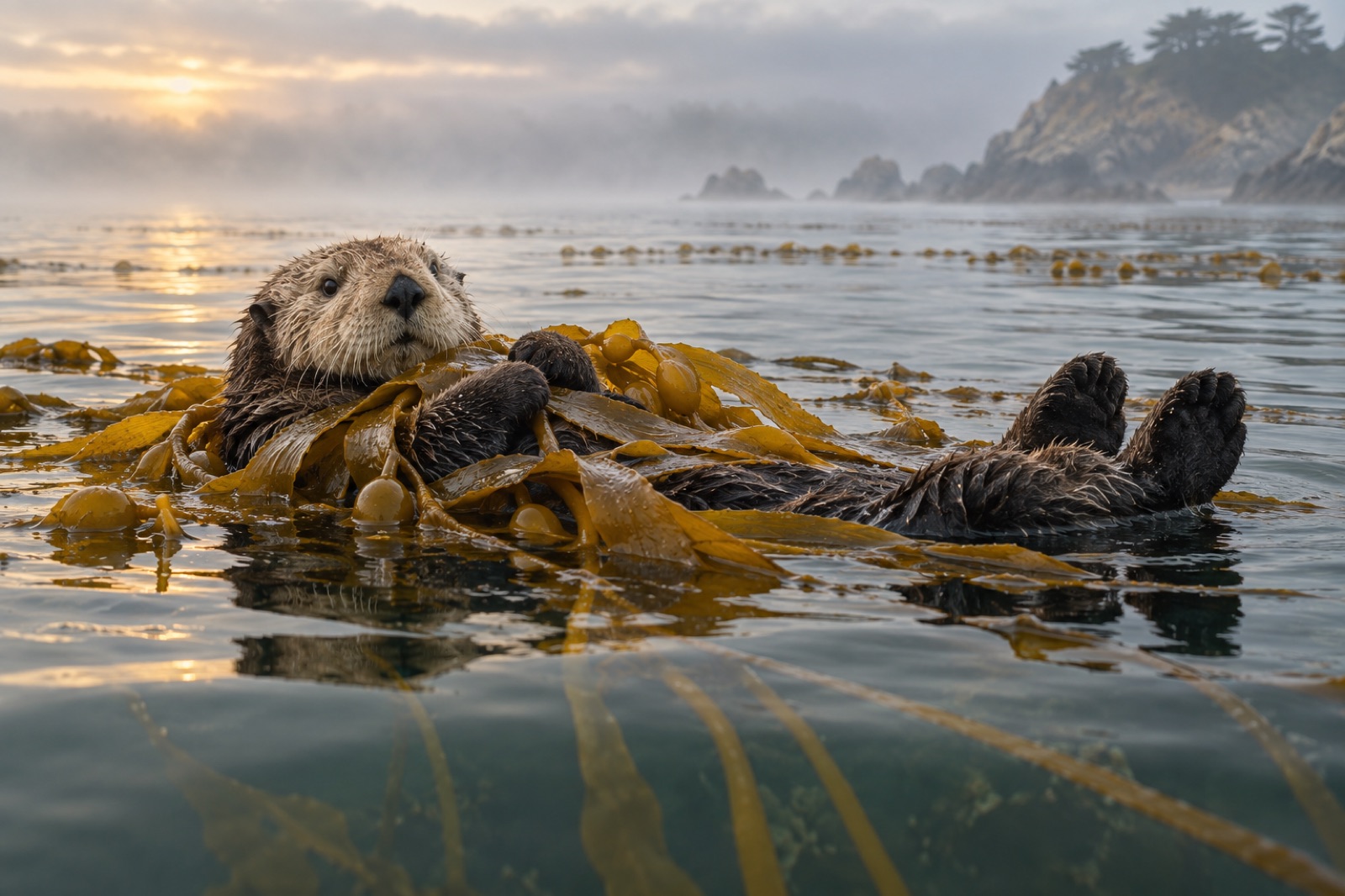
Two years after Tidewright reseeded an urchin barren off the Monterey Peninsula, a raft of sea otters moved in. Field notes on what that return really signals.
Jack Callum ·