Tidewright is a fictional company created as a design and content demonstration. These field notes are works of fiction written in the voice of our field operations team, and the figures in them are illustrative.
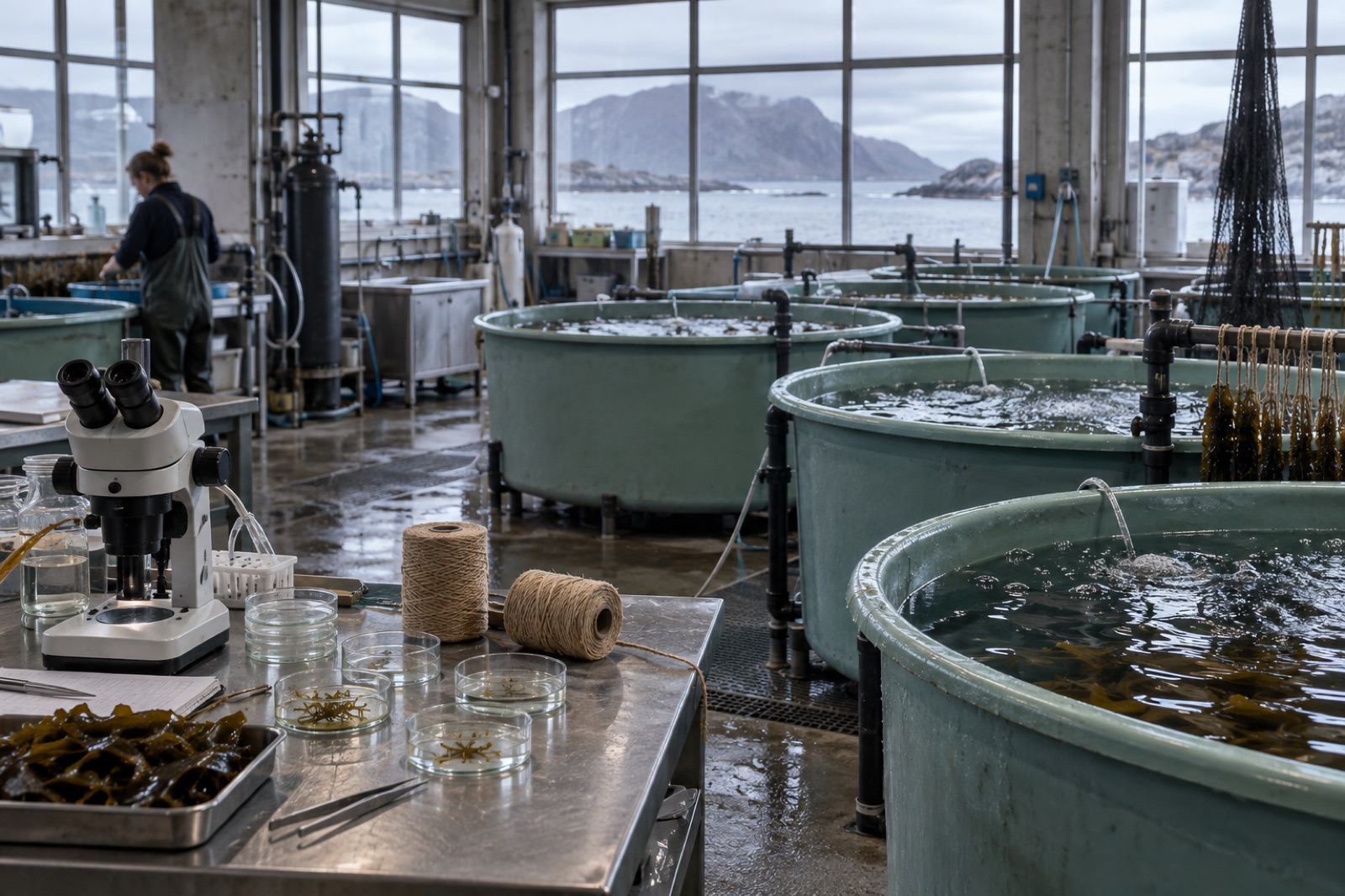
The hatchery at two in the morning is a building turned inside out. Everything that is loud in the day — the seawater pumps, the forklift, the radio, the argument about whose turn it is to sterilise the inoculation hood — goes quiet. What remains is the hum of the chillers, the click of the light timers, and the slow red glow leaking under the culture room door. If you've never stood a night watch over a living crop, you'd think nothing was happening. If you have, you know that two in the morning is when the building tells you the truth.
These are my notes from a stretch of night shifts at the Holdfast hatchery earlier this season — the quiet weeks between spore collection and the first big outplanting, when the gametophyte cultures decide whether the rest of the year has a forest at the end of it.
Why the lights are red
First thing trainees ask: why does the culture room glow like a submarine at battle stations? The answer is the trick that makes the whole Holdfast platform possible.
A kelp's life runs through two bodies — the big blade you know from the water, and a microscopic filament stage called the gametophyte that does the reproductive work. Our explainer on kelp's hidden generation covers the biology. The hatchery's job is to hold gametophytes in a kind of suspended adolescence: alive, dividing slowly, but forbidden from maturing into eggs and sperm until we say so. The lock on that door is light. Deep-red light, to be exact — the culture-room wavelengths sit in a band the gametophytes register as a dim, unpromising day. Given that light, they stay vegetative. Given full-spectrum light and the right temperature swing, they trip into reproduction within days.
Which means the night shift patrols a building full of tiny sleeping forests, each flask a few centimetres of red-lit threads that could, in principle, resettle a coastline. The gametophyte bank in the cold room behind me — racks of cryo vials holding wild-collected lineages from every project coast — is the long memory; the flasks under the red lights are the live season.
The rounds
A night round takes forty minutes if nothing is wrong, and a whole watch if it is. The checklist is not glamorous: chiller water temperatures at the culture-room manifold, conductivity of the filtered seawater feed, dissolved oxygen in the nursery troughs where the seeded twine spools wait, the backup generator's fuel state, and — the heartbeat of the place — the culture-room thermostat.
You learn to read the building by sound. There's a particular pitch the compressor makes when it's short-cycling that means a relay is on its way out. There's a silence from the nursery hall that means a circulation pump has tripped and the water has, in the space of a commercial break, gone still. Moving water is oxygen; still water at 3 a.m. is the beginning of a mortality report. Twice this season the night shift caught a tripped pump within minutes, and both times the only evidence it ever happened is a line in the log: 00:47, trough 3 pump reset, DO recovered. That is what success looks like at night — the boring sentence nobody ever has to explain.
The full technical picture of what we monitor and why — light cycles, nutrient media, contamination control — is laid out properly in the farming library, in pieces like running a gametophyte culture room and hatchery light cycles. My job out here is less the recipe than the raft the recipe floats on.
The 02:11 alarm
The shift worth writing about happened on a Tuesday, naturally. Every bad night happens on a Tuesday.
At 02:11 the culture room thermostat alarm chirped — not the screamer, the polite one — reading 14.8 °C against a set point of 12. A degree and a half doesn't sound like much. In gametophyte terms it's the difference between a crop that sleeps and a crop that starts thinking about reproducing a week early, unsynchronised, unharvestable — a season's seed budget spent on biology doing what biology wants instead of what the calendar needs.
The fault traced, as faults do, to the single least heroic component in the building: a fan in the chiller condenser with a bearing on the way out, turning slower than rated, shedding less heat. The fix was not heroic either — switch the culture room to the spare chiller loop (a redundancy we argued hard for in the build budget, and at 02:20 I felt the whole argument vindicated), log the failed fan for morning maintenance, and walk the next two hours with a handheld thermometer checking flasks by touch. The room peaked at 15.2 °C and was back in band by 03:40.
What did it cost? By the growth curves afterward: nothing measurable. What would it have cost undetected until the day shift arrived at seven? The culture supervisor's estimate, delivered over breakfast with the flat affect of someone who has done the arithmetic before: roughly nine weeks of the seed production calendar, and with it the two restoration sites that were scheduled to receive those lines first. Ninety minutes of red-lit pottering versus a lost growing window across two coasts. Night shift arithmetic is always like that.
What the quiet teaches
The thing nobody tells you about hatchery quality is how much of it is hygiene of attention rather than hygiene of technique. Day shifts are good at protocol — the sterilise, inoculate, incubate rhythm is taught and tested, as the trainee diaries show. Night rounds teach a different discipline: pattern recognition on a quiet system. You learn what the building sounds like when it's right. You learn that the flask labels fade in the condensation and you rewrite them before anyone asks; that the spore-season twine reels in the wet hall — the ones collected in those frantic two weeks — carry a faint iodine smell when they're healthy and a flat one when something's grazing on them.
And you learn the pace of the season. Seeds don't hurry for anyone. The flask you check at midnight and at six looks identical, and then one morning it's different, and the whole building pivots because the crop chose its hour.
Handover
Shift handover is at six with the first light. The day crew gets the log, the state of the chillers, and whatever the night cost us — ideally nothing, ideally a string of boring sentences in a column. On the good nights I finish with the last round done as the gulls start, coffee going, the red glow thinning to nothing as the timers bring up the working lights.
People ask if it's lonely. It isn't. The building is full of forests at one ten-millionth scale, sleeping on red light, and your whole job is to keep the sleep undisturbed. It's the least alone you'll ever be.
Key takeaways
- Kelp gametophytes are held vegetative under deep-red light, letting hatcheries stockpile live "sleeping forests" and trigger reproduction on schedule.
- The night shift's work is system vigilance: temperatures, oxygen, pumps, timers — small excursions caught at 2 a.m. that would become lost seasons by morning.
- Redundancy — spare chiller loops, backup power, logged failure history — is what converts a 02:11 alarm into a footnote instead of a catastrophe.
- Hatchery quality is as much attention as protocol: reading the quiet system, rewriting faded labels, smelling the twine reels.
- Every boring line in the night log is a restored reef that still gets planted on time.
FAQ
Why use red light in a kelp hatchery?
Kelp gametophytes respond to red wavelengths as weak, non-inducing light — enough to grow slowly, not enough to trigger reproduction. It lets culturists pause the life cycle without refrigeration-level stress on the tissue.
What temperature do gametophyte cultures live at?
Cool — typically around 10–14 °C, depending on species and provenance. A couple of degrees of drift, sustained, can push a culture toward early maturity, which is why thermostats have three-tier alarms.
Do you really smell the seaweed cultures to check health?
Subjective but real: experienced staff learn the baseline smell of their wet halls, and sharp departures — a sour, sulphurous or otherwise off note — are an early contamination flag worth lab time. It's auxiliary to instruments, not a substitute.
How many gametophyte lineages does one hatchery hold?
Across Tidewright's fictional programs, roughly two hundred distinct wild-collected lineages in the cryo bank, with a dozen or so in active culture per season — chosen per site for local genetic match, as our provenance work demands.
What happens to a season if a night alarm is missed?
Worst case: unsynchronised early reproduction across the flasks, forcing re-induction, re-seeding and re-scheduling outplanting — typically a multi-week loss that ripples into which project sites get planted before winter.