"Sea moss" is one of the most searched seaweed terms on the internet, and almost none of the search results agree on what it is. Depending on who's selling, sea moss means a Caribbean-grown red algae, a cold-water Irish species, a golden supplement gel, or a marketing word for any reddish seaweed at all. For anyone thinking about farming it — or just buying it honestly — the first job is taxonomy, the second is agronomy, and the third is learning to ignore most of what's said about it on social media.
Here is the grounded version: what the main "sea moss" species actually are, how they are farmed at real scale, what yields and markets look like, and where the honest opportunities sit.
What sea moss actually means
Three groups dominate the term:
1. Kappaphycus and Eucheuma ("spiny sea moss"). Tropical red seaweeds, native to the western Pacific and now farmed widely across the Philippines, Indonesia, East Africa and the Caribbean. These are the animals behind most commercial "eucheuma cottonii" (Kappaphycus alvarezii) and "eucheuma spinosum" (Eucheuma denticulatum). The aquaculture industry grows them for their carrageenan content — the thickener used in everything from toothpaste to plant milks.
2. Gracilaria. Another tropical-to-temperate red seaweed, farmed heavily for agar (see our Gracilaria and agar guide). Caribbean growers increasingly market farmed Gracilaria as "sea moss" for the food and supplement trade, because it's fast-growing and tolerates pool and line culture well.
3. Chondrus crispus ("Irish moss"). The original sea moss of north Atlantic tradition — the carrageen moss that Irish cooks used for puddings and set desserts (we cover it in our carrageen moss dessert guide). Chondrus grows on cold rocky shores from Ireland to Canada. Almost all of it is wild-harvested, not farmed, and it's a different animal entirely from the Caribbean product.
When a supplement jar says "wildcrafted St. Lucian sea moss," it is usually Kappaphycus, Gracilaria, or a mix of both — farmed on ropes in shallow lagoons. That's not a scandal; farmed tropical red seaweed is a legitimate, decades-old industry. But buyers (and future farmers) should know the difference.
How tropical sea moss is actually farmed
The production system is beautifully simple, which is why it spread so far:
Vegetative propagation, not spores. Kappaphycus and Eucheuma are grown from cuttings. Farmers take healthy thallus fragments of 50–150 grams and tie them into monofilament lines at spaced intervals. This is closer to planting cuttings of a shrub than to the hatchery-based kelp seeding described in our seed stock guide. No laboratory, no sterile culture — just healthy parent stock, kept clean.
Off-bottom and floating methods. Small-scale farmers traditionally use the "off-bottom" method: stakes driven into the seabed in waist-deep, protected water, with lines strung between them at the surface layer. Larger farms move to longlines, rafts or floating tubes in deeper water — essentially the geometry described in our article on longline design, scaled down and moved to the tropics.
45–60 day grow-out. In warm water (roughly 25–30 °C) with good current and decent nutrients, lines go from planted cuttings to harvest in six to eight weeks. Farmed seaweed growth at its best can approach 5% per day, though real-world averages are lower.
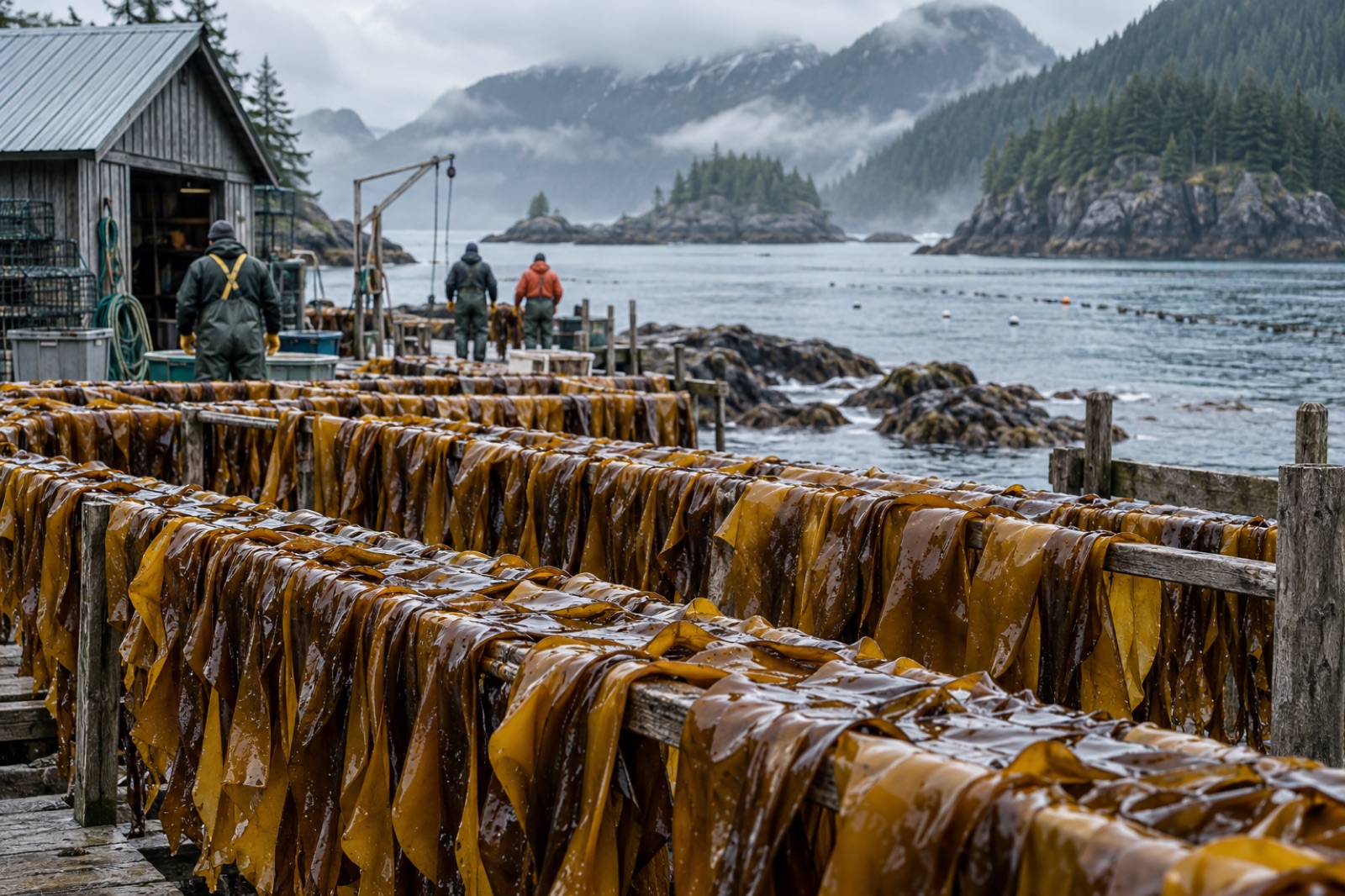
Harvest and sun-dry. Whole lines are hauled up, fronds are stripped or shaken free of epiphytes and debris, washed in clean seawater, and sun-dried on racks or tarps down to a moisture content stable enough for storage. Drying quality determines grade, exactly as with kelp — see drying methods compared.
The economics have made this one of the few aquaculture sectors where a family with shallow-water access, rope and labour can earn real income. It also makes quality control the whole game: a farm's reputation rides on clean, well-dried, contaminant-free product.
Temperate sea moss: the harder case
Chondrus crispus resists easy farming. Its life cycle alternates between a visible gametophyte and a crusty tetrasporophyte, growth is slow by tropical standards, and the species is adapted to cold, wave-swept rock — conditions hard to recreate on a rope. Some operators grow Chondrus in tanks on land, and research on tank-grown carrageenophytes is active, but almost all commercial Irish moss on the market is wild-harvest.
That matters for two reasons:
- If you want to farm "sea moss" in North America or Europe, your realistic species list is different: sugar kelp, dulse (see tank farming dulse), sea lettuce (Ulva farming), and winged kelp — not Chondrus. Chasing the sea-moss label in cold water usually ends in either a wild-harvest permit or a pivot to a species that grows well there.
- If a cold-water farmer claims to grow authentic Irish moss at scale, ask for the production records. Wild harvest sold under a farming story is one of the quiet dishonesties in this trade. Our piece on farmed vs wild-harvested seaweed covers how to ask the difference.
Sorting the hype
Supplement marketing around sea moss is a swamp. Three honest anchors:
- "92 of the 102 minerals the body needs" is not a real claim. Seaweeds do contain a broad mineral profile — that's genuine, and our seaweed nutrition guide covers what the data actually shows. The "92 minerals" figure traces to internet repetition, not analysis. Seaweed mineral content also varies enormously with species, site and season.
- Iodine is real and cuts both ways. Carrageenan-bearing red seaweeds contain appreciable iodine. That can be a feature for some people and a hazard (thyroid) for others in large daily doses. Read iodine and seaweed safety before treating any seaweed as a supplement rather than a food.
- Carrageenan is a food additive with a long safety record, but the supplement aisle often conflates it with its degraded relative (poligeenan), which is not a food ingredient. Food-grade carrageenan extraction is a regulated, chemically distinct process.
For farmers, the hype matters because it distorts prices. Retail supplement jars sell sea moss gel at margins that farmgate dried product will never approach. If you build a business plan on supplement-retail prices, you will fail. Build it on actual bulk grades — our guide to selling seaweed walks through the real buyer tiers.
Realistic numbers
Indicative figures from smallholder tropical red-seaweed farming, presented as ranges rather than promises:
- Production cycle: 6–8 weeks from planting to harvest.
- Farming footprint: A family operation typically runs one to five hectares of line, often in water less than three metres deep.
- Drying ratio: Fresh Kappaphycus dries at roughly seven or eight to one — a tonne of wet harvest becomes 100–150 kg of dried product.
- Farmgate price: Dried, well-graded Kappaphycus trades at fractions of a dollar per kilogram in bulk carrageenan channels, and considerably more in niche food channels. The spread between grades is larger than the spread between species.
The skills that matter are the same as everywhere in aquaculture: clean seed stock, consistent drying and handling (see post-harvest processing), honest grading, and reliable shipping. The biology is the easy part.
Where Tidewright fits
Tidewright's Harvest division works with red-seaweed growers in restoration-adjacent waters, but we are deliberately blunt about the sea moss trade: we buy graded, traceable product, not wellness stories. If you're a grower looking at tropical red-seaweed culture alongside reef or reef-algae restoration, our approach pairs farming with monitoring exactly as described on the solutions for fisheries page — the income is real, claimed benefits are not a business model, and water quality data is non-negotiable.
Key takeaways
- "Sea moss" isn't one thing. Most commercial product is Kappaphycus, Eucheuma or Gracilaria farmed in tropical shallows; Chondrus crispus, the original Irish moss, is largely wild-harvested in the north Atlantic.
- Tropical red-seaweed culture is vegetative (cuttings on lines), fast (6–8 weeks), and genuinely accessible to small operators with shallow-water access.
- Cold-water farmers should not chase the sea-moss label — grow species that belong in their waters and be honest about provenance.
- Supplement-marketing claims ("92 minerals") are not a basis for business planning or health advice. Iodine is real; the rest mostly isn't.
- The money is in drying quality, grading, and repeat relationships with buyers — not in jars with green labels.
FAQ
Can I grow sea moss at home?
In tropical water, yes — a few off-bottom lines in a sheltered bay is exactly how most of the world's supply starts. In temperate water, attempting "sea moss" usually means growing the wrong species in the wrong conditions. Grow what belongs: kelps, dulse, or sea lettuce depending on your coast.
Is farmed sea moss as good as wild?
Farmed tropical red seaweed is the industry standard and often cleaner and more consistent than wild harvest, because it comes from known water with known handling. The romantic idea that "wildcrafted" is automatically better doesn't survive a look at drying tarps beside a road versus a managed rack.
How much can a small sea moss farm earn?
Honest farmgate value is modest per kilogram; it's a volume and efficiency business, not a get-rich crop. Family operations earn meaningful local income; anyone projecting supplement-brand margins from a line farm is selling you a course.
Is Chondrus crispus endangered by wild harvest?
Harvest intensity varies by region, and well-managed rotational harvest of fronds (leaving the holdfast) is generally considered sustainable. Poor cutting practice is the risk. If you buy Irish moss, ask where and how it was harvested.
What's the difference between sea moss gel and carrageenan?
Carrageenan is a purified polysaccharide extracted industrially from red seaweeds. Sea moss gel is simply soaked, blended seaweed — the whole tissue, minerals and all. They're related materials at very different levels of processing and consistency.