Oxygen Minimum Zones Explained: The Ocean's Midwater Low-Oxygen Layers
What oxygen minimum zones are, where they form, how they shape the largest daily migration on Earth, and why warming is pushing them wider and shallower.
Dr. Lena Fischer ·
Explainers on the physics, chemistry and biology of temperate seas — marine heatwaves, upwelling, holdfast biology, trophic cascades, eDNA.
213 articles
What oxygen minimum zones are, where they form, how they shape the largest daily migration on Earth, and why warming is pushing them wider and shallower.
Dr. Lena Fischer ·
A little, briefly, and mostly repaid by dusk. The honest math of kelp's oxygen, the atmosphere's vast bank, and why the air won't notice.
Dr. Mara Ellison ·
Alginate, agar and carrageenan: the gelling polysaccharides inside seaweed cell walls, why each species gives a different gel, and how extraction works.
Dr. Theo Nakamura ·
As oceans warm, tropical herbivores and warm-adapted species are moving poleward into kelp reefs — reshaping forests from Tasmania to Japan. The science of tropicalization.
Dr. Lena Fischer ·
Significant wave height, swell period, direction, water temperature — learn to decode ocean buoy reports like a waterman and plan safer, better days on the sea.
Tom Okafor ·
What causes red tides and harmful algal blooms, the toxins behind shellfish closures, why warming waters are shifting the risk, and how scientists watch for them.
Dr. Lena Fischer ·
Healthy kelp forests crackle, rasp and croak. Researchers now eavesdrop with hydrophones to judge reef health — and even use sound as a restoration tool.
Dr. Mara Ellison ·
Rip currents are the surf zone's return plumbing — narrow, fast rivers of seawater leaving the beach. The physics behind them, and how to get out of one.
Dr. Lena Fischer ·
Rivers deliver iron, silica and nutrients that kelp need — and sediment, freshets and effluent that can bury them. How land–sea connectivity shapes kelp forests.
Dr. Lena Fischer ·
River plumes deliver nutrients that feed kelp forests — and floods that smother them in sediment and fresh water. The double-edged physics of the river mouth.
Dr. Lena Fischer ·
Why rocky reefs flip from kelp forest to urchin barren — and why flipping them back is so much harder. Alternate stable states and hysteresis, explained.
Dr. Theo Nakamura ·
Some reefs are too deep, too cold or too dangerous for divers. Remotely operated vehicles take the instruments instead. How ROVs changed reef science.
Tom Okafor ·
Ocean colour satellites turn faint light reflected from the sea into maps of phytoplankton, sediment and kelp. How the sensors work, what they see — and what they miss.
Dr. Mara Ellison ·
Sea ice forms, grows and melts on the ocean itself, reshaping light, salt and circulation. How it forms, why algae bloom under it, and what its retreat means for kelp.
Dr. Lena Fischer ·
Sea levels are rising faster than at any time in millennia. What actually drives it — expanding water, melting ice, sinking land — and what it means for coasts and kelp.
Dr. Lena Fischer ·

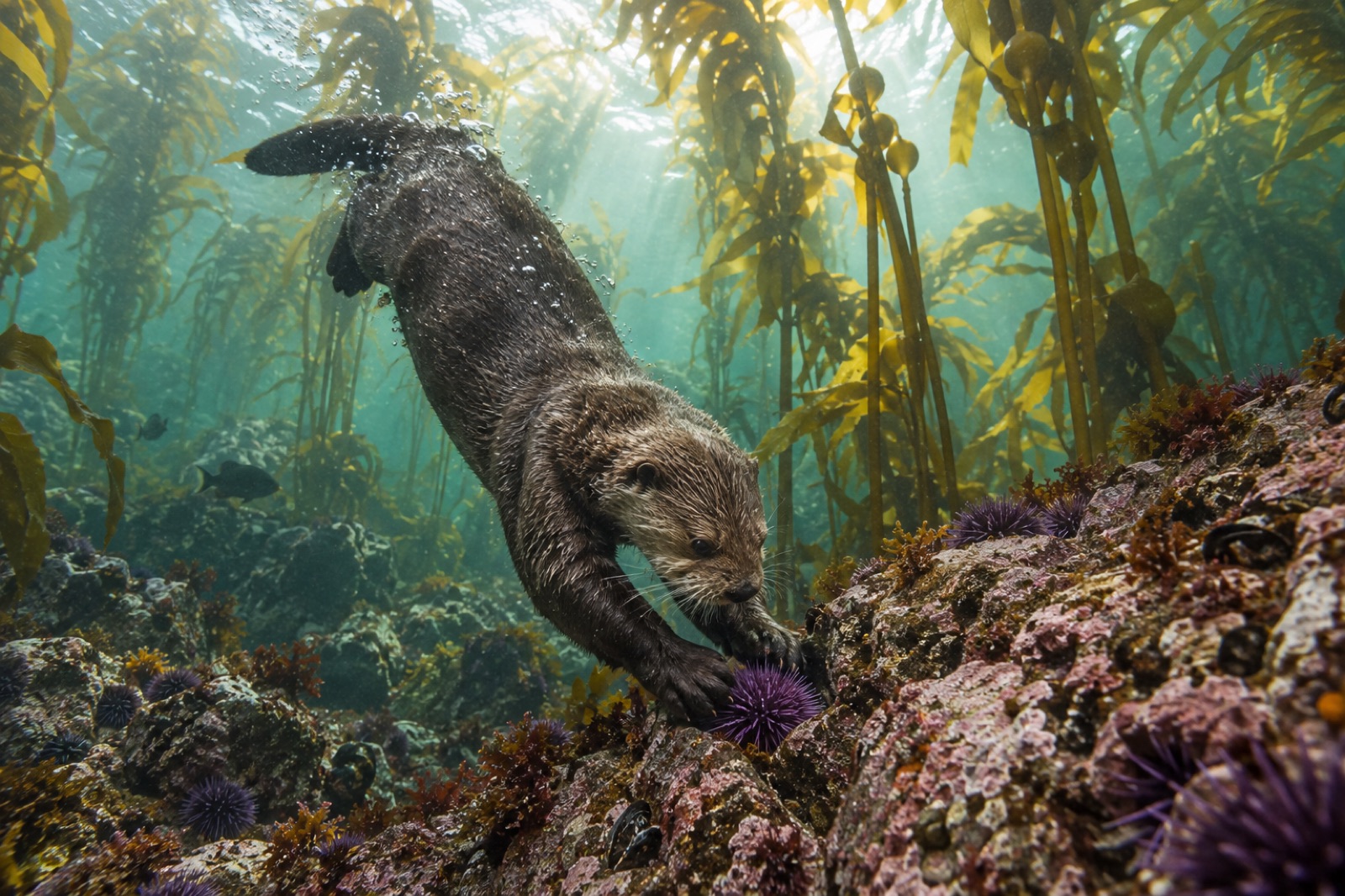
Sea otters dive 40-90 seconds at a time, all day, in cold water — with the densest fur of any mammal and one of the fastest metabolisms. Here's how the physiology works.
Dr. Mara Ellison ·
From 2013, sea star wasting liquefied stars from Alaska to Mexico and erased the sunflower star, a keystone urchin predator. The science, and the kelp fallout.
Dr. Mara Ellison ·
How satellites derive sea surface temperature from infrared and microwave radiometers, why clouds and fog mask kelp coasts, and how scientists validate SST.
Dr. Lena Fischer ·
From photon to map: the orbits, instruments, processing levels and data products behind satellite sea surface temperature — and how to read an SST map like an oceanographer.
Dr. Lena Fischer ·
Kelp forests, seagrass meadows and estuaries trade food, animals and larvae across the coastal mosaic. Why connectivity — not patch size — decides resilience.
Dr. Mara Ellison ·
Why the sea is salty, why it's slightly alkaline, and why its pH is drifting. A gentle but rigorous introduction to the chemistry that rules marine life.
Dr. Lena Fischer ·
Green, brown or red: seaweed colour is chemistry plus ancestry. A guide to algal pigments, the three seaweed lineages, and what colour says about depth.
Dr. Theo Nakamura ·
Kelp fights back without moving. How phlorotannins, iodine bursts and acid vacuoles deter grazers and foulers — and why that chemistry shapes whole reefs.
Dr. Theo Nakamura ·

Between the kelp blades and the open ocean runs an invisible microbial economy: exudates out, nutrients back, viruses policing it all. A field guide.
Dr. Theo Nakamura ·